 Environment & Health
GS Paper 3 · 14 August 2026
Shrinking tanks expose the governance of a water commons
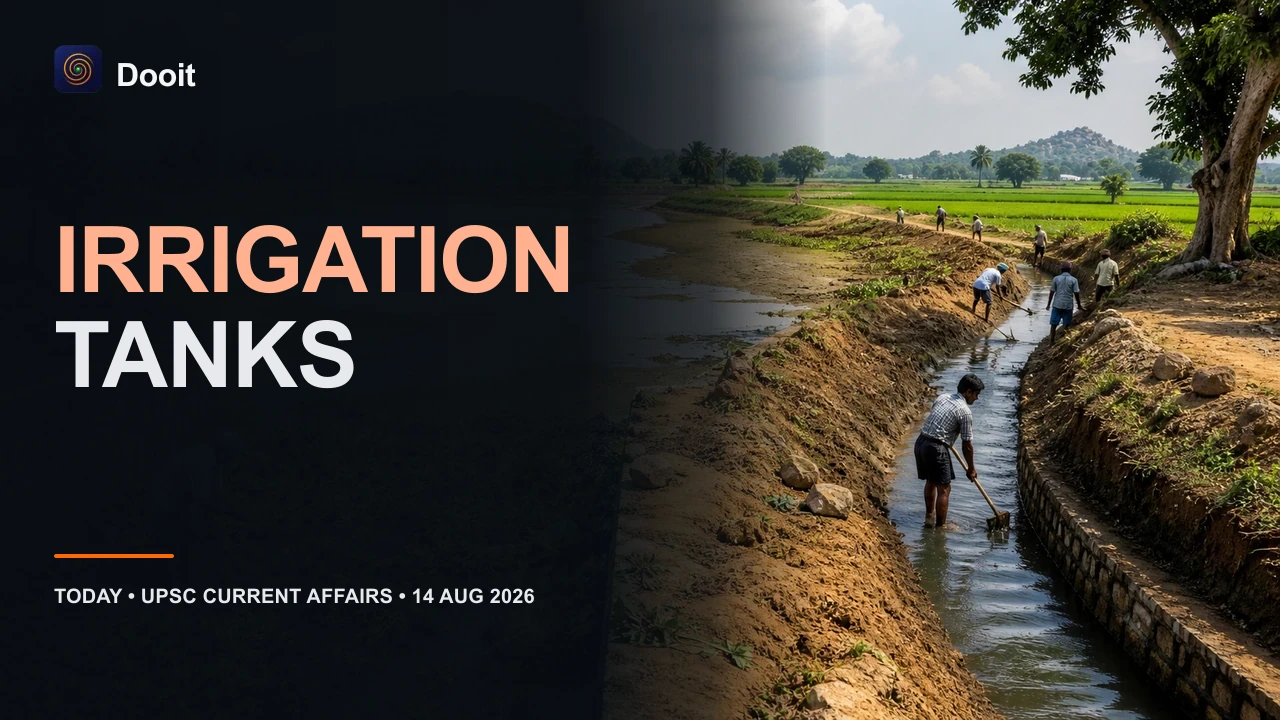
Inspection of four irrigation tanks in Gudipala mandal highlighted shrinking storage linked to silt accumulation and alleged encroachment. The report also connected reduced inflows and catchment changes with weakened irrigation while noting district-administration rejuvenation efforts across the affected local water system.
Why UPSC cares
For GS III, a traditional tank is not an isolated excavation site. It is a connected system of catchment land, feeder channels, tank bed, bund, command area, groundwater recharge and community rules. Rejuvenation that removes silt but leaves an obstructed inlet or encroached catchment may not restore water security. The case connects decentralised natural-resource governance with irrigation, drought resilience, land records, local participation and transparent public works.
How to study this story
Use the story to distinguish restoration from desiltation. Desiltation may recover part of the tank's capacity, but a tank will shrink again if feeder channels remain blocked, catchment land changes, bunds fail or maintenance institutions are weak. Begin an answer with a system diagram. Upstream lies the catchment; in the middle are channels, tank and structures; downstream are farms, households and aquifers. Then layer governance on the diagram. Revenue records and field mapping identify public land and alleged encroachment. Technical surveys estimate silt, inflow and structural safety. Panchayats, water-user groups and farmers help set priorities and monitor work. Public disclosure of contractors, excavated material and before-after measurements limits rent seeking. Add ecology: tanks can support groundwater recharge, local biodiversity and moderation of drought, but benefits depend on location and management. Avoid asserting that the reported rejuvenation has already restored outcomes; the source notes efforts, not completed proof. Recommend geotagged baseline data, protection of feeder channels, lawful and transparent handling of encroachment claims, periodic rather than episodic maintenance and monitoring across multiple monsoons. The UPSC value is a broader principle: common resources survive when engineering, land administration and community institutions are designed as one governance system.
The larger paper context
Map the hydrological system before listing schemes. Rain falls on a catchment, flows through channels, is stored behind a bund, supports irrigation and recharge, and depends on maintenance rules. Failures can occur at each link: land-use change reduces runoff, silt lowers capacity, encroachment blocks flow, damaged structures leak and unequal distribution weakens collective action. Therefore, success indicators should include restored inflow, storage and irrigated reliability—not merely the volume of earth removed or money spent.
Probable question
Why does rejuvenation of traditional irrigation tanks require catchment-scale governance rather than a one-time civil-work approach?
Quick practice check
Q1
Which pressures were expressly associated with the shrinking tanks?
- Siltation, reduced inflows, catchment changes and alleged encroachment
- Only ocean salinity
- Only glacier calving
- No storage or inflow problem
Show answer
Correct answer: Siltation, reduced inflows, catchment changes and alleged encroachment
The report linked storage and irrigation weakness with siltation, reduced inflows, catchment change and alleged encroachment.
Q2
Where were the four inspected irrigation tanks located?
- Gudipala mandal
- The Strait of Hormuz
- Kathmandu city centre
- A United States drone warehouse
Show answer
Correct answer: Gudipala mandal
The report concerned four irrigation tanks inspected in Gudipala mandal in Andhra Pradesh.