 International Relations
GS Paper 2 · 19 August 2026
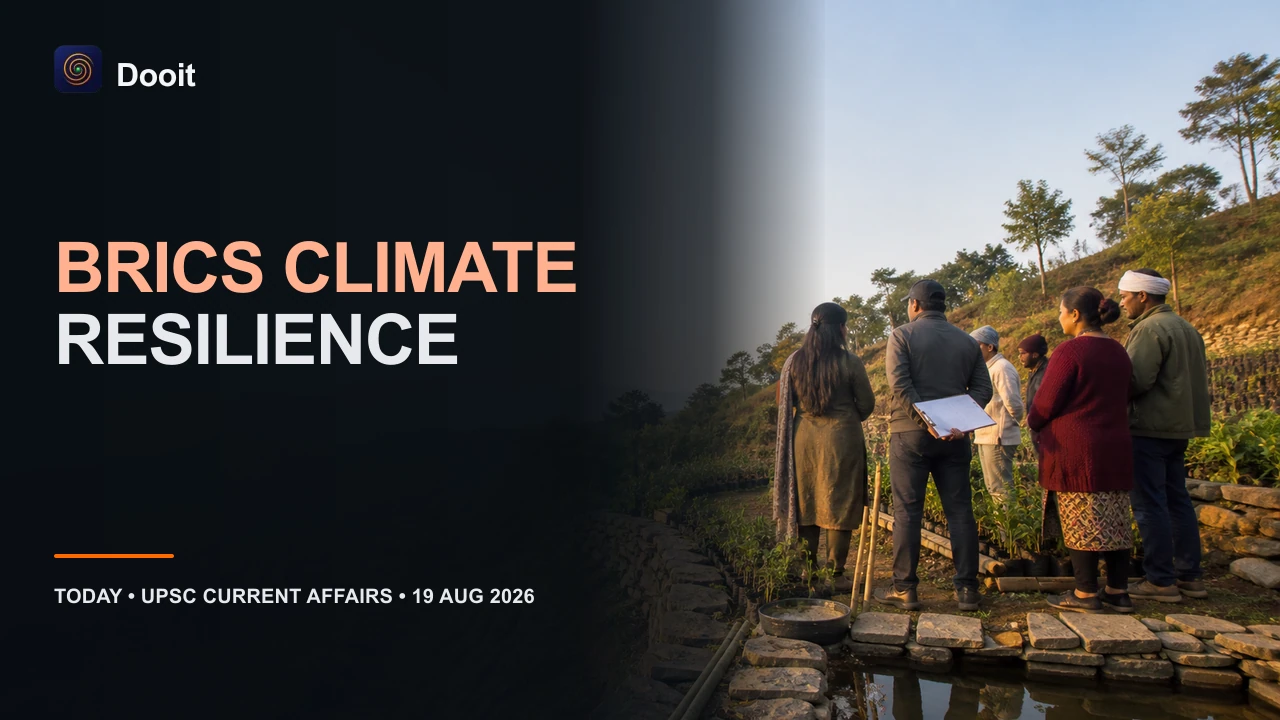
BRICS Environment Ministers Adopt Joint Statement on Community-Centred Resilience
The 12th BRICS Environment Ministers' Meeting in New Delhi concluded on 18 August 2026 with consensus on a Joint Ministerial Statement and four outcome documents. They cover an institutional knowledge network for sustainable lifestyles, integrated landscape management, forest-fire preparedness and response, and people-centred climate adaptation drawing on traditional knowledge. India framed its BRICS chairship around sustainable lifestyles, afforestation and disaster resilience, circular economy, and adaptation. The outcome is significant because it converts broad South-South environmental cooperation into issue-specific principles, but implementation will depend on finance, technology cooperation, national capacity and measurable follow-through.
Why UPSC cares
GS-2 international relations and GS-3 environment: BRICS as a platform for Global South cooperation, climate adaptation, forest-fire governance, land restoration and traditional knowledge. Answers should distinguish a consensual ministerial statement from a binding treaty and test whether knowledge-sharing arrangements produce finance, capacity and local implementation.
How to study this story
The meeting matters because it moved beyond a generic call for climate cooperation and organised work around four practical areas: sustainable lifestyles, landscape management, forest-fire preparedness, and community-centred adaptation. Yet a ministerial statement is political commitment, not a treaty with enforceable obligations. Its value lies in agenda setting, shared principles, institutional contact and the possibility of joint pilots or capacity building. For the Global South, BRICS can widen the conversation from mitigation targets to adaptation finance, traditional knowledge and development constraints. The main risk is implementation dilution: broad consensus may conceal different national interests, administrative capacities and funding priorities. In a Mains answer, describe this as soft-law cooperation that can shape norms and reduce knowledge costs even without legal compulsion. Then test it against three questions: whether communities participate in design, whether technology and finance reach vulnerable regions, and whether outcomes are measured rather than merely announced. India's emphasis on people-centred resilience is normatively useful because climate impacts are locally experienced. It becomes credible only when domestic planning, disaster management and budget systems embody the same principle.
The larger paper context
The GS-2 cluster concerns legitimacy in institutions that operate through trust, data and cooperation. PM CARES places disclosure and outcome accountability in the foreground. The Aadhaar school drive shows how state capacity can reduce last-mile friction while making correction, privacy and fallback mechanisms indispensable. The BRICS environment outcome demonstrates soft-law cooperation: consensus can organise knowledge and priorities, but domestic implementation remains decisive. In answers, separate the authority's stated objective from the accountability mechanism and ask who can seek correction when delivery fails.
Probable question
Can plurilateral groupings such as BRICS strengthen community-centred climate adaptation despite the absence of binding obligations? Analyse.
Quick practice check
Q1
The BRICS environment outcome is best understood as which kind of instrument?
- A binding treaty automatically enforceable in domestic courts
- A consensual ministerial statement that can guide cooperation and norm development
- A compulsory global carbon tax
- A judicial order governing member countries
Show answer
Correct answer: A consensual ministerial statement that can guide cooperation and norm development
The meeting adopted a consensual Joint Ministerial Statement and outcome documents. These can organise cooperation but are not described as a binding treaty.
Q2
Which element was part of the adopted environmental cooperation package?
- Community-based climate adaptation drawing on traditional knowledge
- A prohibition on all national adaptation programmes
- Replacement of local knowledge by a single central model
- Withdrawal from forest-fire cooperation
Show answer
Correct answer: Community-based climate adaptation drawing on traditional knowledge
The source lists people-centred and community-based adaptation built on traditional knowledge among the agreed outcomes.
Related previous-year questions
- GS-2: Evaluate the role of emerging plurilateral groupings in advancing the interests of the Global South.
- GS-3: Explain why local communities and traditional knowledge are important for climate adaptation.