 Economy & Energy
GS Paper 3 · 19 August 2026
Regional Rural Banks Expand Credit While Retaining Priority-Sector Focus
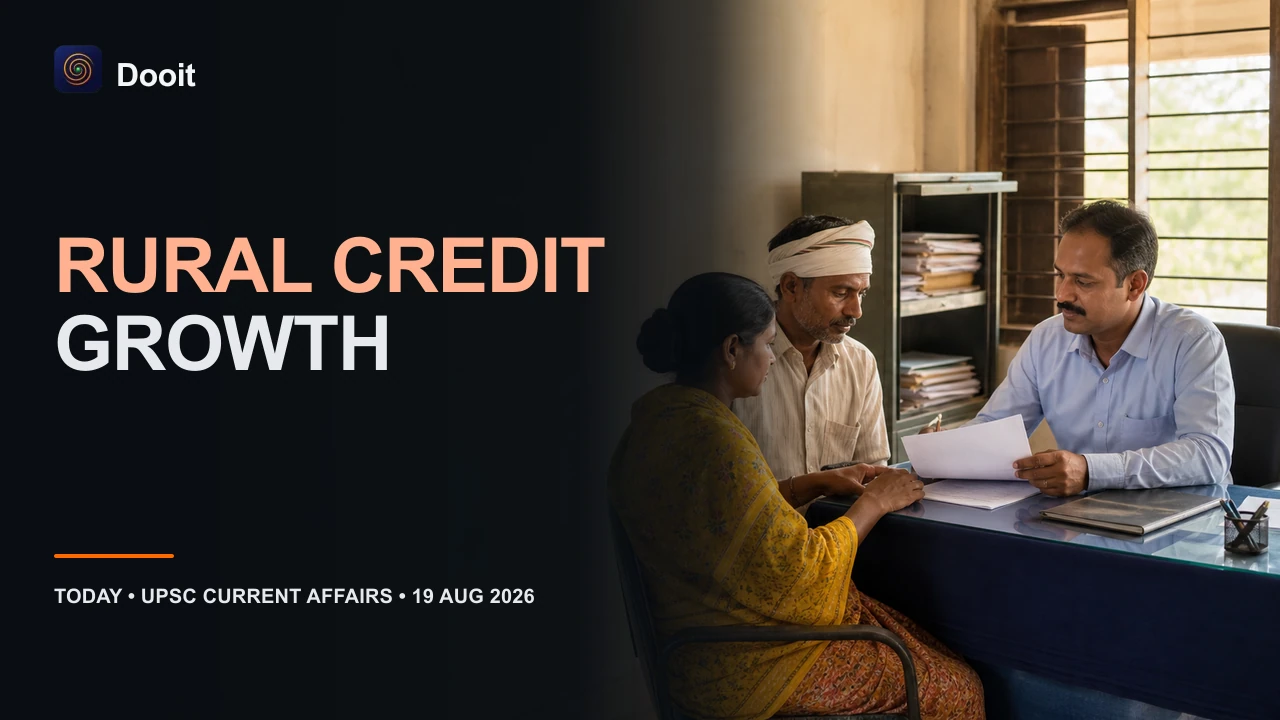
The Finance Ministry reported on 18 August 2026 that gross loans outstanding of Regional Rural Banks rose 10.3%, from ₹5.24 lakh crore in FY 2024-25 to ₹5.78 lakh crore in FY 2025-26. Average priority-sector lending reached 91.7% of adjusted net bank credit against the prescribed 75% target. Agriculture and allied activities accounted for ₹3.78 lakh crore and 77% of priority-sector lending; MSME credit stood at ₹66,978 crore, with more than 95% directed to micro enterprises. Credit to weaker sections reached ₹3.49 lakh crore. The figures show RRBs' continuing development role, while asset quality, regional balance, technology and customer protection remain necessary for judging sustainability.
Why UPSC cares
GS-3 economy: financial inclusion, priority-sector lending, rural credit and institutional finance. High target achievement indicates developmental orientation, but a complete answer must ask whether lending is productive, regionally inclusive and financially sound, and whether borrowers receive suitable products, fair recovery practices and effective grievance redress.
How to study this story
Regional Rural Banks were created to combine local knowledge with institutional finance, so their performance must be judged on both reach and soundness. Gross loans rose 10.3% to ₹5.78 lakh crore, while priority-sector lending reached 91.7% of adjusted net bank credit against a 75% target. Agriculture remained dominant and more than 95% of MSME lending went to micro enterprises. These indicators show developmental focus, but they do not reveal repayment stress, geographic concentration, borrower income gains or the quality of customer service. Excessive target orientation can encourage unsuitable lending, while excessive caution can reproduce the very exclusion RRBs were designed to correct. A good answer therefore links credit expansion with better appraisal, crop and enterprise cash-flow understanding, digital access, financial literacy and fair recovery. Consolidation and technology can improve efficiency, but they should not erode the local presence that gives RRBs comparative advantage. The analytical conclusion is that priority-sector achievement is a means, not the final outcome. Sustainable inclusion occurs when institutional credit displaces exploitative borrowing, finances productive assets and remains available through economic and climate shocks.
The larger paper context
The GS-3 cluster shows the state shaping markets through directed credit, procurement certainty, fiscal uniformity and resource allocation. RRB lending supports inclusion; defence indigenisation seeks domestic capability; the MMDR amendment pursues a predictable mineral market; and the PNG scheme rewards active household connections. None should be assessed by input volume alone. Link each instrument to productivity, competition, consumer protection, environmental externalities and measurable outcomes. A balanced conclusion supports strategic capacity while retaining transparency, federal consultation and independent evaluation.
Probable question
Assess the role of Regional Rural Banks in reconciling financial inclusion with prudent and sustainable rural credit delivery.
Quick practice check
Q1
What does the reported RRB priority-sector performance most directly indicate?
- A strong developmental lending orientation
- The absence of all credit risk
- Uniform borrower outcomes in every region
- That financial sustainability no longer requires monitoring
Show answer
Correct answer: A strong developmental lending orientation
High priority-sector lending shows developmental focus, but the source does not establish zero risk or identical outcomes.
Q2
Which approach best reconciles rural inclusion with prudent banking?
- Credit targets without borrower assessment
- Local cash-flow appraisal, suitable products and fair recovery practices
- Withdrawal from agricultural lending
- Replacing all local branches with distant central offices
Show answer
Correct answer: Local cash-flow appraisal, suitable products and fair recovery practices
Sound inclusion combines access with appropriate appraisal, customer protection and repayment structures suited to rural livelihoods.
Related previous-year questions
- GS-3: Explain how institutional credit can reduce rural indebtedness and support inclusive growth.
- GS-3: Discuss the challenges of balancing developmental banking with financial sustainability.