 Polity & Governance
GS Paper 2 · 19 August 2026
UIDAI School Drive Completes Over Two Crore Biometric Updates
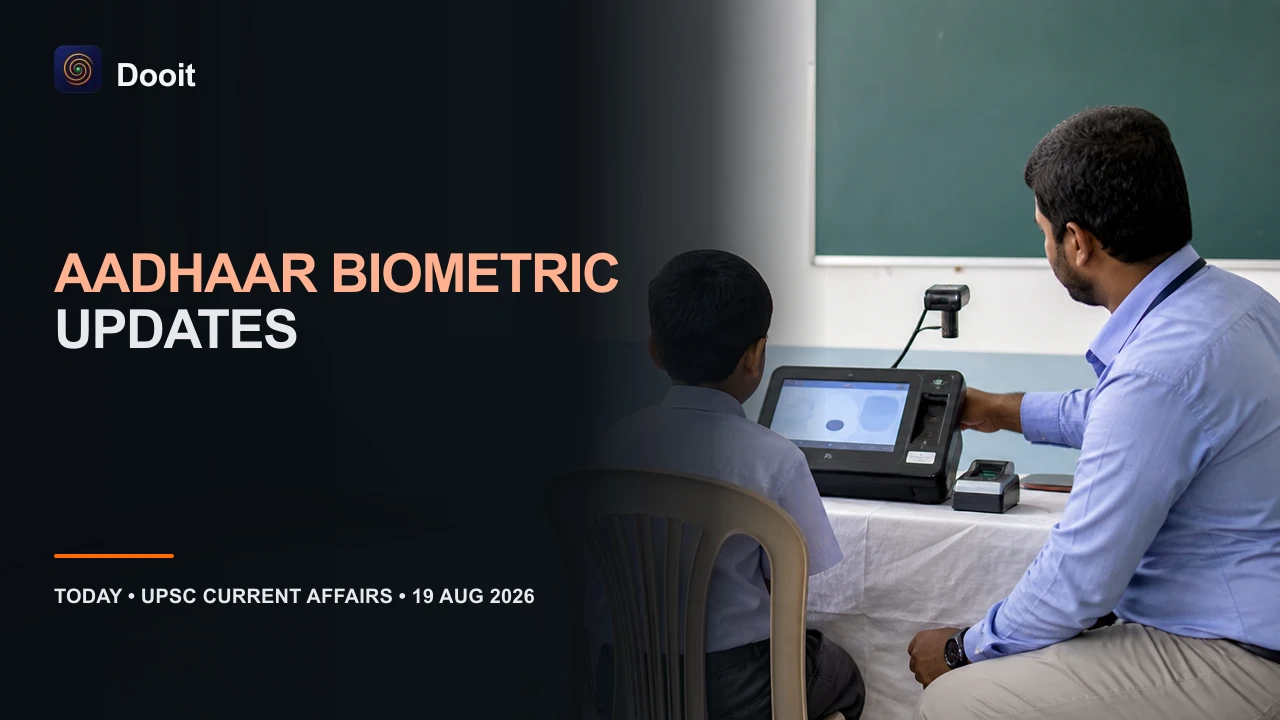
UIDAI announced on 18 August 2026 that its school-based drive had completed more than 2 crore Mandatory Biometric Updates across about 1.56 lakh schools. Integration with UDISE+ helps identify update status, while school camps bring the service closer to children. Aadhaar enrolment below age 5 captures demographic details and a photograph but not fingerprints or iris data; biometric updates are required at age 5 and again at age 15. The service remains free for ages 5 to 17 until 30 September 2026. The initiative can reduce authentication failures in welfare and examination processes, but it also makes data accuracy, informed communication, grievance redress and privacy safeguards central governance concerns.
Why UPSC cares
GS-2 governance and social justice: digital identity, last-mile delivery, education administration and exclusion risks. The key analytical balance is between accurate authentication for access to benefits and exams, and safeguards relating to notice, consent appropriate to children, correction mechanisms, data minimisation and accessible alternatives when authentication fails.
How to study this story
The UIDAI drive illustrates how administrative integration can solve a last-mile problem. Linking update status with UDISE+ enables schools and authorities to identify children who need biometric renewal, while school camps reduce travel and transaction costs for families. More than 2 crore updates across about 1.56 lakh schools indicate substantial reach. The policy rationale is also clear: fingerprints and iris data are not captured below age 5, and later updates help authentication remain reliable as a child grows. But the governance standard cannot stop at completion numbers. Children may face exclusion from benefits or examinations if records are stale, data are mismatched, or correction is difficult. A rights-sensitive system therefore needs advance communication in understandable language, minimal data sharing between databases, secure handling at camps, accessible correction and grievance channels, and a non-punitive alternative when authentication fails. School staff should facilitate access, not become coercive identity enforcers. In Mains, present digital identity as public infrastructure whose legitimacy depends on proportionality and remedy. Efficiency and privacy are not competing extras; accurate data, limited purpose and effective fallback together make authentication trustworthy.
The larger paper context
The GS-2 cluster concerns legitimacy in institutions that operate through trust, data and cooperation. PM CARES places disclosure and outcome accountability in the foreground. The Aadhaar school drive shows how state capacity can reduce last-mile friction while making correction, privacy and fallback mechanisms indispensable. The BRICS environment outcome demonstrates soft-law cooperation: consensus can organise knowledge and priorities, but domestic implementation remains decisive. In answers, separate the authority's stated objective from the accountability mechanism and ask who can seek correction when delivery fails.
Probable question
How can school-based digital identity updating improve service delivery without deepening exclusion or weakening children's data safeguards? Discuss.
Quick practice check
Q1
Why are Mandatory Biometric Updates required as children grow?
- Because fingerprints and iris data are not captured below age 5 and biometric information must later be updated
- Because Aadhaar records contain no demographic information
- Because every school creates a separate national identity number
- Because updates permanently remove the need for grievance redress
Show answer
Correct answer: Because fingerprints and iris data are not captured below age 5 and biometric information must later be updated
The source states that enrolment below age 5 captures demographic information and a photograph but not fingerprints or iris biometrics.
Q2
Which safeguard most directly reduces exclusion when Aadhaar authentication fails?
- Denying the service without review
- Providing correction, grievance and alternative-access mechanisms
- Sharing all school data without purpose limits
- Making teachers decide final legal disputes
Show answer
Correct answer: Providing correction, grievance and alternative-access mechanisms
Accessible correction, grievance redress and fallback access prevent a data or authentication problem from becoming denial of an entitlement or opportunity.
Related previous-year questions
- GS-2: Examine the potential and limitations of digital technologies in welfare delivery.
- GS-2: Discuss how grievance redress and privacy safeguards strengthen citizen-centric e-governance.