 Economy & Energy
GS Paper 3 · 22 August 2026
India Signs a 230 Million Dollar ADB Loan for Chennai Water and Sanitation Modernisation
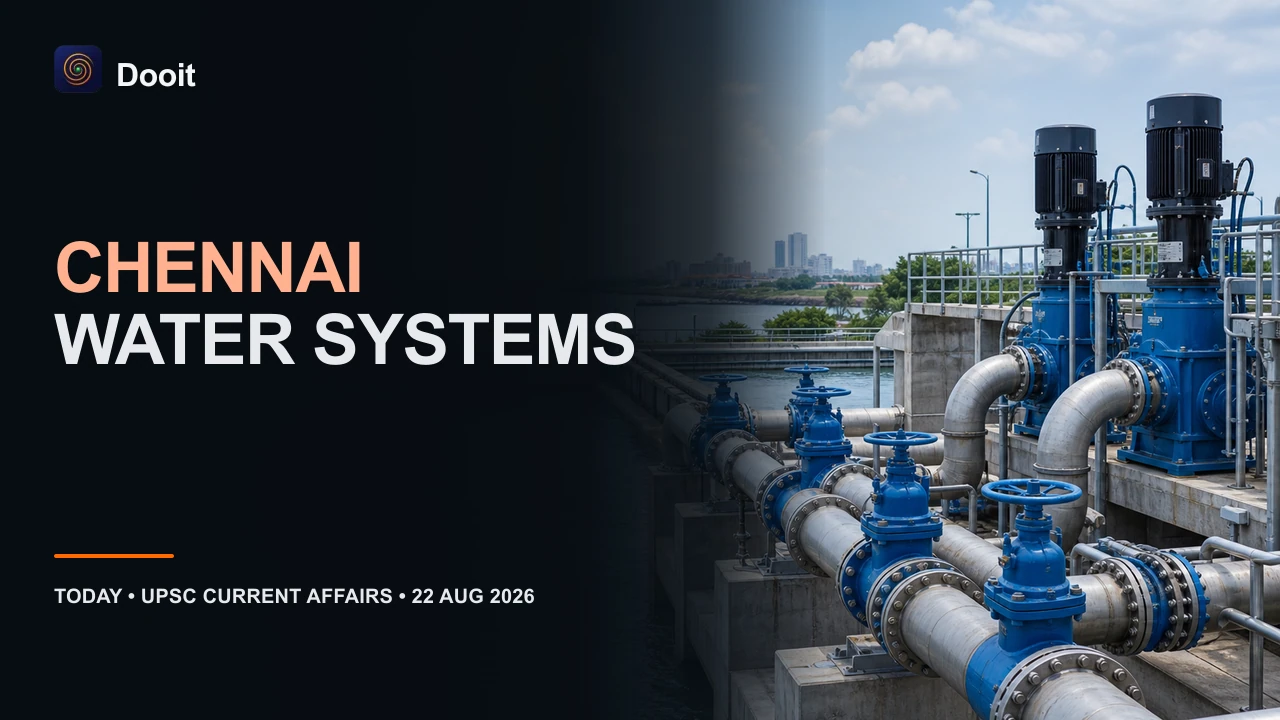
The Government of India signed a 230 million dollar loan agreement with the Asian Development Bank to modernise water supply and sanitation in Chennai. The stated scope includes more than 170 km of water and sewer pipelines, upgrades to 7 water-pumping stations and 38 sewer-pumping stations, and stronger monitoring and operational systems. The wider programme is intended to improve services for Greater Chennai's residents through a ring-main approach and safer sewer operations. The financing creates an implementation opportunity, not an achieved service outcome; procurement, leakage control, worker safety, affordability and climate resilience remain decisive.
Why UPSC cares
For GS Paper 3, use the project to discuss urban infrastructure, municipal service delivery and climate-resilient investment. A balanced answer should connect capital works with non-revenue-water reduction, continuous quality monitoring, safe sanitation work, equitable household access and accountable debt-funded implementation.
How to study this story
Chennai's programme shows why urban water and sanitation must be managed as connected networks. A ring main can improve flexibility when one segment fails, while renewed pipes and pumping stations can reduce breakdowns and support more reliable pressure. Physical assets alone will not solve intermittent supply, leakage or unequal access. The utility needs district-level metering, timely repair, water-quality surveillance and public performance data. Sanitation reform must include mechanised inspection, protective equipment, training and enforceable prohibition of hazardous manual entry. Climate resilience requires planning for both water scarcity and intense rainfall, protecting sources and ensuring pumping systems can operate during disruption. Loan-financed projects also need transparent procurement, lifecycle maintenance budgets and a credible path to repayment without pricing poor households out of essential service. For UPSC, evaluate the project through service continuity, water quality, non-revenue water, safe working conditions and inclusion rather than kilometres laid. External finance can bring capital and technical discipline, but local institutions remain responsible for operation. The public-value test is whether households experience safer, affordable and more predictable service after construction is complete. Independent monitoring should compare baseline conditions with post-project performance and publish corrective action when service gaps persist.
The larger paper context
Read the GS-3 stories through systems regulation. Urban networks need maintenance and affordability, road safety needs coordinated engineering and emergency care, and bond distribution needs platform responsibility and conflict controls. Capital, technology or reach is an input; reliable service, reduced harm and enforceable accountability are the outcomes.
Probable question
Urban water security requires institutional and operational reform alongside new infrastructure. Discuss with reference to Chennai's modernisation programme.
Quick practice check
Q1
What is the strongest test of Chennai's water investment?
- The loan signature itself
- The number of contractors
- Pipeline length without maintenance
- Reliable, safe and equitable service after completion
Show answer
Correct answer: Reliable, safe and equitable service after completion
Infrastructure creates value when residents receive better service and systems remain maintainable.
Q2
Why can a ring-main design improve resilience?
- It can provide alternative network paths during disruption
- It eliminates every drought
- It removes the need for water-quality checks
- It guarantees free water
Show answer
Correct answer: It can provide alternative network paths during disruption
Network redundancy can help reroute supply, but it does not replace source security, monitoring or maintenance.
Related previous-year questions
- UPSC GS-3: infrastructure and sustainable urban development