 Society & Demography
GS Paper 2 · 22 August 2026
DAY-NRLM Launches Entrepreneurship Campaign-II for Rural Women and Community Enterprises
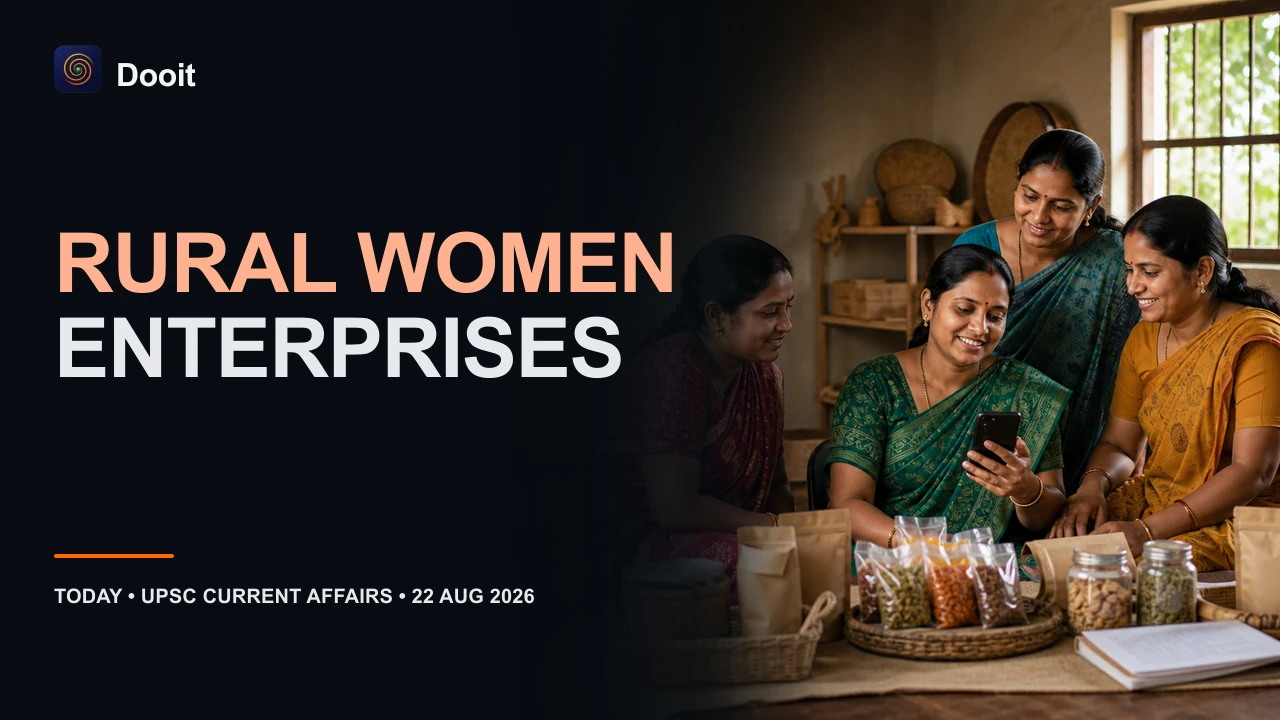
The Rural Development Ministry launched a three-month Entrepreneurship Campaign-II under the Deendayal Antyodaya Yojana-National Rural Livelihoods Mission, running until 21 November. The programme is designed to orient 50,000 community cadres, train 5 lakh self-help-group women, support formalisation of 50,000 enterprises and onboard 25,000 members to e-commerce. It also plans a database of 5 lakh adolescent girls from member households, wider producer-group participation and agro-ecological outreach to 20 lakh women. These are campaign targets; durable gains depend on finance, market access, skills, care support and enterprise survival.
Why UPSC cares
For GS Paper 2, connect the campaign to women-led development, self-help groups and last-mile livelihood institutions. Evaluation should move beyond training counts to credit quality, formal registration, repeat sales, income stability, digital capability and control over earnings, with safeguards against debt stress and exclusion.
How to study this story
The campaign builds on the institutional advantage of self-help groups: repeated meetings, savings discipline and peer support can lower barriers faced by women who lack collateral, business networks or confidence in public offices. Training, however, does not automatically create a viable enterprise. Participants need demand assessment, appropriate credit, bookkeeping, product quality, packaging, logistics and repeat buyers. E-commerce can widen reach but also introduces platform fees, returns, digital fraud and the need for reliable fulfilment. Formalisation should simplify access to finance and procurement rather than impose compliance that overwhelms a micro-enterprise. The adolescent-girl database also requires purpose limitation, consent, minimal collection and safe access controls. Evaluation should track enterprise survival, net income, control over earnings and changes in unpaid work, not merely orientation or onboarding totals. Producer groups can improve bargaining power when governance is democratic and benefits are transparent. For UPSC, connect women-led development to agency: a programme succeeds when women influence household and enterprise decisions, not only when a loan is issued in their name. The central lesson is to join social mobilisation with markets, public services and accountable financial support.
The larger paper context
Read the GS-2 stories through access and coordination. Geographic proximity can reduce justice barriers, but only with court capacity. An open border needs security cooperation that protects legitimate movement. Women's collectives need finance, markets and agency after mobilisation. Distinguish an announced institution or campaign from the citizen outcome it is meant to produce.
Probable question
Self-help groups become engines of women-led development only when social mobilisation is connected to viable enterprises and markets. Examine.
Quick practice check
Q1
Which indicator best measures durable rural enterprise success?
- The number of launch speeches
- Enterprise survival and stable net income
- Training attendance alone
- The size of the beneficiary database
Show answer
Correct answer: Enterprise survival and stable net income
Training is an input; sustained enterprise activity and income show whether capabilities reached the market.
Q2
What safeguard is especially important for the proposed adolescent-girl database?
- Unlimited secondary use
- Public disclosure of household records
- Purpose limitation and controlled access
- Collection without consent
Show answer
Correct answer: Purpose limitation and controlled access
Personal data should be limited to a defined purpose and protected against unrelated or unsafe use.
Related previous-year questions
- UPSC GS-2: role of self-help groups in development