 International Relations
GS Paper 2 · 22 August 2026
India and Nepal Conclude the 14th Joint Working Group Meeting on Border Management
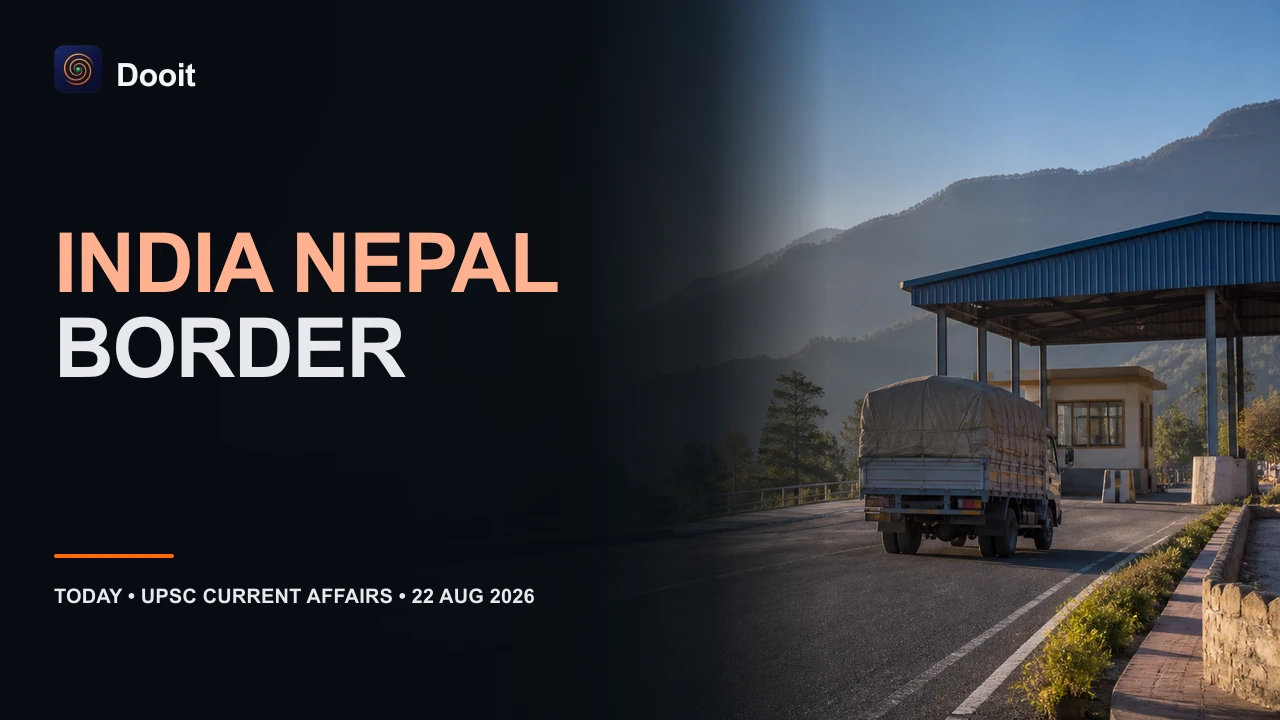
India and Nepal concluded the two-day 14th Joint Working Group meeting on border management in Dehradun on 21 August. The delegations reviewed trans-border crime, border infrastructure, roads and rail connectivity, encroachments, boundary pillars, institutional coordination and capacity building. India was led by a Joint Secretary in the Ministry of Home Affairs and Nepal by a Joint Secretary in its Home Ministry. The meeting reaffirmed cooperation along an open and socially connected border, where security action must coexist with legitimate mobility, trade and close community ties.
Why UPSC cares
For GS Paper 2, this is a case of neighbourhood diplomacy implemented through continuing administrative mechanisms. Answers should examine intelligence sharing, coordinated patrolling, lawful movement, resilient border infrastructure and timely maintenance of boundary markers, while recognising that trust and local livelihoods are central to managing an open border.
How to study this story
India-Nepal border management cannot be reduced to fences and patrols because the open border sustains kinship, employment, pilgrimage and commerce. This social density is a strategic asset, but criminals can also exploit uneven enforcement, weak documentation and gaps between agencies. A standing working group allows both governments to exchange assessments, resolve local infrastructure problems and coordinate action without treating every incident as a diplomatic crisis. Boundary-pillar maintenance and encroachment management need joint verification and careful communication; unilateral claims can damage trust. Security agencies should improve lawful information sharing, victim-sensitive action against trafficking and compatible procedures at crossing points. Roads and railways can strengthen legitimate connectivity while also requiring customs, policing and disaster-response capacity. For UPSC, frame the relationship through neighbourhood first, cooperative security and people-to-people ties. Avoid presenting openness and security as opposites. The better objective is risk-based facilitation: keep ordinary movement predictable while concentrating scrutiny on credible threats. Success should be measured through resolved incidents, reduced trans-border crime, maintained boundary infrastructure and citizen confidence on both sides. Regular local review can surface emerging problems early and preserve political space for cooperative solutions before disputes harden.
The larger paper context
Read the GS-2 stories through access and coordination. Geographic proximity can reduce justice barriers, but only with court capacity. An open border needs security cooperation that protects legitimate movement. Women's collectives need finance, markets and agency after mobilisation. Distinguish an announced institution or campaign from the citizen outcome it is meant to produce.
Probable question
How can India and Nepal strengthen border security without weakening the legitimate mobility and social ties sustained by their open border?
Quick practice check
Q1
Why does India-Nepal border management require a cooperative approach?
- The border has no security risks
- Only railways cross the boundary
- Legitimate social mobility coexists with trans-border risks
- Local communities have no role
Show answer
Correct answer: Legitimate social mobility coexists with trans-border risks
The open border sustains deep ties while requiring coordinated responses to crime and infrastructure issues.
Q2
Which outcome would best demonstrate effective working-group follow-through?
- More declarations without field action
- Unilateral alteration of boundary markers
- Suspension of all lawful movement
- Jointly resolved incidents and maintained border infrastructure
Show answer
Correct answer: Jointly resolved incidents and maintained border infrastructure
Cooperation is credible when shared decisions produce verified operational improvements.
Related previous-year questions
- UPSC GS-2: India and its neighbourhood relations