 International Relations
GS Paper 2 · 26 August 2026
India and Japan Put Semiconductors and AI at the Centre of Economic-Security Cooperation
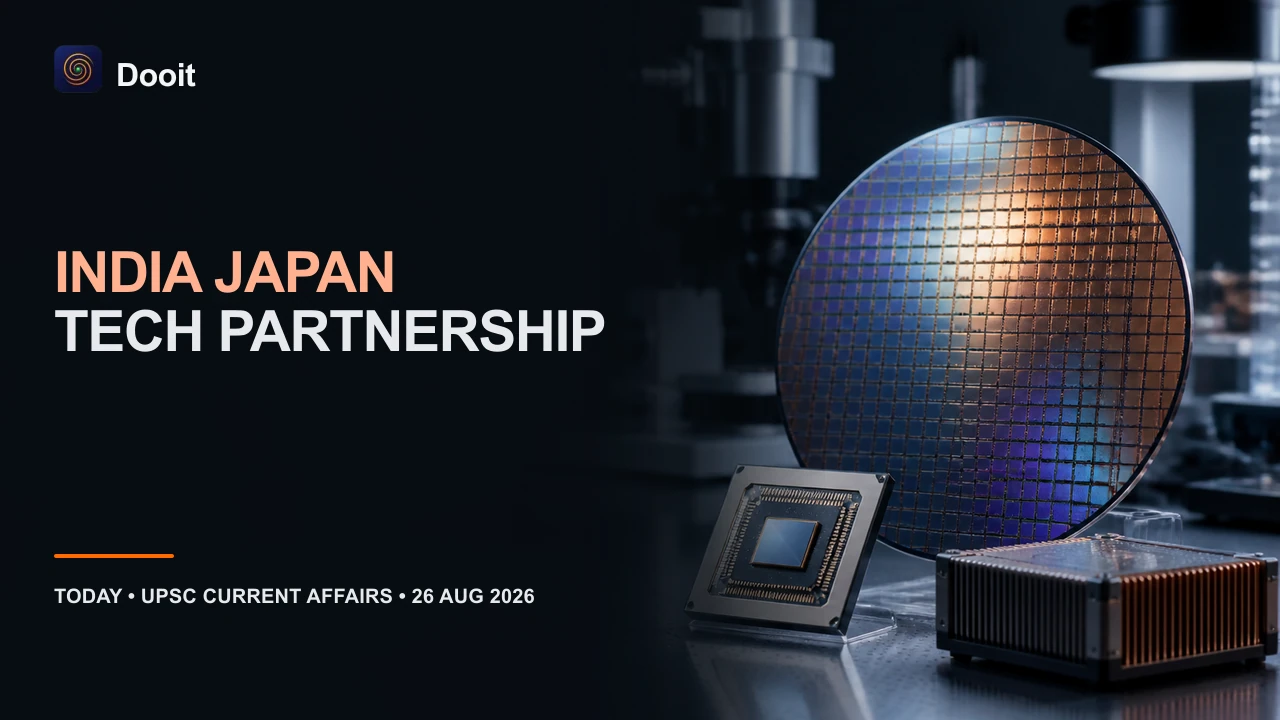
India and Japan convened a roundtable in Tokyo on 25 August 2026 with government, industry and technology participants to deepen cooperation in semiconductors and artificial intelligence. The two sides treated trusted supply chains, research partnerships, skills and investment as elements of economic security rather than isolated commercial projects. They also agreed to accelerate the review of the Comprehensive Economic Partnership Agreement and referred to a target of JPY 10 trillion in private investment. The policy opportunity lies in matching India's design talent, digital market and manufacturing incentives with Japanese capital, process discipline, equipment and materials capabilities. Yet durable cooperation requires specific projects, predictable standards, intellectual-property arrangements, research mobility and supplier development. Investment totals alone cannot show whether domestic capability is deepening. Evaluation should ask whether Indian firms move into higher-value segments, whether research links produce transferable knowledge and whether supply chains become diversified without creating a new single-country dependence.
Why UPSC cares
For GS Paper 2, analyse the India-Japan special strategic partnership and economic diplomacy. For GS Paper 3, connect semiconductor capacity, artificial intelligence, investment quality and resilient supply chains with technological self-reliance.
How to study this story
Semiconductors sit at the intersection of industrial policy, national security and technological learning. A trusted partnership can diversify supply, share risk and connect complementary strengths, but investment value depends on where capability is created. Assembly may generate employment while leaving design tools, advanced materials, equipment maintenance and process knowledge abroad. Policy should therefore track supplier development, research output, skilled personnel, intellectual-property arrangements and movement into higher-value stages. Public incentives need transparent milestones and clawbacks so support rewards verified capability rather than promised capacity. India-Japan cooperation can also build resilient standards for artificial intelligence, cybersecurity and data use, but alignment should preserve policy space and competition. Universities and firms require durable research links, not only ceremonial agreements. Smaller suppliers need quality certification, finance and patient demand if they are to enter global production networks. A trade-agreement review can address market access, services mobility and regulatory friction, yet sensitive technology flows will still require security screening. UPSC answers should define strategic autonomy as the ability to choose and sustain policy under disruption. Diversified partners, domestic learning and interoperable standards expand that choice. The correct measure is not the announced investment total alone, but whether the partnership creates transferable knowledge, competitive firms and reliable supply.
The larger paper context
For GS Paper 2, treat registries and partnerships as institutional systems. Electoral administration must balance accurate rolls with notice, hearing and remedy. Social-security databases must turn identity into portable benefit access. Technology diplomacy must convert broad intent into governed projects, skills, standards and reciprocal capability. In answers, identify the responsible body, the citizen or strategic interest at stake, the procedural safeguard and an outcome that can be independently measured.
Probable question
Technology partnerships strengthen strategic autonomy only when investment builds domestic capabilities and diversified supply chains. Discuss with reference to India-Japan cooperation.
Quick practice check
Q1
Which outcome best indicates capability-building from a semiconductor partnership?
- Only a headline investment total
- Transferable knowledge and stronger domestic suppliers
- Permanent dependence on one source
- Elimination of technical standards
Show answer
Correct answer: Transferable knowledge and stronger domestic suppliers
Domestic learning, supplier depth and higher-value activity show that investment has created resilient capability.
Q2
What should accompany public incentives for technology investment?
- No performance review
- Automatic protection from competition
- Transparent milestones and verified delivery
- A ban on research mobility
Show answer
Correct answer: Transparent milestones and verified delivery
Milestones and verification connect public support to actual capacity, skills and production outcomes.
Related previous-year questions
- UPSC GS-2: bilateral agreements involving India and their effect on India's interests