 Economy & Energy
GS Paper 3 · 27 August 2026
India-Seychelles Fisheries Talks Link Blue-Economy Growth with Science and Surveillance
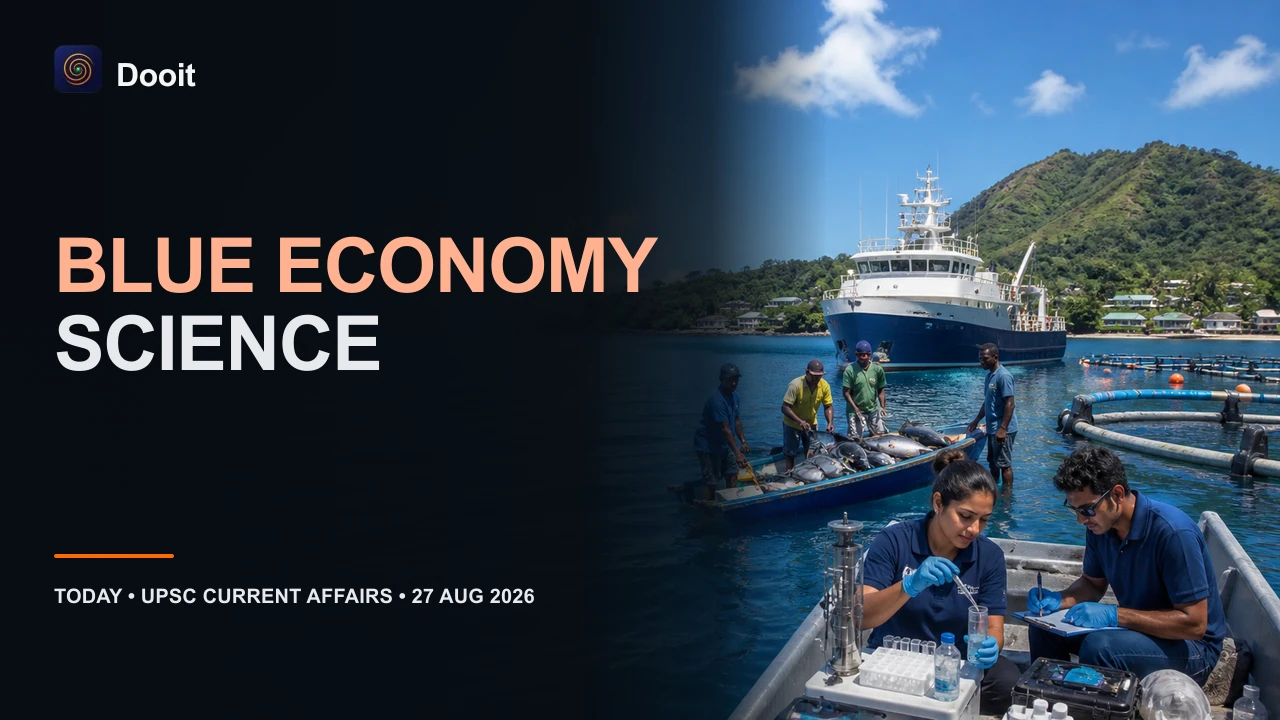
India and Seychelles held a high-level fisheries and blue-economy meeting on 25 August to identify a structured programme of technical cooperation. India reported national fish production of 19.7 million tonnes and seafood exports worth USD 8.46 billion. The agenda included mariculture, hatcheries, tuna fisheries, stock assessment, post-harvest engineering, conservation, fisheries data systems and monitoring, control and surveillance. The two sides also discussed artificial intelligence in harvest management, tuna value chains, fish-waste use, reciprocal laboratory access and joint pilots. They supported an annual work plan and Seychelles expressed interest in a dedicated bilateral memorandum for fisheries and aquaculture. The opportunity is significant because small-island and coastal economies need both livelihoods and ecological limits. Technology can improve observation and traceability, but sustainable harvesting still requires credible stock science, enforcement, community participation and transparent rules.
Why UPSC cares
For GS Paper 2, examine India's Indian Ocean partnerships and capacity building with small island states. For GS Paper 3, connect fisheries growth with the blue economy, marine conservation, value chains and monitoring systems.
How to study this story
The blue economy is not a licence to maximise extraction from the sea. It is a governance framework for using marine resources while retaining the ecological systems that make future use possible. Stock assessment is therefore foundational. Catch data, surveys and biological indicators should inform harvest limits, but uncertainty must be explicit. Monitoring, control and surveillance can deter illegal or unreported fishing; its legitimacy improves when rules are clear, enforcement is proportionate and small fishers have accessible compliance channels. Artificial intelligence may detect vessel patterns or improve forecasts, yet biased or incomplete data can create false confidence. Human review and appeal remain necessary. India-Seychelles cooperation is especially useful when it combines India's research and training scale with Seychelles' island and tuna-fishery experience. Laboratory access and joint pilots can create reciprocal capability rather than dependency. Value-chain cooperation should reduce post-harvest loss, improve cold-chain quality and increase local processing, while waste utilisation must follow safety standards. Conservation cannot be separated from livelihoods. Community knowledge, alternative income during closed seasons and fair access to finance influence compliance. Annual work plans should name outputs, timelines and responsible institutions; an agreement without implementation metrics adds little. For UPSC, link maritime diplomacy with food security, employment and ecosystem governance. The central test is whether productivity and income rise without hiding declining stocks or shifting environmental costs to coastal communities.
The larger paper context
For GS Paper 3, connect the blue economy, vehicle certification and food-price intervention through lifecycle governance. Technology or procurement creates value only when monitoring, accountability and feedback continue after launch.
Probable question
A sustainable blue economy must reconcile fishery livelihoods with stock science, surveillance and ecosystem limits. Analyse the role of India-Seychelles cooperation in this balance.
Quick practice check
Q1
Which field was part of the India-Seychelles fisheries agenda?
- Lunar mining
- Stock assessment and marine surveillance
- Urban metro finance
- Inland border fencing
Show answer
Correct answer: Stock assessment and marine surveillance
The bilateral agenda explicitly covered stock assessment and monitoring, control and surveillance systems.
Q2
What is the best safeguard when AI is used in harvest management?
- Treat every output as a legal order
- Hide data limitations
- Human review and explicit uncertainty
- Remove stock surveys
Show answer
Correct answer: Remove stock surveys
Digital analysis must remain subordinate to verified data, transparent uncertainty and accountable human decisions.
Related previous-year questions
- UPSC GS-3: economics of animal-rearing and conservation, environmental pollution and degradation