 Economy & Energy
GS Paper 3 · 27 August 2026
Onion Buffer Release Combines Price Stabilisation with Rail-and-Road Logistics
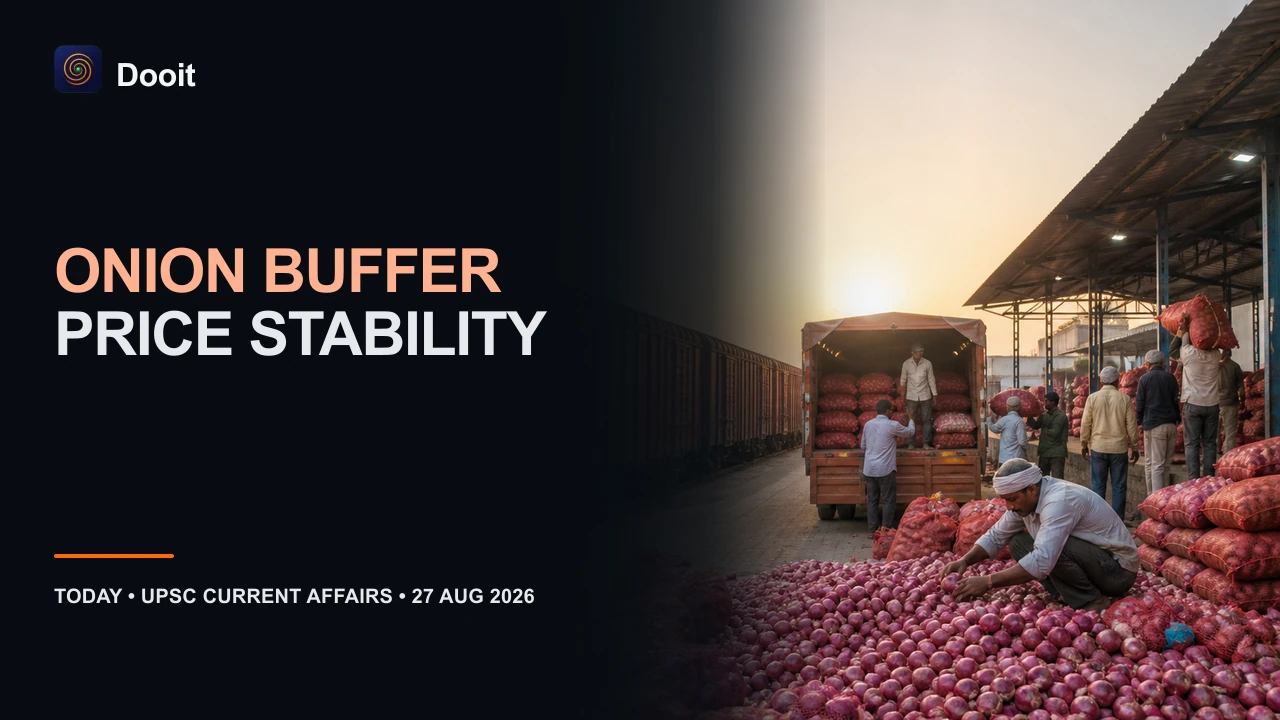
The government began calibrated releases from the Price Stabilisation Fund onion buffer as seasonal demand increased. Estimated onion production for 2025-26 is 307.37 lakh metric tonnes, broadly near the previous year's 307.67 lakh metric tonnes. Against a 2.00 lakh metric tonne buffer procurement target for 2026-27, NAFED and NCCF had procured about 1.21 lakh metric tonnes after operations began on 15 May. The Central Warehousing Corporation was engaged for the first time as storage agency for this buffer. Retail intervention at ₹35 per kilogram is planned through NAFED, NCCF, Safal and Kendriya Bhandar channels. Rail-and-road movement is being guided by market conditions; the Kanda Express system had carried about 88,000 metric tonnes in 86 rakes to 16 cities during 2025-26. Price stabilisation must balance consumer affordability, farmer returns, storage loss and transparent release rules rather than suppress prices indiscriminately.
Why UPSC cares
For GS Paper 3, connect food-price management with buffer stocks, the Price Stabilisation Fund, agricultural logistics, market intelligence and the consumer-farmer balance. Evaluate timing and targeting, not intervention alone.
How to study this story
Onion prices are volatile because production is seasonal, demand is widespread and the crop loses quantity and quality in storage. A buffer can shift supply across time, but buying and releasing at the wrong moment may either fail consumers or weaken farm-gate prices. The policy challenge is therefore calibration. Procurement should be geographically diverse, quality-tested and priced so it does not crowd out normal trade. Storage agencies need transparent loss norms, inventory audits and rotation rules because headline procurement is not the same as usable stock. Rail rakes move large quantities efficiently between major centres, while road transport offers flexibility for smaller or urgent destinations. A hybrid network is sensible if allocation follows observed arrivals, wholesale-retail spreads and local demand rather than political discretion. Retail sales at a fixed intervention price should be temporary and targeted, with quantity and outlet data published. Market intelligence also needs scrutiny: daily averages can hide neighbourhood shortages or quality differences. Farmers benefit from predictable procurement and lower waste, but long-term resilience requires improved varieties, storage, processing and less fragmented supply chains. Consumers benefit when competition and logistics work before emergency sales become necessary. UPSC answers should treat the Price Stabilisation Fund as a counter-cyclical tool, not a permanent administered-price system. Judge it by reduced extreme volatility, manageable fiscal and storage cost, fair farmer realisation and transparent exit once markets normalise.
The larger paper context
For GS Paper 3, connect the blue economy, vehicle certification and food-price intervention through lifecycle governance. Technology or procurement creates value only when monitoring, accountability and feedback continue after launch.
Probable question
Perishable-food price stabilisation requires more than procurement. Examine how storage, logistics, market intelligence and calibrated releases can protect consumers without weakening farmer incentives.
Quick practice check
Q1
Which agencies procured onions for the 2026-27 buffer?
- NAFED and NCCF
- SEBI and RBI
- NHAI and AAI
- FSSAI and ICAT
Show answer
Correct answer: NAFED and NCCF
The official release states that NAFED and NCCF conducted the procurement operation.
Q2
What is the main advantage of combining rail and road movement?
- Eliminating market data
- Replacing all private trade
- Large-volume efficiency plus destination flexibility
- Preventing inventory audits
Show answer
Correct answer: Large-volume efficiency plus destination flexibility
Rail can shift bulk consignments, while road transport adapts to more varied and urgent consumption centres.
Related previous-year questions
- UPSC GS-3: issues related to direct and indirect farm subsidies, buffer stocks and food security