 Art & Culture
GS Paper 1 · 27 August 2026
Patradevi Memorial Reframes Goa Liberation as a National Movement of Memory and Unity
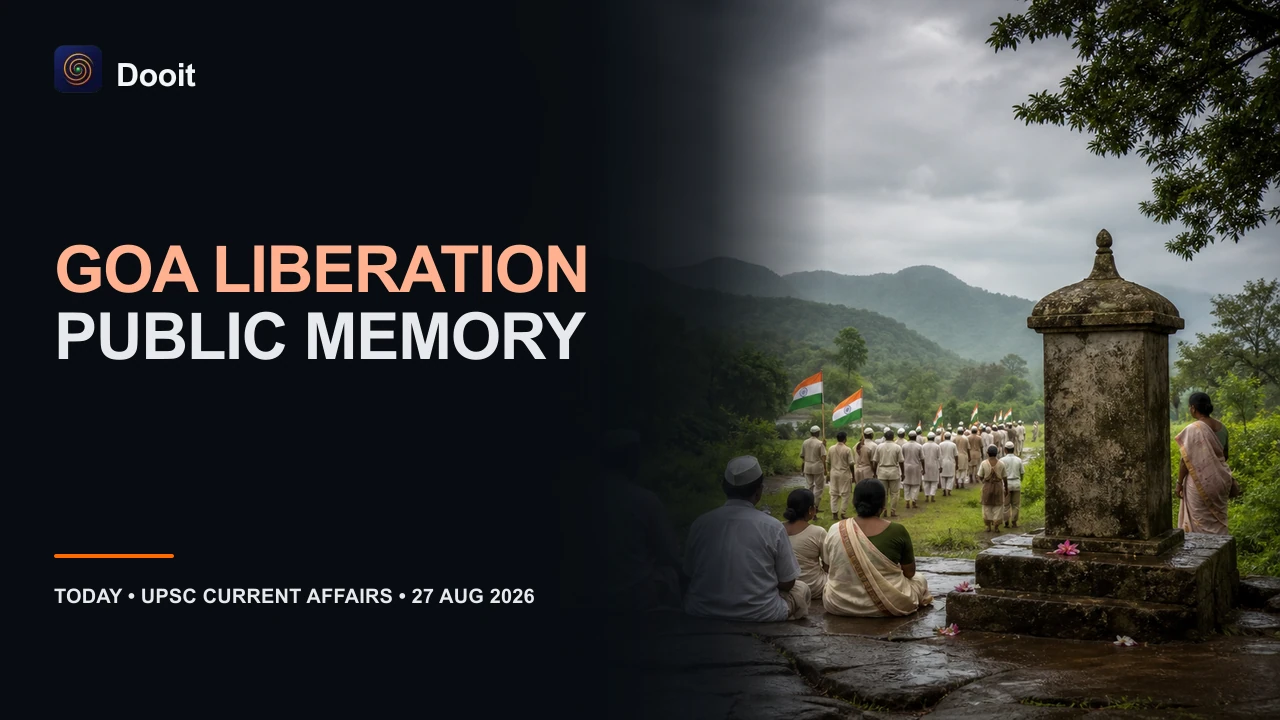
The redeveloped Hutatma Smruti Smarak at Patradevi was inaugurated at a site associated with Goa's liberation struggle against Portuguese rule. The Goa government redeveloped the memorial through its State Infrastructure Development Corporation at an estimated cost of Rs 9.50 crore. Its central monument, sculptures, information hubs and murals are intended to make the site an educational as well as commemorative space. Patradevi recalls the peaceful satyagraha of 15 August 1955, when volunteers from across India entered Goa carrying the national flag and faced Portuguese gunfire. Goa was ultimately liberated through Operation Vijay in 1961. The public-policy significance lies in treating regional freedom struggles as part of national history while preserving evidence, local voices and the distinction between civic commemoration and partisan mobilisation. A memorial earns educational value when its interpretation is accurate, plural, accessible and connected to archives, schools and community testimony.
Why UPSC cares
For GS Paper 1, connect Goa's liberation with post-Independence consolidation, anti-colonial movements and the public interpretation of history. Assess memorials as institutions of civic education, not merely physical monuments.
How to study this story
Public memory is an institution, not a neutral container. A memorial selects events, names, images and causal explanations; those choices influence how later generations understand citizenship and nation-building. Patradevi can widen the familiar story of Independence by showing that decolonisation continued after national freedom and involved volunteers from several regions. Its strongest educational design would separate three connected layers: the peaceful satyagraha of 1955, the wider diplomatic and political struggle, and the military culmination in 1961. Archives, oral histories and multilingual interpretation can prevent a single ceremonial narrative from displacing complexity. Families of participants and local communities should be contributors to interpretation, while professional historians verify claims and chronology. Accessibility matters too: school modules, tactile exhibits, captions and digital catalogues turn a monument into usable public knowledge. Visitor numbers alone are a weak success measure. Better indicators include learning outcomes, archival additions, participation by local institutions and correction of documented errors. The state must also avoid converting remembrance into exclusionary nationalism. Constitutional patriotism can honour sacrifice while recognising non-violence, diversity and lawful democratic disagreement. For UPSC, use the site to connect post-Independence integration, heritage governance and civic education. The analytical conclusion is that commemoration becomes nation-building when evidence, plurality and public access reinforce one another.
The larger paper context
For GS Paper 1, read public memory through evidence, inclusion and civic education. A memorial should connect local experience with national history without flattening contested or complex processes.
Probable question
Public memorials can convert a regional liberation struggle into shared civic memory only when commemoration is historically rigorous and socially inclusive. Discuss with reference to Goa's liberation.
Quick practice check
Q1
What occurred at Patradevi on 15 August 1955?
- A commercial port opened
- A peaceful satyagraha faced Portuguese gunfire
- Operation Vijay concluded
- Goa became a Union Territory
Show answer
Correct answer: A peaceful satyagraha faced Portuguese gunfire
The official account links Patradevi to a peaceful flag-bearing satyagraha that faced Portuguese firing.
Q2
Which approach best gives a public memorial educational value?
- A single unreviewed narrative
- Visitor numbers alone
- Evidence-based, plural and accessible interpretation
- Removal of local testimony
Show answer
Correct answer: Evidence-based, plural and accessible interpretation
Public history becomes educational when verified evidence, multiple perspectives and accessible interpretation are combined.
Related previous-year questions
- UPSC GS-1: post-Independence consolidation and reorganisation within the country