 Economy & Energy
GS Paper 3 · 27 August 2026
India's First 15-Metre Sleeper-Bus Certificate Puts Homologation at the Centre of Road Safety
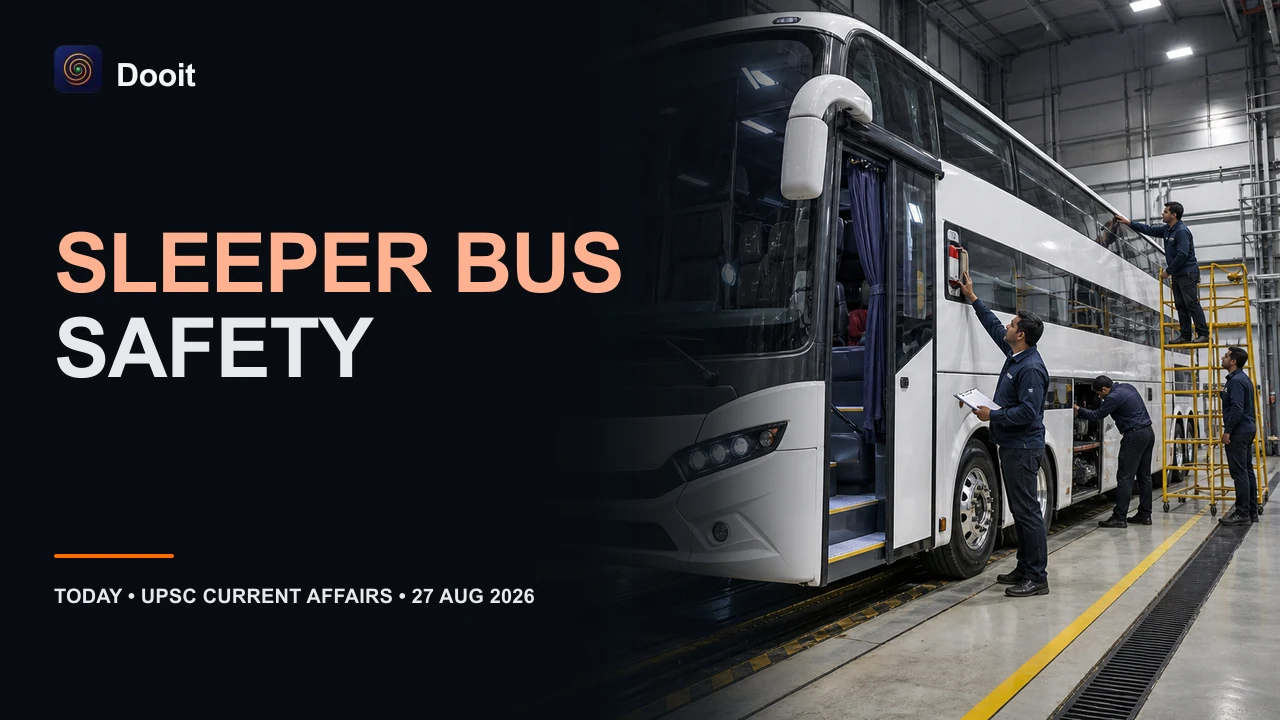
The International Centre for Automotive Technology issued its first compliance certificate for a 15-metre multi-axle sleeper bus under AIS-119 and AIS-153 in accordance with the Central Motor Vehicles Rules. The certificate went to Synaty Automotive for one of the longest permitted bus-body configurations in passenger transport. The fully sleeper version has 42 berths, while the hybrid configuration has 21 berths and 42 seats. ICAT said the vehicle was evaluated for structural integrity, emergency and fire safety, passenger movement, accommodation and comfort. The development is not a blanket safety guarantee for every bus in service; it confirms that a specific design and configuration met prescribed requirements at certification. Road safety still depends on consistent production, registration checks, maintenance, driver hours, speed management, operator accountability and enforcement throughout the vehicle's life.
Why UPSC cares
For GS Paper 3, connect transport infrastructure and road safety with vehicle standards, homologation, regulatory capacity and lifecycle compliance. Distinguish type approval from continuing operational safety.
How to study this story
Homologation is a gate between design and lawful market entry. It asks whether a vehicle type, in the tested configuration, satisfies notified technical requirements. This protects consumers and creates a common benchmark for manufacturers. Yet road safety failures often occur after the gate. A manufacturer may vary materials or assembly quality; an operator may alter the body, overload the vehicle, defer maintenance or schedule unsafe driver hours. Regulators therefore need conformity-of-production audits, periodic fitness testing and traceable records for repairs and modifications. Sleeper buses create specific evacuation and fire risks because passengers may be lying down, asleep or separated by interior structures. Emergency exits, aisle access, material flammability, signage and drills should be evaluated in realistic conditions. Certification bodies require independence, technical competence and public disclosure of the applicable standard without exposing proprietary detail. When an incident occurs, investigation should distinguish design defect, manufacturing variance, maintenance failure, driver behaviour and infrastructure condition. Recall and corrective-action powers complete the feedback loop. Passenger comfort should not be traded against escape access or structural safety. UPSC answers should place standards inside a systems approach: safe vehicle, safe road, safe speed, safe user and post-crash response. The certificate is a meaningful regulatory milestone, but its public value depends on continuous compliance and evidence-led enforcement across the fleet.
The larger paper context
For GS Paper 3, connect the blue economy, vehicle certification and food-price intervention through lifecycle governance. Technology or procurement creates value only when monitoring, accountability and feedback continue after launch.
Probable question
Vehicle homologation is necessary but insufficient for road safety. Discuss the lifecycle institutions needed to keep long-distance passenger transport safe after type certification.
Quick practice check
Q1
The 15-metre sleeper bus was certified under which standards?
- AIS-119 and AIS-153
- BIS-1 and BIS-2
- Only a municipal by-law
- A maritime convention
Show answer
Correct answer: AIS-119 and AIS-153
ICAT certified the configuration under AIS-119 and AIS-153 with the applicable Central Motor Vehicles Rules.
Q2
Why does type certification not complete the road-safety task?
- It eliminates maintenance
- Lifecycle operation and production can diverge from the tested design
- It replaces driver regulation
- It makes fitness tests illegal
Show answer
Correct answer: Lifecycle operation and production can diverge from the tested design
Continuing safety depends on conformity, maintenance, operation and enforcement after the tested type enters service.
Related previous-year questions
- UPSC GS-3: infrastructure, including transport, and issues related to planning and mobilisation