 Polity & Governance
GS Paper 2 · 28 August 2026
India-Africa Exchange Puts Interoperable Land Records at the Centre of Digital Governance
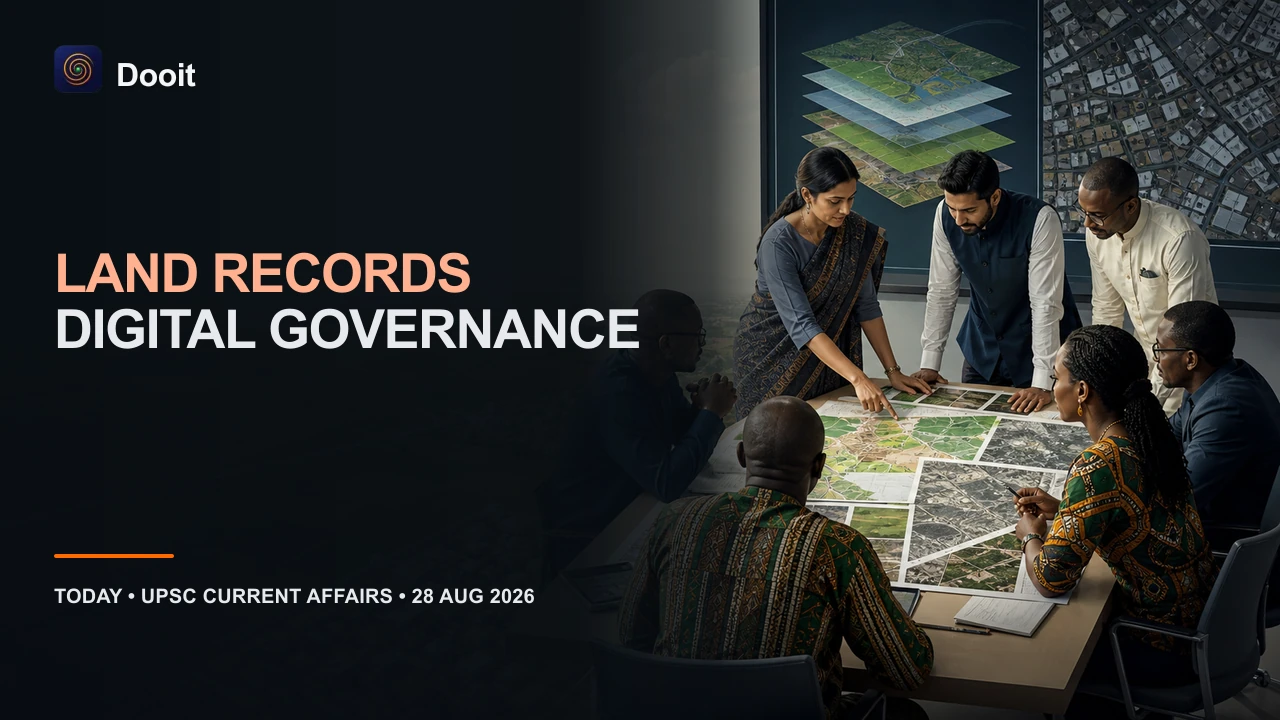
A delegation involving the African Union Commission, representatives of African countries and UNDP engaged with India's Department of Land Resources on digital public infrastructure for land governance. Technical discussions covered the Digital India Land Records Modernisation Programme, Bhu-Aadhaar or ULPIN, the National Generic Document Registration System, the Bharat Land Stack and the NAKSHA urban-mapping pilot. The exchange presented computerised records, digitised cadastral maps and interoperable identifiers as tools for transparent and accessible land administration. Yet technology does not by itself settle ownership, correct legacy errors or protect vulnerable occupants. Transferable value lies in common standards, verifiable updates and service integration, while each jurisdiction must retain lawful adjudication, privacy protection, local-language access and a clear correction process. The visit also illustrates South-South cooperation in which a domestic digital system becomes an object of institutional learning rather than a ready-made export template.
Why UPSC cares
For GS Paper 2, connect land administration with digital public infrastructure, cooperative federalism, due process, data protection and South-South cooperation. For GS Paper 3, relate clean records to credit, investment and urban planning.
How to study this story
Land information is unusually sensitive because a digital entry can influence possession, credit, taxation, planning and litigation. Interoperability is valuable when survey maps, ownership records and registration events can be checked against one another instead of remaining isolated departmental files. A unique parcel identifier can reduce ambiguity, while common registration software can make transactions easier to trace. Yet digitisation also amplifies an error if the wrong record moves seamlessly across systems. The design must therefore preserve provenance: who changed a field, on what authority, using which supporting document and with what notice to affected persons. A correction channel should be accessible offline as well as online, available in local languages and backed by a reasoned decision. Federal diversity matters because land administration rests heavily with States; common standards should enable exchange without erasing lawful institutional differences. The India-Africa engagement is analytically useful as South-South cooperation based on shared administrative problems. Its success would not be measured by copying one platform, but by adapting principles such as open standards, modular services, verified updates and citizen remedies. For UPSC, balance efficiency with rights. The best digital land system is not the one that produces the most records fastest; it is the one whose records are trusted because they remain lawful, explainable and correctable.
The larger paper context
For GS Paper 2, compare implementation systems rather than scheme objectives. District health capacity, digital land records and vendor support all require clear responsibility, coordination across levels of government and a remedy when an eligible person is missed.
Probable question
Digital public infrastructure can improve land administration only when interoperability is matched by due process, correction rights and local institutional capacity. Discuss in the context of India-Africa cooperation.
Quick practice check
Q1
Which initiative discussed in the India-Africa exchange provides a unique identifier for a land parcel?
- NAKSHA
- Bhu-Aadhaar or ULPIN
- PM SVANidhi
- RuPay
Show answer
Correct answer: Bhu-Aadhaar or ULPIN
Bhu-Aadhaar or ULPIN identifies land parcels; the other options concern urban mapping, street-vendor support or payments.
Q2
What is the strongest safeguard when interoperable land records contain a legacy error?
- Replicate the entry across every system immediately
- Disable all registration services
- Treat the database as conclusive regardless of title law
- Preserve provenance, give notice and provide a lawful correction route
Show answer
Correct answer: Preserve provenance, give notice and provide a lawful correction route
Interoperability can spread error, so traceable changes, notice and an accessible legal correction process are essential.
Related previous-year questions
- UPSC GS-2: Important aspects of governance, transparency and accountability; e-governance applications, models, successes and limitations