 Environment & Health
GS Paper 2 · 28 August 2026
Health Budget Projects Shift from Announcements to District-Level Capacity
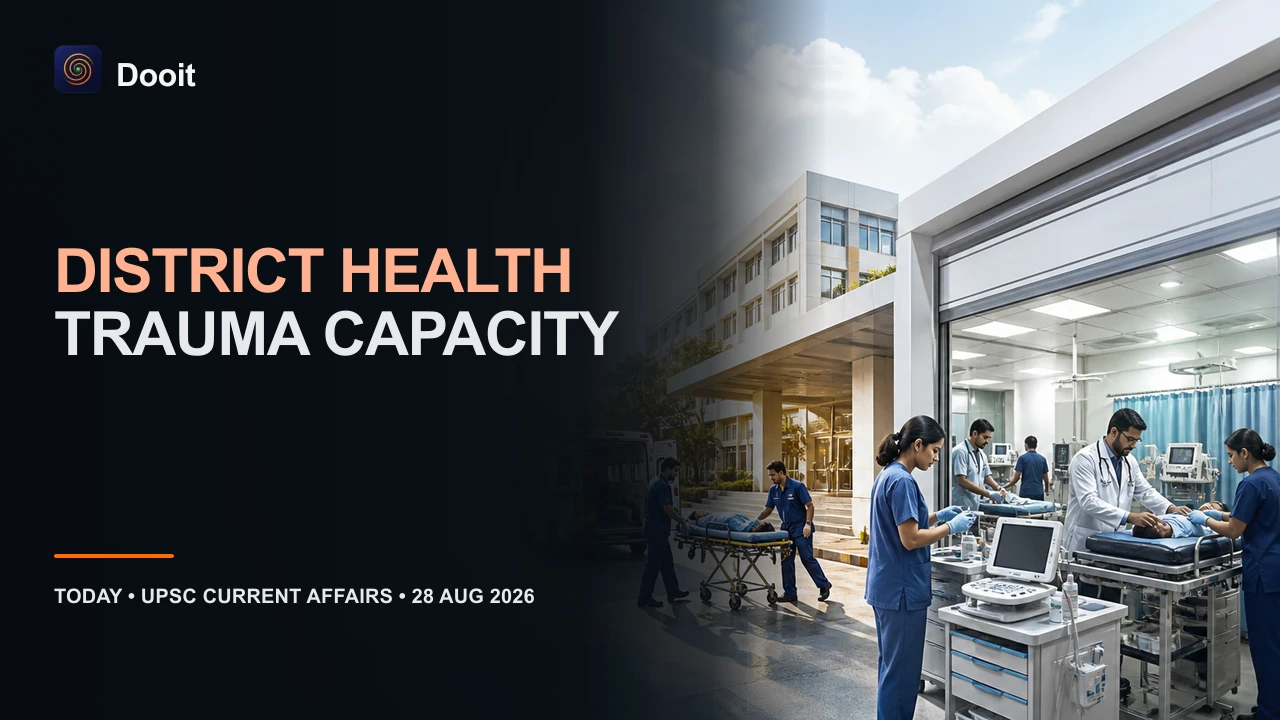
The Union Health Ministry reviewed implementation of health initiatives announced in the Union Budget 2026-27. A gap analysis against Indian Public Health Standards has classified 613 District Hospitals for phased expansion of emergency and trauma care: 160 hospitals are targeted in the first phase by March 2027, followed by 203 and 250 hospitals in later phases. The wider package also seeks to add 1 lakh allied health professionals over five years and train 1.5 lakh multiskilled caregivers. Preparatory work covers drug-regulatory capacity, clinical-research networks, mental-health institutions and regional medical hubs. The policy lesson is that a budget announcement becomes a health outcome only when infrastructure, staffing, referral pathways, pre-hospital integration, standards and monitoring advance together. Counting upgraded buildings without measuring clinical readiness, workforce retention and equitable access would overstate implementation.
Why UPSC cares
For GS Paper 2, connect public-health capacity with budget implementation, Indian Public Health Standards, Centre-State coordination, health workforce planning and measurable service delivery. Distinguish capital creation from functional readiness.
How to study this story
Treat the district hospital as a capability system, not a building project. Emergency care depends on triage, trained teams, diagnostics, blood access, operating support, referral transport and continuous availability. A weakness in any link can turn nominal capacity into delay. Indian Public Health Standards provide a common benchmark, but classification must lead to local gap-closing plans because patient load, geography and workforce supply differ. Phasing can improve execution if later hospitals are not left without interim safeguards and if lessons from the first phase alter subsequent design. Workforce additions also need role clarity, accredited training, supervision and retention; a headline count does not show whether the right skills are available at the hour of need. Pre-hospital integration deserves equal weight because stabilisation and referral begin before a patient enters the facility. Monitoring should therefore combine input indicators with readiness and outcome indicators: functioning equipment, staffed shifts, referral time, continuity of essential services and equitable reach. Centre-State coordination is necessary for finance, standards and human resources, while hospital managers need operational authority and transparent review. A strong UPSC conclusion is that public investment creates health security only when standards are translated into dependable clinical pathways and independently verifiable service quality.
The larger paper context
For GS Paper 2, compare implementation systems rather than scheme objectives. District health capacity, digital land records and vendor support all require clear responsibility, coordination across levels of government and a remedy when an eligible person is missed.
Probable question
Budgetary intent improves public health only when infrastructure, personnel, standards and referral systems are converted into functional district-level capacity. Examine.
Quick practice check
Q1
Which measure best tests whether a strengthened District Hospital has functional emergency capacity?
- Staffed shifts, working diagnostics and usable referral pathways
- The value of the construction contract alone
- The number of review meetings held
- A uniform building design regardless of patient load
Show answer
Correct answer: Staffed shifts, working diagnostics and usable referral pathways
Functional capacity requires staff, equipment and referral links to work together; expenditure or a standard building alone cannot show clinical readiness.
Q2
What informed the phased classification of District Hospitals in the reviewed health initiative?
- Only the age of the building
- Only the State population
- Gap analysis against Indian Public Health Standards together with patient load, infrastructure and readiness
- The number of private hospitals nearby
Show answer
Correct answer: Gap analysis against Indian Public Health Standards together with patient load, infrastructure and readiness
The review used an IPHS-based gap analysis and readiness considerations; a single proxy would not support phased implementation.
Related previous-year questions
- UPSC GS-2: Issues relating to development and management of the social sector relating to health