 Economy & Energy
GS Paper 3 · 28 August 2026
Twelve Years of PM Jan Dhan Turn Account Access into a Test of Financial Use
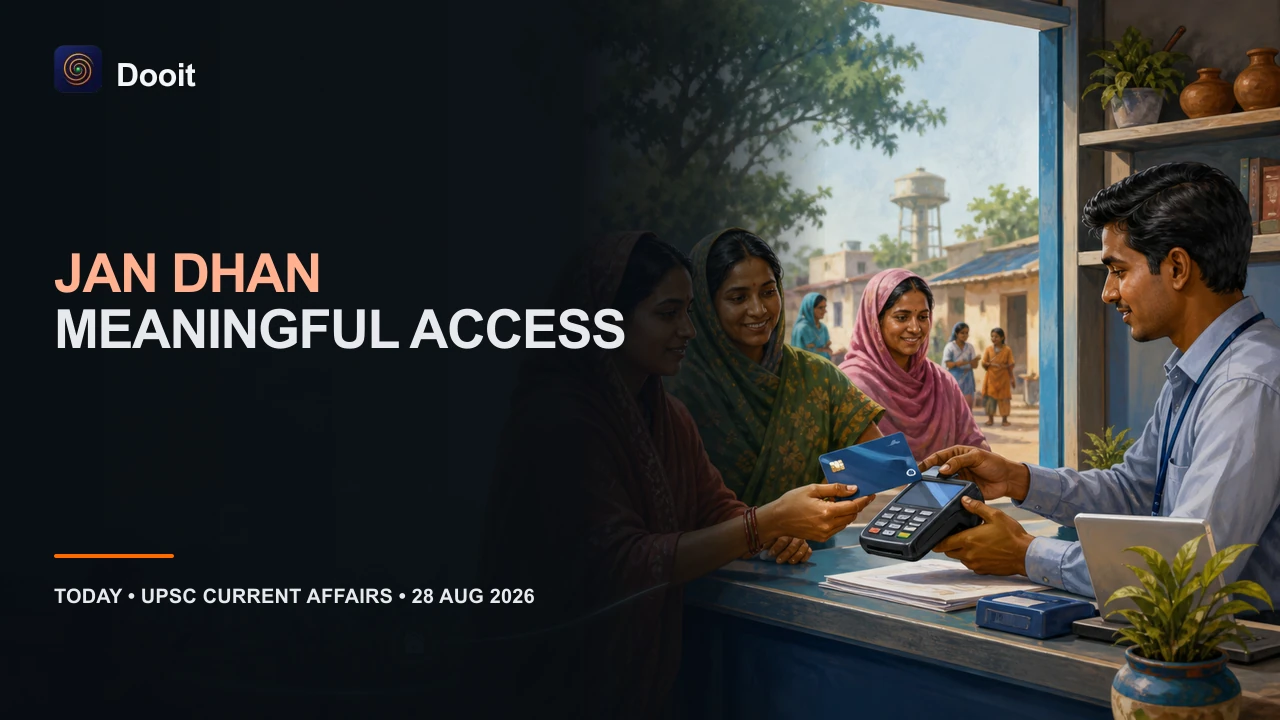
Pradhan Mantri Jan Dhan Yojana completed 12 years with 59.09 crore accounts and deposits of ₹3.17 lakh crore as of 19 August 2026. Women hold 55.7% of accounts, 77.8% are in rural and semi-urban areas, and more than 41 crore RuPay cards have been issued. PMJDY anchors the Jan-Dhan-Aadhaar-Mobile framework used for direct benefit delivery. The scale demonstrates how basic accounts, business correspondents, payment cards and mobile connectivity can lower the entry barrier to formal finance. The next analytical question is use rather than opening: whether accounts remain active, customers understand products, grievance systems work, women control transactions, and rural access points remain reliable. Direct transfer can reduce intermediaries and delays, but authentication failures, fraud, dormancy and weak last-mile assistance can still exclude intended recipients. Financial inclusion should therefore be measured through secure and meaningful use, not possession of an account alone.
Why UPSC cares
For GS Paper 3, connect financial inclusion with banking access, digital payments, direct benefit transfer, women account holders and rural service delivery. For GS Paper 2, examine welfare portability, exclusion risks and grievance redress.
How to study this story
A basic account is an entry point, not the endpoint of inclusion. It can receive benefits, hold savings and connect a household to payments, insurance or pensions, but these possibilities matter only when the account is usable. Business correspondents must remain available, cash points must be liquid, authentication must work and customers must understand consent and fraud risks. Gender-disaggregated ownership is significant, yet ownership does not automatically mean control: household norms, phone access and assisted transactions may determine who actually decides how money is used. Rural reach also needs service-quality measurement because distance, downtime and failed transactions can impose high costs on small balances. Direct benefit transfer improves traceability and can reduce delay, while a dependable grievance route is essential when identity or account mapping fails. Dormancy is another warning: an opened account with no trusted use reveals access without capability. Policy should track active use, complaint resolution, customer loss from fraud, continuity of local access and movement into appropriate savings or protection products. In UPSC analysis, the JAM framework should be treated as public infrastructure whose legitimacy depends on inclusion by design. The mature policy goal is not maximum digitalisation; it is reliable choice across digital and assisted channels, with security, accountability and meaningful agency for the account holder.
The larger paper context
For GS Paper 3, focus on the quality of information that drives economic and environmental decisions. Conservation science, crop-support evidence and financial-inclusion metrics become useful only when they are comparable, auditable and connected to real behaviour.
Probable question
Financial inclusion must be judged by secure and meaningful use, not merely by the number of accounts opened. Discuss with reference to twelve years of PM Jan Dhan Yojana.
Quick practice check
Q1
Which fact best shows PMJDY's rural and semi-urban reach?
- More than 41 crore RuPay cards
- 77.8% of accounts are in rural and semi-urban areas
- Deposits of ₹3.17 lakh crore
- The scheme completed 12 years
Show answer
Correct answer: 77.8% of accounts are in rural and semi-urban areas
The location share directly measures rural and semi-urban reach; the other facts describe cards, balances or duration.
Q2
Which indicator moves beyond account ownership to meaningful financial inclusion?
- A launch anniversary
- The printed number on a card
- One-time enrolment alone
- Reliable active use with security and grievance resolution
Show answer
Correct answer: Reliable active use with security and grievance resolution
Meaningful inclusion requires dependable use, protection and remedies; account possession alone does not show capability.
Related previous-year questions
- UPSC GS-3: Inclusive growth and issues arising from it