 Economy & Energy
GS Paper 2 · 28 August 2026
Restructured PM SVANidhi Links Street-Vendor Credit with Portable Urban Livelihood Support
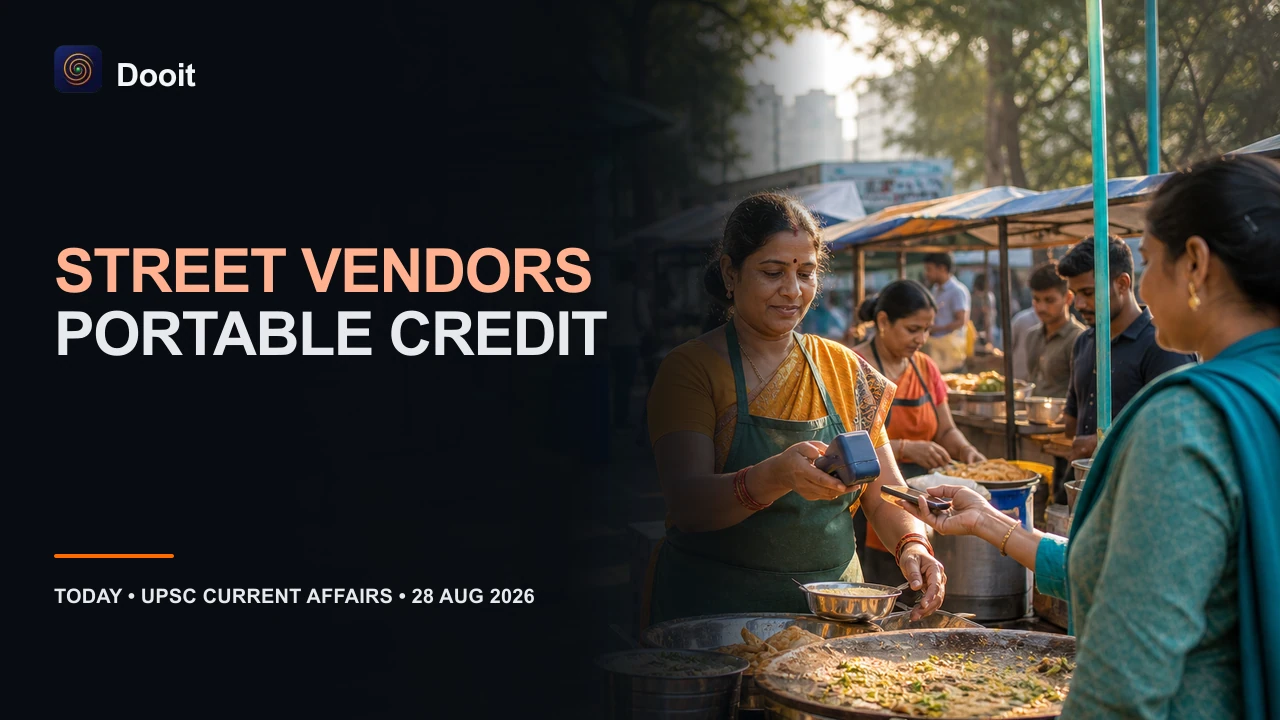
PM SVANidhi completed one year of its restructured phase after lending was extended to 31 March 2030. The revised scheme aims to benefit 1.15 crore street vendors, including 50 lakh new beneficiaries. In the first year after restructuring, 21.86 lakh loans worth ₹6,294 crore were disbursed to 10.56 lakh new beneficiaries. An UPI-linked RuPay credit card with a limit up to ₹30,000, an end-to-end digital lending platform and a migration module for transferring Letters of Recommendation between urban local bodies and Census Towns seek to make formal credit more usable and portable. The programme also connects finance with welfare profiling, food-safety training, vending infrastructure and enterprise innovation. The governance test is not loan volume alone: it is whether vendors receive fair identification, affordable repeat credit, usable vending space, grievance redress and continuity when they move. Digital processing should reduce friction without turning a database mismatch into exclusion.
Why UPSC cares
For GS Paper 2, examine urban livelihoods, local-government capacity and social-security convergence. For GS Paper 3, connect collateral-free working capital, digital payments and credit histories with informal-sector formalisation.
How to study this story
Street vending sits at the intersection of livelihood policy, municipal regulation, finance and the use of public space. Credit can smooth working capital, support inventory and build a repayment history, but it cannot substitute for recognition by the urban local body. A vendor who lacks a valid recommendation, faces repeated eviction or moves to another town may be formally banked yet economically insecure. The migration module therefore matters because portability converts a local document into continuing access, provided receiving authorities update records promptly. An integrated lending platform can shorten processing, though assisted access remains necessary for applicants with weak connectivity or limited digital confidence. The credit card adds flexibility but also makes responsible lending, transparent charges and fraud support important. Linking vendors to welfare and food-safety training broadens the scheme from a loan product into a livelihood system. Infrastructure such as notified vending zones and food hubs must be planned with pedestrian movement, sanitation, safety and customer access rather than pushed to commercially unviable edges. Evaluation should track repeat access, repayment without distress, income stability, benefit continuity and grievance resolution. In a Mains answer, use PM SVANidhi to show that formalisation should increase capability and security, not merely make informal workers legible to databases and lenders.
The larger paper context
For GS Paper 2, compare implementation systems rather than scheme objectives. District health capacity, digital land records and vendor support all require clear responsibility, coordination across levels of government and a remedy when an eligible person is missed.
Probable question
Formal credit can strengthen street-vendor livelihoods only when finance is integrated with recognition, portable entitlements, public space and social protection. Analyse with reference to restructured PM SVANidhi.
Quick practice check
Q1
What problem is the PM SVANidhi Vendor Migration Module designed to address?
- Fixing prices charged by vendors
- Replacing urban local bodies
- Continuity of recommendations when vendors move between covered towns
- Converting every loan into a grant
Show answer
Correct answer: Continuity of recommendations when vendors move between covered towns
The module supports transfer of Letters of Recommendation so an eligible vendor does not lose continuity merely by moving.
Q2
Which outcome best indicates livelihood formalisation rather than loan disbursement alone?
- Repeat affordable credit, secure vending space and working grievance redress
- A larger application database
- Mandatory digital-only service
- Removal of municipal recognition
Show answer
Correct answer: Repeat affordable credit, secure vending space and working grievance redress
Formalisation should improve capability and security through usable credit, recognition and remedies; a database count alone is insufficient.
Related previous-year questions
- UPSC GS-2: Welfare schemes for vulnerable sections and mechanisms constituted for their protection and betterment