 Economy & Energy
GS Paper 3 · 28 August 2026
Moong Procurement Review Links MSP Delivery with Verifiable Crop-Insurance Data
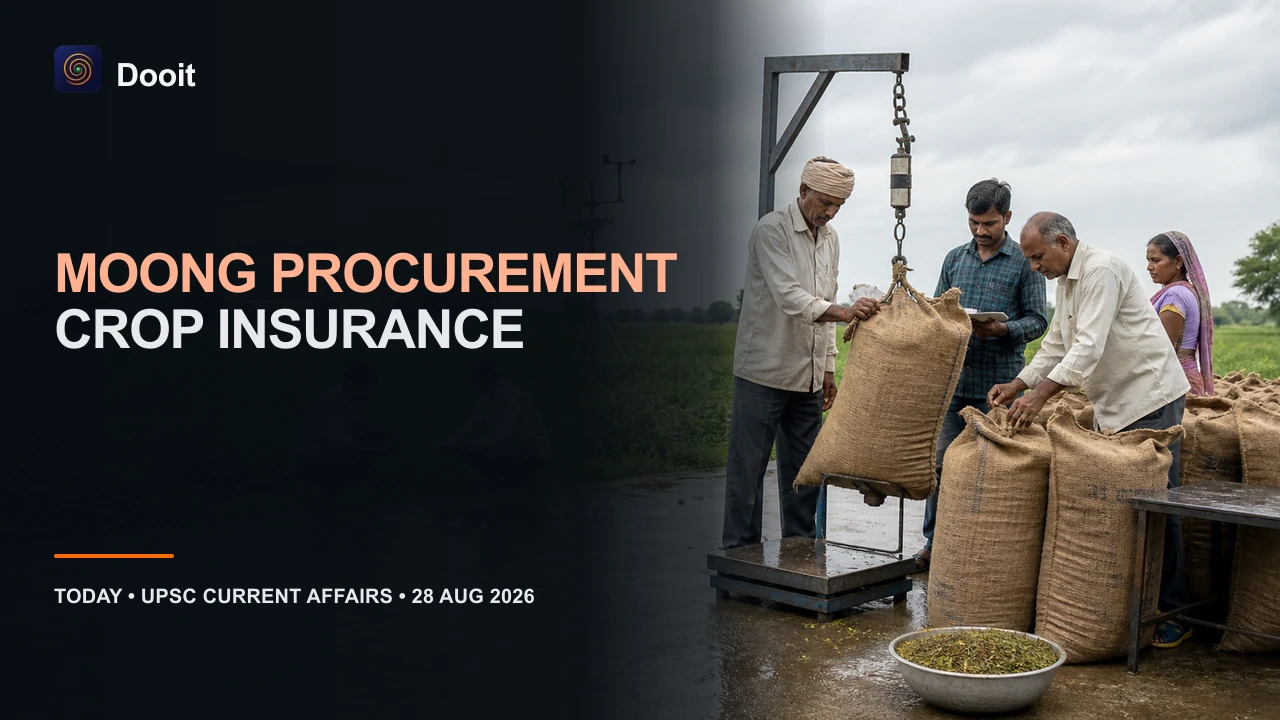
The Agriculture Ministry reviewed summer moong procurement and crop-insurance implementation in Madhya Pradesh. The Centre initially approved procurement of 4,54,580 metric tonnes for the 2026 season and later added 84,492 metric tonnes, taking the total approval to 5,39,072 metric tonnes. The state recorded procurement of about 5.33 lakh metric tonnes, mainly through NAFED and NCCF, with emphasis on timely payment and transparency. The review also examined the Restructured Weather Based Crop Insurance Scheme under PMFBY. The Weather Information Network and Data System remains necessary for reliable implementation, while technology-based yield assessment was advised to retain field ground-truthing through Crop Cutting Experiments. The two policy arms share a common accountability problem: procurement requires verified quantity, farmer eligibility and payment, while insurance requires credible weather and yield evidence. Technology can increase speed and coverage, but calibration, audit trails and an accessible correction mechanism determine whether it builds farmer trust.
Why UPSC cares
For GS Paper 3, connect MSP procurement, market support, PMFBY, weather infrastructure, yield estimation and agricultural risk management. Examine federal coordination and the need to validate remote or model-based assessments with field evidence.
How to study this story
Procurement and insurance protect different farm risks but depend on the same administrative virtue: verifiable delivery. MSP procurement needs transparent registration, accurate weighing, quality testing, traceable stock movement and prompt payment. If any stage is opaque, an approved quantity may not translate into farmer confidence. Procurement agencies also need storage and disposal discipline so that market support does not create avoidable fiscal or logistical loss. Weather-based insurance has a different evidence chain. Reliable stations, timely transmission, quality control and clearly disclosed triggers determine whether a payout reflects the farmer's experience. Technology-based yield models can expand coverage and speed, but field observations are needed to calibrate them and detect systematic error. Crop Cutting Experiments therefore serve as ground truth rather than an old procedure to be discarded automatically. A blended system should publish methodology, record exceptions and provide a practical appeal route when observed loss diverges from the model. Federal coordination is central because the Centre, State, insurers, procurement agencies and local officials control different links. For UPSC, avoid evaluating either policy by expenditure or coverage alone. Better measures include payment timeliness, exclusion and correction rates, data completeness, basis risk and whether support stabilises decisions without distorting crop choice. Trust grows when the evidence behind a benefit can be explained and challenged.
The larger paper context
For GS Paper 3, focus on the quality of information that drives economic and environmental decisions. Conservation science, crop-support evidence and financial-inclusion metrics become useful only when they are comparable, auditable and connected to real behaviour.
Probable question
Agricultural support earns credibility only when procurement and crop insurance are backed by timely payments, reliable data and contestable assessment. Examine.
Quick practice check
Q1
Why were Crop Cutting Experiments recommended alongside technology-based yield assessment?
- To provide field ground-truthing and recalibration
- To remove weather observations
- To replace all digital models permanently
- To determine market retail prices
Show answer
Correct answer: To provide field ground-truthing and recalibration
Field observations help test and recalibrate model estimates; they complement rather than automatically replace technology.
Q2
Which system is necessary for reliable implementation of weather-based crop insurance in the review?
- Bharat Land Stack
- National Generic Document Registration System
- Weather Information Network and Data System
- International Big Cat Alliance
Show answer
Correct answer: Weather Information Network and Data System
WINDS supplies the weather-information backbone needed for a weather-based insurance design; the other systems serve unrelated purposes.
Related previous-year questions
- UPSC GS-3: Issues related to direct and indirect farm subsidies and minimum support prices; crop insurance