 Science & Technology
GS Paper 3 · 29 August 2026
Telecom Growth Data Exposes the Last-Mile Gap Behind Subscriber Scale
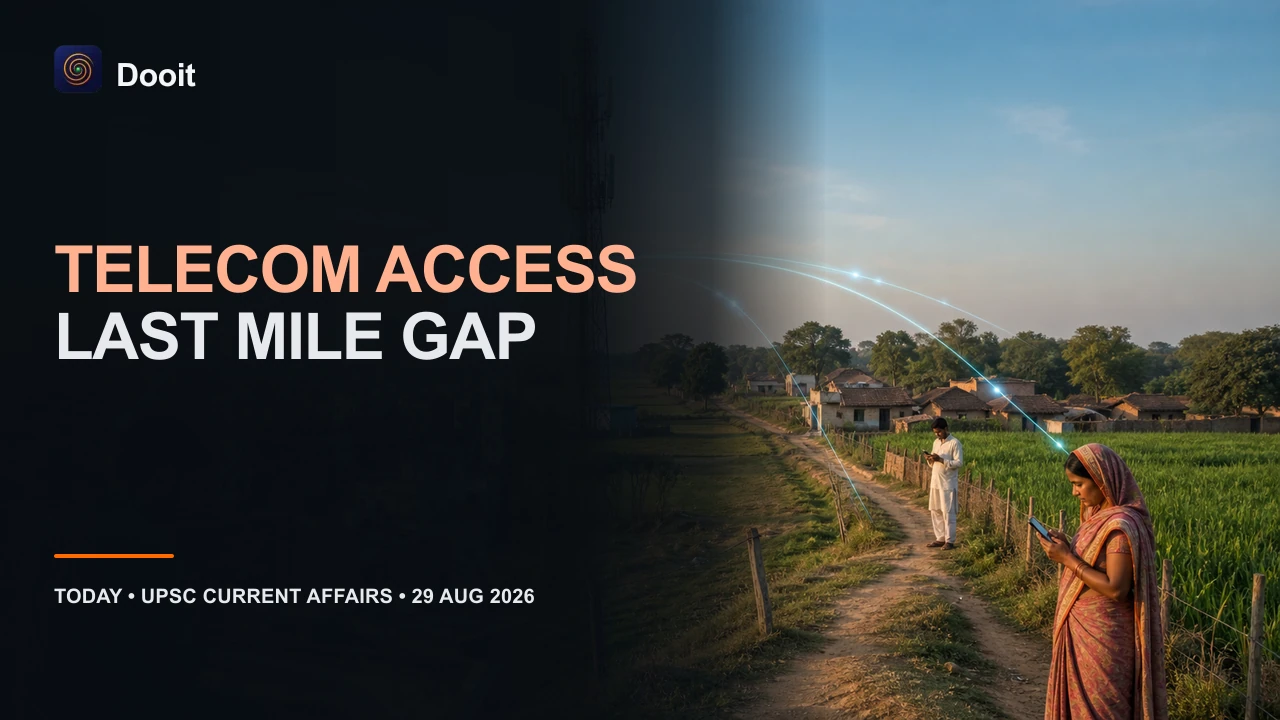
Telecom data for July 2026 recorded 1,354.28 million telephone subscribers and 1,094.48 million broadband subscriptions when cellular machine-to-machine connections are included. The same release shows why aggregate scale cannot be treated as universal access: rural tele-density was 61.05%, compared with 154.12% in urban areas, and only 10.81% of wireline subscribers were rural. Active wireless subscriptions at peak Visitor Location Register were 1,204.01 million, below the total wireless base. These measures describe different things—subscriptions, population-adjusted reach, fixed connectivity and active use. For public policy, the task is therefore not simply to add connections but to improve affordable coverage, quality, device access, digital capability and resilient backhaul in underserved areas. Data definitions also matter because including machine connections raises the broadband total without representing an additional person online.
Why UPSC cares
For GS Paper 3, connect telecommunications infrastructure with inclusive growth, the rural-urban digital divide, broadband quality, competition and measurement. Distinguish subscription counts, tele-density and active usage before drawing conclusions.
How to study this story
Telecommunications data should be read as a layered evidence system. A subscription count records connections, not unique people; one person may hold several SIMs, while machine-to-machine links add broadband subscriptions without adding users. Tele-density adjusts subscriptions against population, but an urban figure above one hundred does not mean every resident has service. Active wireless data is a useful check on nominal subscriptions, yet it still cannot measure speed, reliability, affordability or meaningful use. The rural-urban contrast is therefore a planning signal rather than a single digital-divide score. Closing the gap requires spectrum and tower coverage, fibre or microwave backhaul, reliable electricity, competitive pricing, shared infrastructure and assisted digital capability. Fixed connections matter for schools, health centres, enterprises and public offices because mobile access alone may not provide stable high-capacity service. Policy evaluation should disaggregate geography, gender, income and quality while preserving comparable definitions over time. Universal-service spending needs transparent project milestones and independent coverage tests. A strong answer concludes that connectivity becomes inclusion only when an affordable, dependable connection enables people and institutions to complete useful tasks safely.
The larger paper context
For GS Paper 3, distinguish capacity from headline scale. Subscriber totals, export authorisations, IIP growth, reactor capacity and technology-readiness levels become meaningful only when measurement, risk controls, implementation capability and final outcomes are examined together.
Probable question
High subscriber counts do not by themselves establish universal digital access. Examine the indicators and policy choices needed to close India's last-mile connectivity gap.
Quick practice check
Q1
Why can broadband subscriptions including M2M connections exceed the number that best represents people connected?
- Every M2M connection represents a new household
- Machine connections add subscriptions without necessarily adding individual users
- Tele-density excludes all mobile phones
- Wireline data counts only villages
Show answer
Correct answer: Machine connections add subscriptions without necessarily adding individual users
Cellular M2M links are subscriptions used by machines; including them raises the total without identifying an additional person online.
Q2
Which indicator most directly compares subscription scale with population?
- Tele-density
- Peak VLR date
- Number-portability requests
- Wireline market share
Show answer
Correct answer: Tele-density
Tele-density expresses subscriptions relative to population, although it still does not prove universal or high-quality access.
Related previous-year questions
- UPSC GS-3: Infrastructure—energy, ports, roads, airports, railways and communications