 International Relations
GS Paper 2 · 30 August 2026
India-Argentina Trade Talks Link Market Access with Lithium and Regulatory Trust
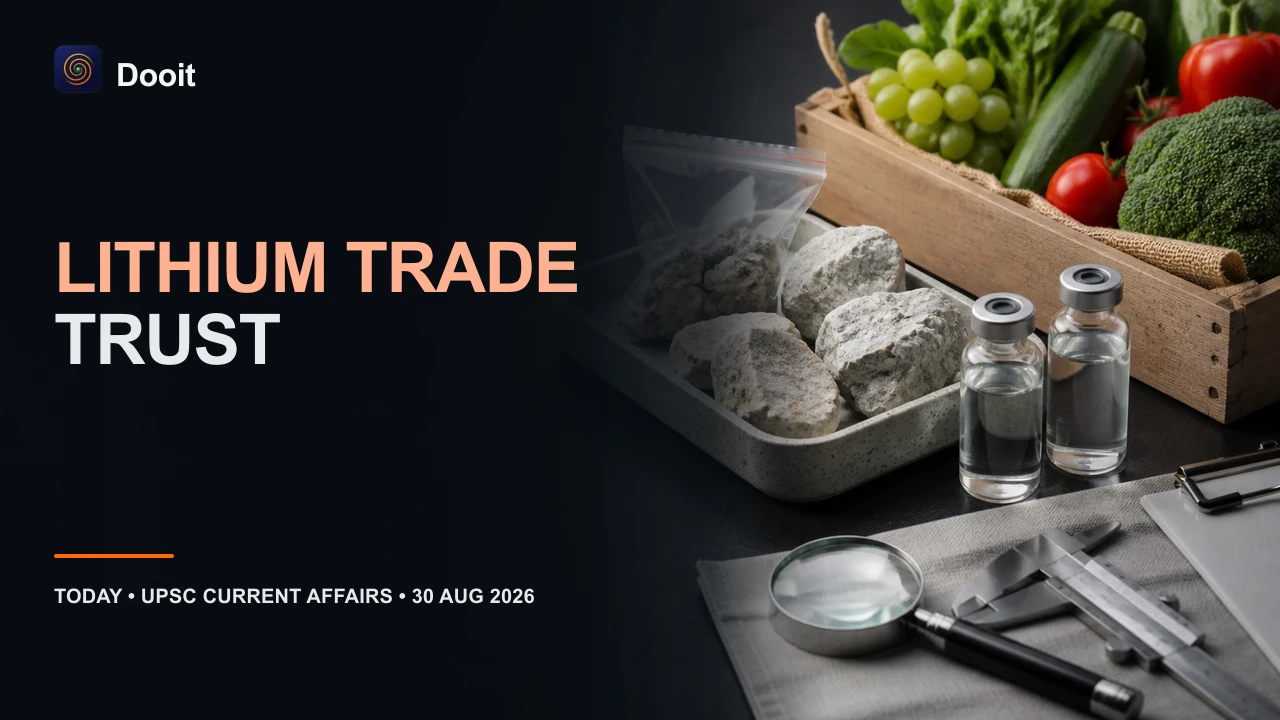
The fourth India-Argentina Joint Trade Committee reviewed a partnership that crossed USD 6.5 billion in bilateral trade in 2025, with annual growth above 17%. India was described as Argentina's fifth-largest trading partner. The agenda joined conventional market access with strategic sectors: KABIL completed Phase II drilling in Catamarca in India's first lithium-mining initiative in Argentina; sanitary and phytosanitary discussions advanced for several Indian farm products; and Argentina agreed to work toward easier regulatory treatment for Indian pharmaceuticals. The India-MERCOSUR Preferential Trade Agreement, digital certificates of origin, space, nuclear cooperation and digital services also featured. More than 25 Indian business leaders joined the associated forum. The policy significance is not trade volume alone. Lithium access must be paired with environmental and community safeguards, agricultural access depends on credible SPS compliance, and pharmaceutical opportunity depends on regulatory confidence. A durable partnership therefore requires diversified commerce, transparent standards and reciprocal investment rather than extraction-led or headline-driven engagement.
Why UPSC cares
For GS Paper 2, examine India-Latin America relations, economic diplomacy and the India-MERCOSUR route. For GS Paper 3, connect critical minerals, SPS standards, pharmaceutical regulation and resilient supply chains.
How to study this story
The Argentina engagement shows how modern economic diplomacy combines goods trade with minerals, regulation and technology. Critical-mineral access can support energy transition and manufacturing, but an extraction-only relationship creates environmental, community and concentration risks. Indian participation should therefore include transparent contracts, responsible mining, local value creation and diversified supply arrangements. Agricultural market access depends on sanitary and phytosanitary rules, which protect health but can become hidden barriers when procedures are opaque or disproportionate. Technical dialogue, traceable production and reciprocal recognition can reduce that friction without lowering safety. Pharmaceutical access similarly rests on confidence in regulators, manufacturing quality and post-market oversight. Preferential trade can widen opportunity, while digital certificates of origin reduce transaction cost only if customs systems are interoperable and fraud controls are strong. Business delegations help discover projects, but public agencies must follow through on finance, dispute resolution and standards. India's wider Latin America strategy gains depth when it links energy and food security with space, digital services, health and research. The test is diversification: both sides should gain new capabilities and markets rather than simply exchange raw materials for finished products.
The larger paper context
For GS Paper 2, examine how institutions create trust across borders and within society. Diplomatic forums require implementation and reciprocity, while disability services require dignity, consent, accessible referrals and coordination across health, education and livelihood systems.
Probable question
India's economic diplomacy with Latin America must move beyond commodity exchange toward standards-based and technology-rich partnerships. Examine with reference to India-Argentina cooperation.
Quick practice check
Q1
Why are SPS discussions important in India-Argentina agricultural trade?
- They set military doctrine
- They govern health-based conditions for market access
- They replace customs documentation entirely
- They determine mining royalties
Show answer
Correct answer: They govern health-based conditions for market access
Sanitary and phytosanitary measures protect plant, animal and human health and shape whether farm products can enter a market.
Q2
Which approach would make critical-mineral cooperation more resilient?
- Relying on one mine without safeguards
- Ignoring community impacts
- Limiting engagement to raw-material purchase
- Combining diversified supply with responsible mining and local value creation
Show answer
Correct answer: Combining diversified supply with responsible mining and local value creation
Diversification, environmental safeguards and shared value reduce concentration and legitimacy risks in mineral partnerships.
Related previous-year questions
- UPSC GS-2: Effect of policies and politics of developed and developing countries on India's interests