 International Relations
GS Paper 2 · 31 August 2026
India and Uzbekistan Elevate Their Partnership from Dialogue to Delivery Mechanisms
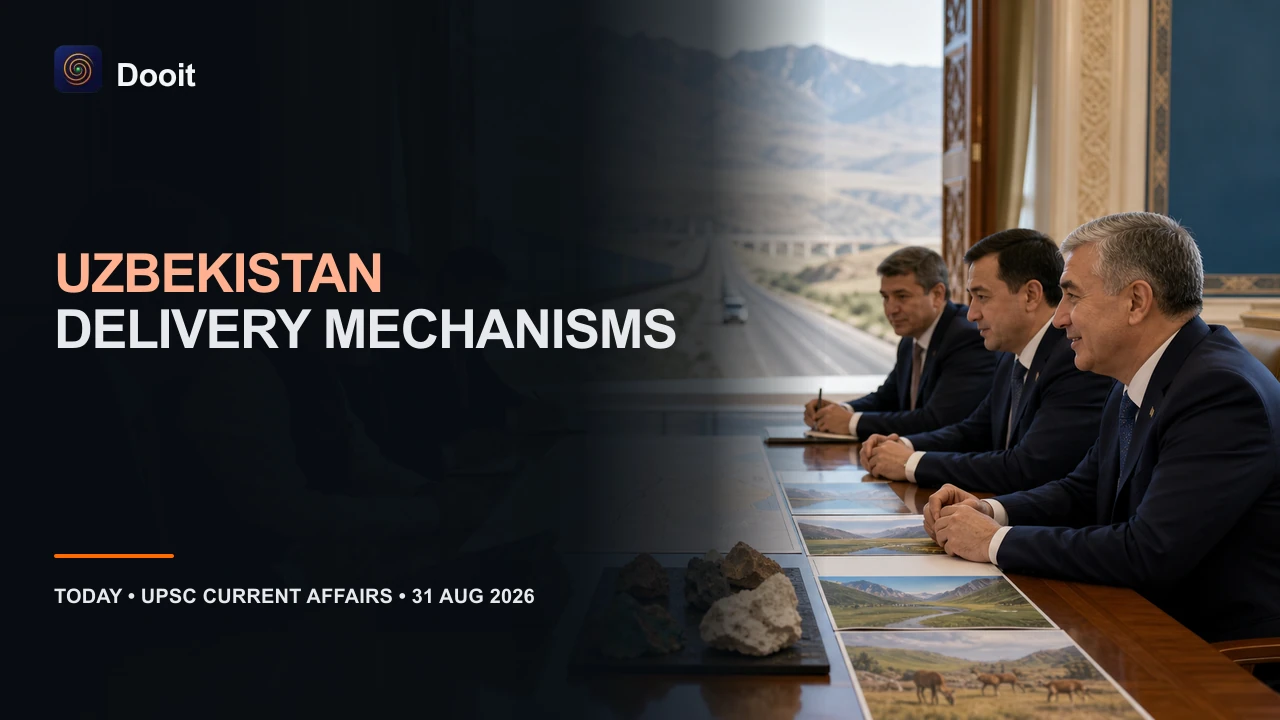
India and Uzbekistan elevated their relationship to a Comprehensive Strategic Partnership during the Prime Minister's state visit on 29–30 August 2026. The outcomes included a Foreign Ministers-led oversight mechanism, cooperation on trade barriers, critical minerals, digital technologies, space, health and education, and follow-up on a feasibility study for a preferential trade agreement. The two sides also signed a cultural exchange programme for 2026–30, agreed to conserve Buddhist sites at Fayaz Tepa and KaraTepa, and announced a USD 1 million Indian grant for afforestation in the Aral Sea region. A payments agreement is intended to allow Indian UPI applications to scan Uzbekistan's UZQR merchant codes. The policy significance lies in joining continental security and connectivity with practical institutions. Central Asian engagement becomes durable only when agreements receive ministerial oversight, trade obstacles are resolved, digital systems interoperate and transport choices respect sovereignty.
Why UPSC cares
For GS Paper 2, connect India-Uzbekistan ties with Central Asia policy, strategic autonomy, counter-terrorism, connectivity, critical minerals, digital public infrastructure and cultural diplomacy. Distinguish a summit declaration from an accountable delivery mechanism.
How to study this story
The India-Uzbekistan outcome shows why Central Asia policy requires several instruments at once. Security dialogue helps address terrorism and instability, but economic partnership needs reliable transport, easier payments, regulatory coordination and viable projects. A Foreign Ministers-led mechanism can reduce the familiar gap between summit intent and departmental follow-through by assigning political oversight to implementation. Digital payments may lower friction for travellers and firms, while cooperation in critical minerals and energy can diversify supply. Such projects still need transparent contracts, cyber safeguards and realistic commercial demand. Cultural and heritage cooperation provides a different form of strategic depth: restoration of Buddhist sites, archival links and scholarships create relationships that endure beyond a transaction. The Aral Sea grant also joins diplomacy with an ecological public good, although its value should be assessed through survival of plantations and local participation rather than the announcement alone. India should avoid treating connectivity as a map line. A sound corridor respects sovereignty, has predictable customs and transit rules, offers route alternatives and serves actual users. Strategic autonomy grows when partners receive credible choices instead of dependence on a single route, platform or financier. The central evaluation question is whether the new oversight machinery turns a broad partnership into completed, measurable and mutually useful outcomes.
The larger paper context
For GS Paper 2, ask who coordinates delivery, how federal and private actors share authority, and which accountability mechanism protects reciprocity, inclusion and public purpose.
Probable question
India's engagement with Central Asia will be judged by institutional delivery rather than diplomatic symbolism. Discuss with reference to the India-Uzbekistan Comprehensive Strategic Partnership.
Quick practice check
Q1
Which new mechanism is intended to oversee implementation of India-Uzbekistan agreements?
- A Foreign Ministers-led mechanism
- A common central bank
- A single customs union
- A joint election commission
Show answer
Correct answer: A Foreign Ministers-led mechanism
The leaders agreed on Foreign Ministers-led oversight to coordinate and monitor implementation.
Q2
Which outcome most directly advances retail payment interoperability?
- An exclusive reserve currency
- A new maritime boundary
- Indian UPI applications scanning UZQR merchant codes
- A shared income tax
Show answer
Correct answer: Indian UPI applications scanning UZQR merchant codes
The commercial arrangement links Indian UPI applications with Uzbekistan's national QR acceptance network.
Related previous-year questions
- UPSC GS-2: Bilateral, regional and global groupings and agreements involving India or affecting India's interests