 Science & Technology
GS Paper 3 · 31 August 2026
Indian Standard Time Rules Turn Precise Time into National Digital Infrastructure
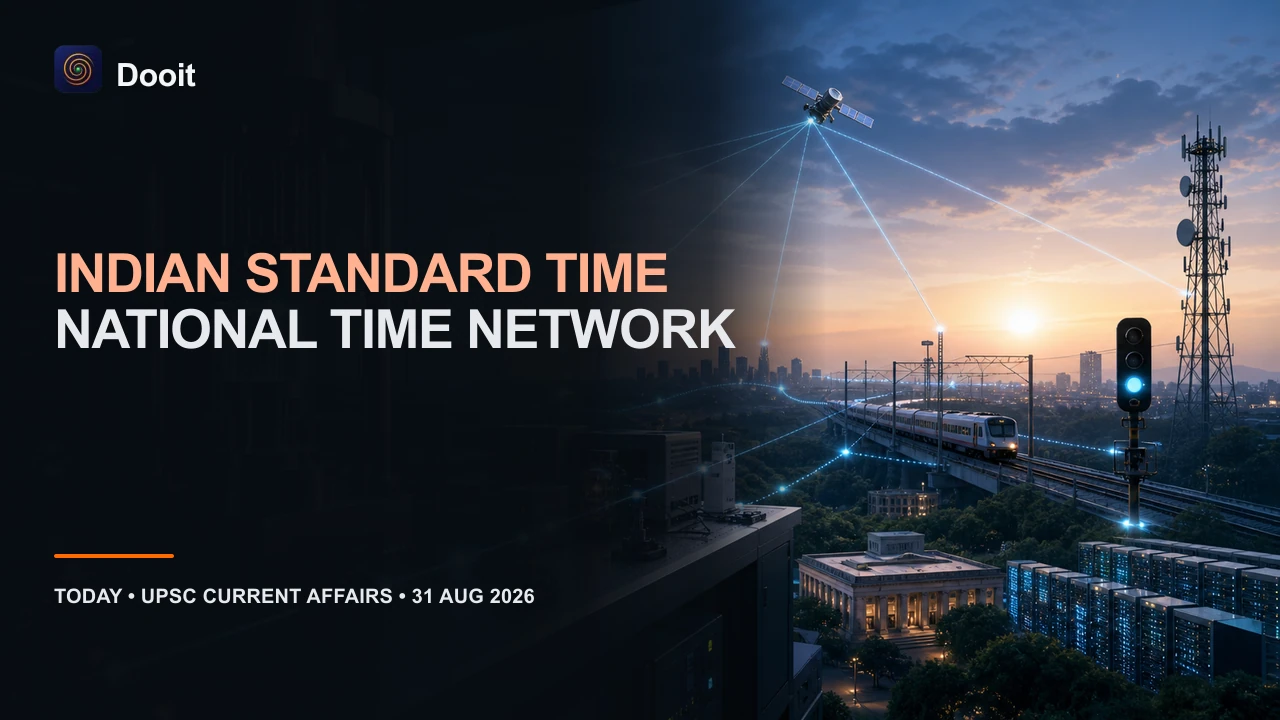
The Department of Consumer Affairs notified the Legal Metrology (Indian Standard Time) Rules, 2026 on 27 August, with commencement after 180 days. The rules establish IST as the common reference for legal, administrative, commercial and other official purposes. Accurate and consistent time stamps matter for banking and digital payments, telecommunications, transport, power systems, computer networks, legal records and emergency services. The government is developing domestic dissemination infrastructure through Indian institutions, Legal Metrology laboratories, NavIC and approved Indian timing sources to reduce dependence on foreign satellite-based time. A White Rabbit technology demonstration network commissioned at the Regional Reference Standard Laboratory, Bengaluru in July 2026 has shown secure high-precision dissemination, including between Bengaluru and NSE Chennai. Time is therefore not merely a clock convention. It is trust infrastructure: distributed systems need an authoritative, traceable reference so transactions can be sequenced, disputes reconstructed and critical networks coordinated.
Why UPSC cares
For GS Papers 2 and 3, link the rules with Legal Metrology, digital governance, NavIC, cyber resilience, critical infrastructure, financial-market integrity and technological self-reliance. Discuss implementation, interoperability and auditability.
How to study this story
Modern infrastructure depends on agreement about when an event occurred. A payment dispute, grid disturbance, cyber incident or transport failure may involve many machines whose logs must be sequenced precisely. If those systems take time from inconsistent or insecure sources, audit and coordination weaken. Making IST the common official reference therefore supports legal certainty as well as engineering reliability. Domestic dissemination through NavIC, national laboratories and approved sources can reduce external dependence, but sovereignty should not mean technical isolation. Systems still need interoperability, independent calibration, redundancy and continuous comparison with international standards. White Rabbit technology is useful because high-precision networks can carry timing across distributed equipment, yet a demonstration becomes public infrastructure only after scale, security and maintenance are proven. Implementation also involves transition costs: banks, exchanges, telecom firms, transport systems and government departments must audit existing clocks, software and vendor dependencies before commencement. Regulators need proportional compliance rules so smaller organisations are not confused by requirements designed for critical networks. Cybersecurity is essential because a trusted time source can itself become a high-value target. A mature regime records traceability from the authoritative source to the end system, tests failover and publishes clear responsibility. The UPSC lesson is that digital sovereignty rests on mundane shared standards that make complex networks verifiable and dependable.
The larger paper context
For GS Paper 3, follow the full value chain. Standards, data, finance and technology matter only when they improve resilience, ecological safety, market access and last-mile outcomes without creating opaque exclusion.
Probable question
Precise national time is a component of digital sovereignty and critical-infrastructure resilience. Discuss with reference to the Legal Metrology (Indian Standard Time) Rules, 2026.
Quick practice check
Q1
Why is a common official time reference important for digital systems?
- It removes every cyber risk
- It replaces legal records
- It supports consistent sequencing and audit of events
- It ends the need for network redundancy
Show answer
Correct answer: It supports consistent sequencing and audit of events
Consistent time stamps allow events across distributed systems to be sequenced, investigated and reconciled.
Q2
Which Indian capability is expressly relevant to domestic time dissemination?
- NavIC
- A foreign tax database
- A commodity cartel
- A private electoral roll
Show answer
Correct answer: NavIC
The rules provide for NavIC and other approved Indian timing sources.
Related previous-year questions
- UPSC GS-3: Awareness in the fields of IT, space and indigenisation of technology