 Economy & Energy
GS Paper 3 · 31 August 2026
Mission Rangeen Machhli Seeks a Biosecure Value Chain for Ornamental Fisheries
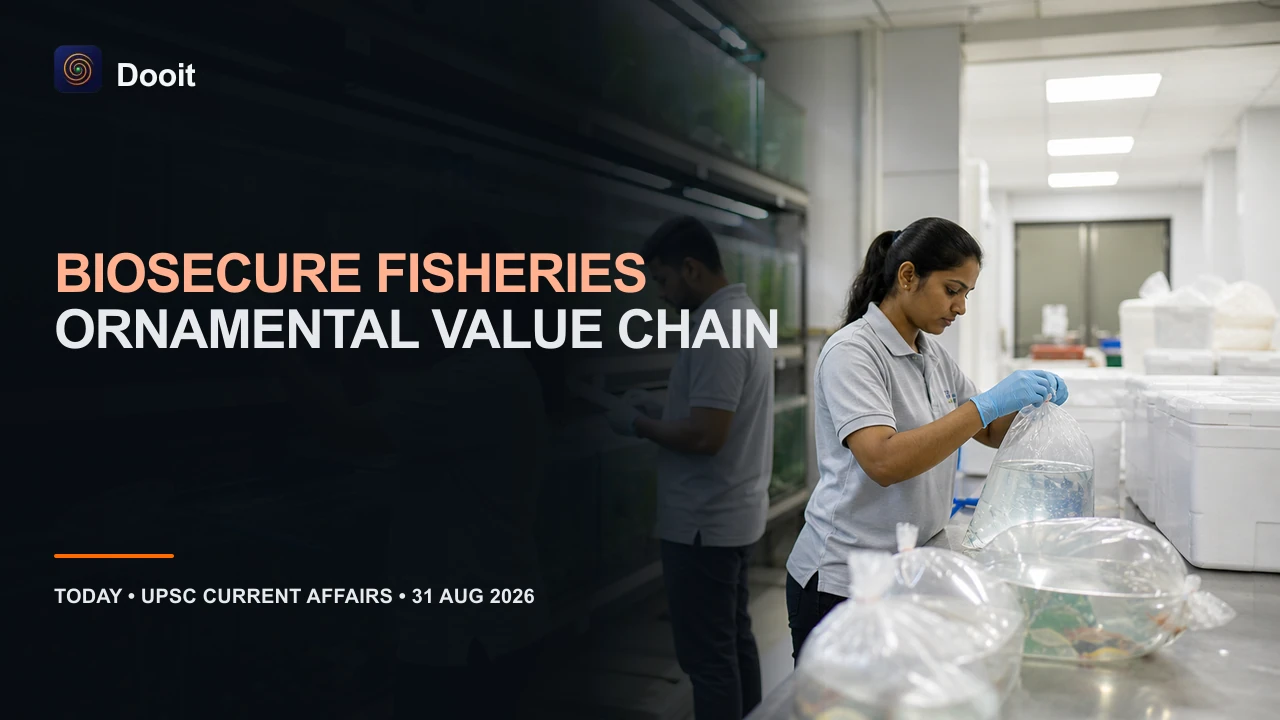
The Department of Fisheries announced that the Vice President would release the Mission Rangeen Machhli 2031 Strategic Action Plan at Agatti, Lakshadweep. The plan seeks a uniform framework for broodstock management, breeding, hatcheries, production, quarantine, health management, traceability, aquarium operations, handling, transport and trade. Certification, biosecurity and consistent quality are intended to turn a fragmented activity into an organised and competitive value chain. Lakshadweep has also been notified as a dedicated seaweed cluster. The official background notes India's coastline of about 11,099 km, an Exclusive Economic Zone of about 24 lakh sq km, marine-fisheries potential of 58.6 lakh MT and livelihoods for about 50 lakh fishers; seafood exports were around Rs 73,890 crore in FY 2025-26. The opportunity must be balanced with ecosystem limits. Live-animal trade can spread disease or encourage unsustainable collection unless quarantine, traceability, captive breeding and habitat protection are enforced.
Why UPSC cares
For GS Paper 3, link ornamental fisheries with the blue economy, island livelihoods, biosecurity, traceability, mariculture, export standards and ecosystem conservation. Evaluate growth through ecological safeguards and producer capability.
How to study this story
Ornamental fisheries are a high-value segment in which quality depends on animal health, appearance, survival and traceable handling. A uniform framework can lower uncertainty for breeders, traders and buyers by clarifying quarantine, transport, health and certification expectations. It can also help small producers join organised markets if training, testing and common facilities are accessible. The ecological risk is equally important. Collection from reefs or lagoons can damage habitats and deplete attractive species; movement of live organisms can spread pathogens or invasive species; and poor transport practices create high mortality. Captive breeding, species-specific harvest limits, veterinary surveillance and verifiable chain-of-custody systems should therefore precede aggressive export expansion. Lakshadweep's island economy offers livelihoods and marine resources, but logistics, freshwater limits, waste management and community consent constrain scale. A cluster approach can coordinate seaweed, fisheries, processing and market links, yet different activities need separate ecological carrying-capacity assessments. Certification is credible only if independent checks reach hatcheries and traders rather than ending at a document. Producer organisations can improve bargaining power and distribute the cost of compliance. Mission Rangeen Machhli 2031 should ultimately be measured through survival rates, disease control, captive-bred share, producer income and habitat condition. The blue economy is sustainable when value is increased without exhausting the natural capital that supports it.
The larger paper context
For GS Paper 3, follow the full value chain. Standards, data, finance and technology matter only when they improve resilience, ecological safety, market access and last-mile outcomes without creating opaque exclusion.
Probable question
A competitive ornamental-fisheries sector requires biosecurity and ecosystem safeguards as much as export promotion. Discuss with reference to Mission Rangeen Machhli 2031.
Quick practice check
Q1
Which safeguard is especially important in trade involving live ornamental fish?
- Biosecurity and quarantine
- Removal of traceability
- Open release of non-native species
- Unverified wild collection
Show answer
Correct answer: Biosecurity and quarantine
Live-animal movement can spread disease or invasive organisms, making quarantine and biosecurity essential.
Q2
Which outcome would best show that the mission is ecologically sustainable?
- More announcements
- Only higher shipment volume
- Improved producer income with healthy habitats and lower mortality
- Elimination of all certification
Show answer
Correct answer: Improved producer income with healthy habitats and lower mortality
Sustainable value growth must improve livelihoods while protecting animal welfare, disease control and ecosystems.
Related previous-year questions
- UPSC GS-3: Economics of animal-rearing and food processing and related industries in India