 Polity & Governance
GS Paper 2 · 31 August 2026
PM-SETU Gives Industry a Governing Role in Upgrading ITI Clusters
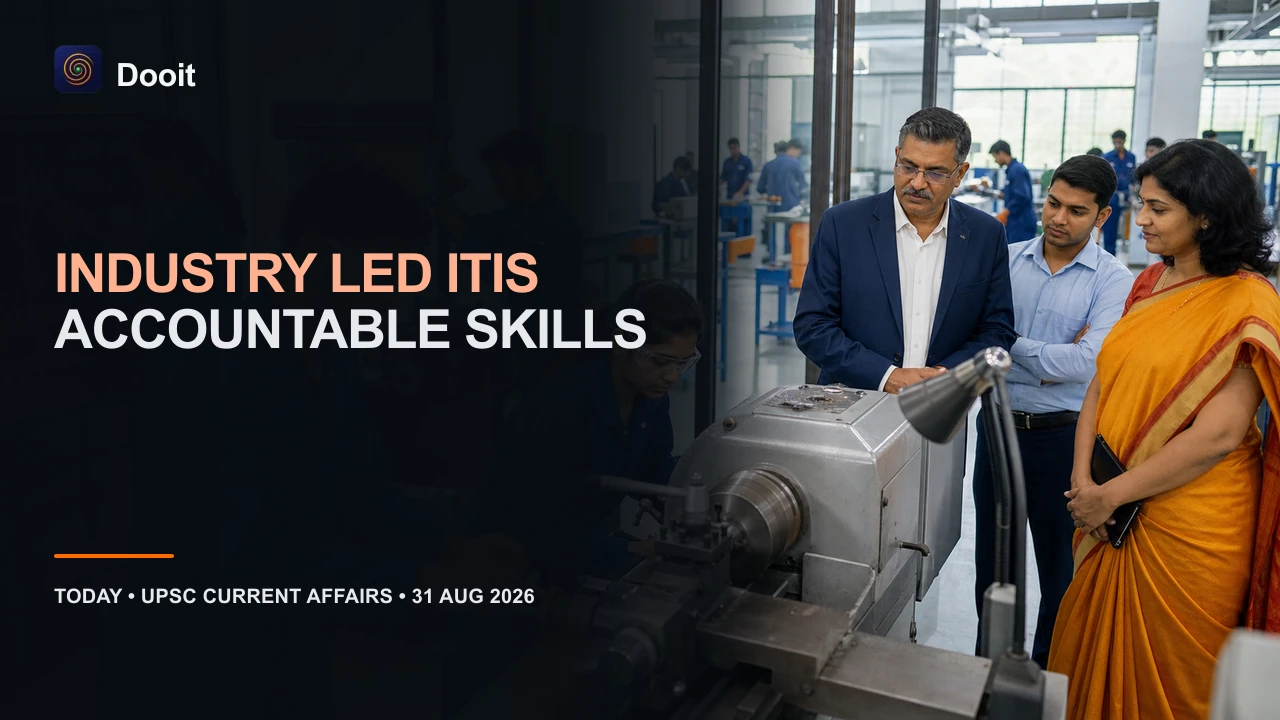
The Skill Development Ministry and Uttar Pradesh organised a PM-SETU industry conclave to deepen industry's role in vocational education. Under the scheme, a cluster can combine one hub ITI with four spoke ITIs and attract investment of up to Rs 241 crore. The stated funding pattern is 50 percent from the Union government, 33 percent from states and 17 percent from industry partners. A special-purpose vehicle gives the anchor industry partner 51 percent ownership, while the Union and state governments hold 24.5 percent each. Uttar Pradesh has identified 32 ITIs in 8 clusters, and approved proposals nationally represent more than Rs 1,500 crore of committed industry-led investment across 7 clusters in 5 states. The design aims to align curricula, equipment and training with real production needs. Its test is whether industry leadership improves placement, apprenticeships and future skills without weakening public access, broad occupational learning or accountability for public funds.
Why UPSC cares
For GS Papers 2 and 3, analyse skill development, demographic dividend, cooperative federalism, public-private governance, ITI reform, apprenticeships and employability. Assess incentives alongside equity, quality and outcome measurement.
How to study this story
ITI reform faces a persistent coordination failure: public institutes may teach with outdated equipment while firms complain that recruits lack current skills, and individual companies may hesitate to finance training whose workers can move elsewhere. Cluster funding and anchor-industry leadership try to align incentives by giving employers a direct role in equipment, curricula, trainers and operations. The hub-and-spoke design can share specialised facilities across nearby institutes instead of duplicating expensive assets. Industry control, however, should not narrow education to one employer's immediate vacancies. Learners need portable foundations, recognised qualifications and exposure to changing occupations, while local MSMEs need a voice alongside large anchor firms. Public ownership and funding create duties of transparency, equitable admissions, gender inclusion, safe workshops and value-for-money procurement. Placement numbers should be accompanied by retention, wages, apprenticeship quality and employer diversity so short contracts do not masquerade as success. Trainers require continuous industry exposure without losing pedagogic independence. States remain central because local labour markets differ and institutes need coordination with schools, transport and social support. The special-purpose vehicle should publish decisions, conflicts of interest and performance. PM-SETU can convert demographic scale into capability if it treats learners as adaptable citizens, not merely inputs for a current production line, and if public accountability follows every industry-led investment.
The larger paper context
For GS Paper 2, ask who coordinates delivery, how federal and private actors share authority, and which accountability mechanism protects reciprocity, inclusion and public purpose.
Probable question
Industry leadership can make vocational education relevant, but public accountability must protect inclusion and long-term capability. Examine the governance design of PM-SETU.
Quick practice check
Q1
What distinguishes the PM-SETU governance model described in the release?
- No industry participation
- Anchor-industry majority ownership in the cluster vehicle
- Only private funding
- Removal of state governments
Show answer
Correct answer: Anchor-industry majority ownership in the cluster vehicle
The anchor industry partner holds a majority position in the special-purpose vehicle, with Union and state participation.
Q2
Which indicator is more informative than placement count alone?
- Number of banners
- Length of the inauguration speech
- Age of the building
- Retention, wages and apprenticeship quality
Show answer
Correct answer: Retention, wages and apprenticeship quality
Durable employment and quality learning reveal whether training created transferable capability.
Related previous-year questions
- UPSC GS-2: Issues relating to development and management of social sector services relating to education and human resources