 Polity & Governance
GS Paper 2 · 1 September 2026
Bihar-Jharkhand Sone Agreement Shows How Water Federalism Can Move from Dispute to Delivery
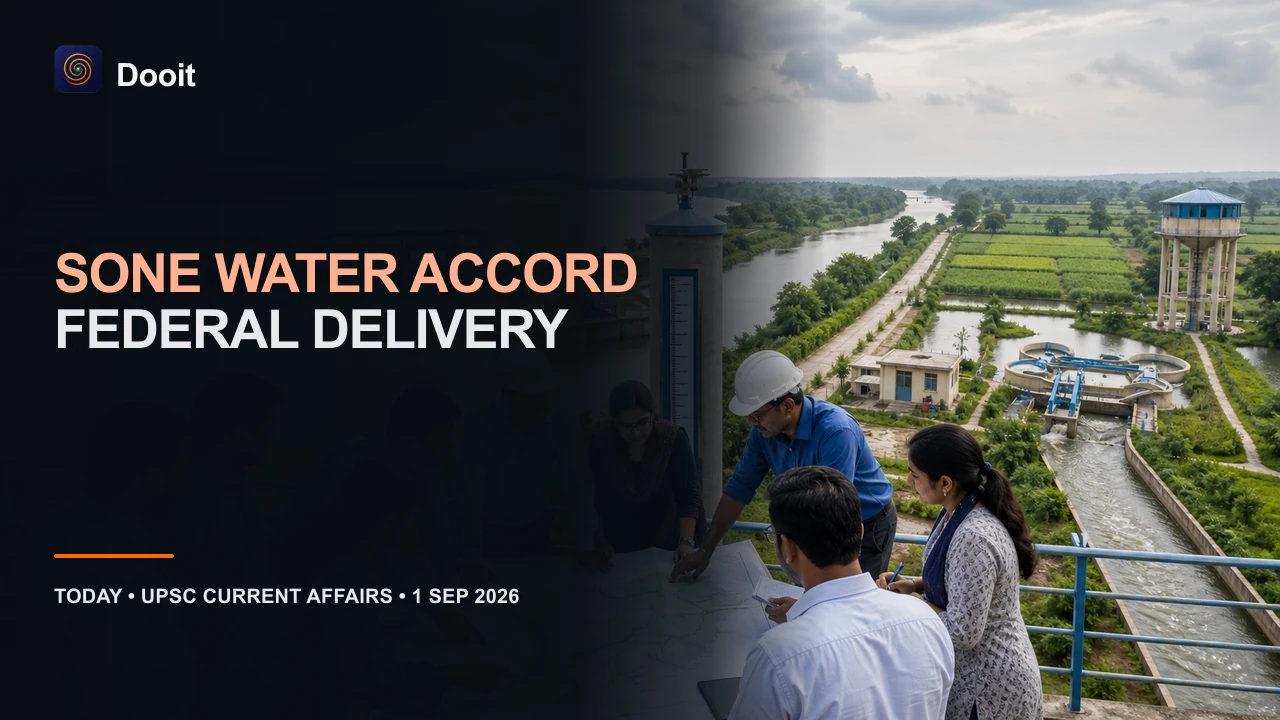
Bihar and Jharkhand signed an MoU on sharing Sone River water after what the official release described as a nearly 25-year dispute. The agreement is intended to support irrigation across rural areas and drinking-water access, and was presented as the fourth inter-state water agreement reached during 2026 through dialogue associated with the Inter-State Council process. The development matters beyond the two states because river governance sits at the intersection of federalism, hydrology, agriculture and public health. An MoU can resolve an allocation impasse, but durable cooperation requires operational rules for seasonal variability, reservoir releases, data exchange, drought and flood conditions, and grievance settlement. The constitutional framework provides adjudicatory routes for inter-state river disputes, yet negotiation can be faster when states share trusted data and retain political ownership of the settlement. Public confidence will depend on disclosure of allocation principles, ecological flows, monitoring institutions and beneficiary outcomes rather than a broad claim that the dispute has ended.
Why UPSC cares
For GS Paper 2, connect the MoU with cooperative federalism, Article 262, the Inter-State River Water Disputes Act, the Inter-State Council, negotiated settlement and accountable implementation.
How to study this story
Inter-state water disputes are rarely solved by dividing a fixed quantity once. River flows vary by season and climate; reservoirs serve irrigation, drinking water, power, flood moderation and ecosystems. A durable agreement therefore converts a political settlement into a repeatable operating system. Joint measurement stations and common hydrological methods should create one accepted data set. A technical committee can recommend releases, while a ministerial body resolves exceptional cases. The agreement should define drought-sharing and flood-coordination rules before a crisis, not improvise them under pressure. Farmers and drinking-water agencies need predictable schedules, but environmental flows and downstream needs cannot be treated as residual claims. Transparency also matters because opaque releases invite suspicion between states and among districts. Public dashboards can report storage, inflow, release and compliance without exposing sensitive infrastructure detail. The Inter-State Council can support dialogue, while constitutional and statutory remedies remain a backstop if negotiation fails. Cooperative federalism does not mean the absence of disagreement; it means institutions that make disagreement manageable and keep essential services running. Success should be judged by reliable water delivery, fewer emergency confrontations, equitable burden-sharing during scarcity and ecological condition. The Sone MoU is therefore a beginning. Its credibility will come from rules, data, review and accessible remedies.
The larger paper context
For GS Paper 2, test whether diplomacy and federal negotiation are supported by transparent institutions, shared evidence, legal principles and enforceable delivery arrangements.
Probable question
Negotiated river agreements can complement adjudication, but they require institutions for data, variability and compliance. Discuss in the context of the Bihar-Jharkhand Sone water-sharing MoU.
Quick practice check
Q1
Which constitutional provision enables Parliament to provide for adjudication of inter-state river water disputes?
- Article 262
- The Finance Commission provision
- The Election Commission provision
- The President’s Rule provision
Show answer
Correct answer: Article 262
Article 262 deals with adjudication of disputes relating to waters of inter-state rivers or river valleys.
Q2
Which feature most strengthens a negotiated river agreement?
- Keeping flow data secret from both states
- Joint measurement and pre-agreed drought and flood rules
- Treating ecological flows as irrelevant
- Changing allocations without review
Show answer
Correct answer: Joint measurement and pre-agreed drought and flood rules
Shared data and rules for variable conditions turn a political settlement into an operational arrangement.
Related previous-year questions
- UPSC GS-2: Issues and challenges pertaining to the federal structure; dispute-redressal mechanisms and institutions