 Internal Security
GS Paper 3 · 1 September 2026
INS Nipun Adds Indigenous Underwater Intervention and Submarine-Rescue Depth
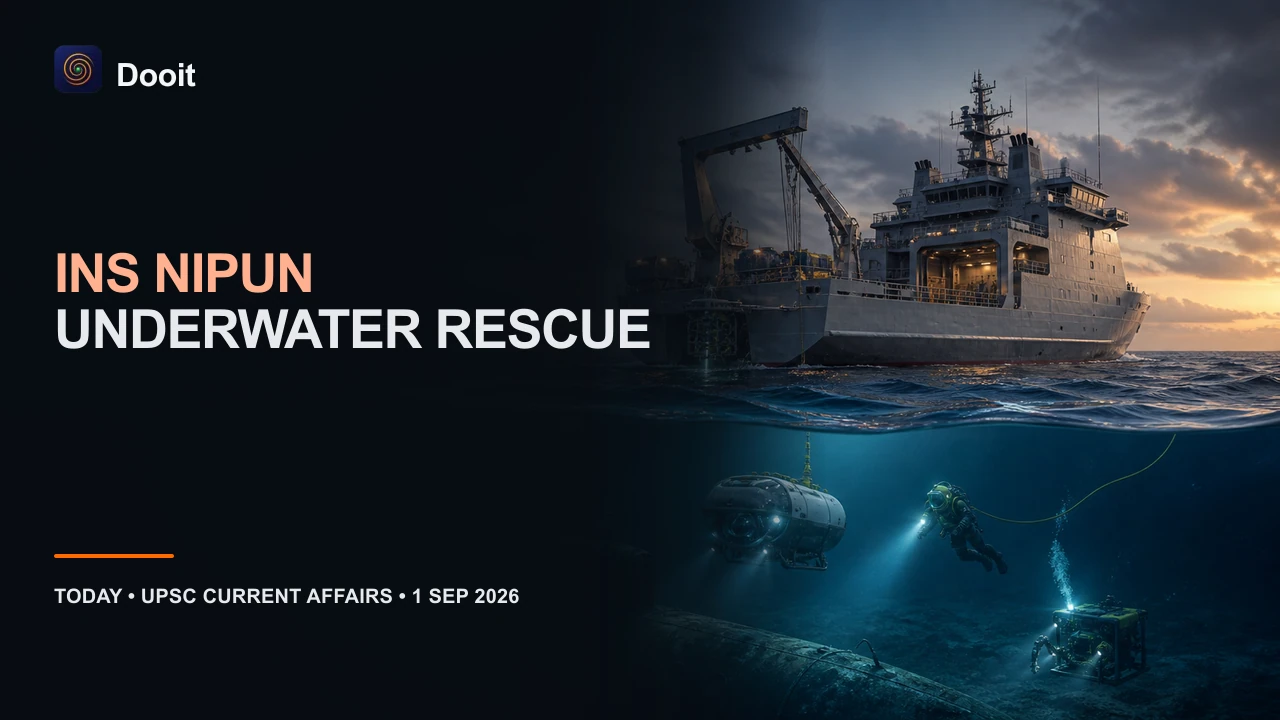
The Indian Navy commissioned INS Nipun, the second Diving Support Vessel of the Nistar class, at Mumbai on 31 August 2026. Designed and built by Hindustan Shipyard Limited, the vessel supports deep-sea diving, underwater inspection and intervention, salvage and submarine-rescue operations. Its capabilities include saturation, air and heliox diving, remotely operated underwater systems, dynamic positioning, a specialised diving complex, and associated life-support and medical facilities. A specialist vessel matters because underwater emergencies demand endurance, precision and a trained system rather than a single platform. Indigenous construction can improve maintenance, supply assurance and design learning, but real self-reliance also depends on domestic subsystems, certified equipment, skilled divers, medical teams and repeated exercises. The capability has both combat and peacetime value: it can assist a distressed submarine, inspect underwater infrastructure and support salvage. UPSC analysis should therefore see the commissioning as part of maritime preparedness, defence industrial capacity and safety governance, not merely a ceremonial addition to fleet numbers.
Why UPSC cares
For GS Paper 3, link INS Nipun with maritime security, submarine rescue, indigenous defence production, complex systems integration, maintenance sovereignty and dual-use underwater capability.
How to study this story
Submarine rescue is a low-frequency but catastrophic-risk mission. A force cannot improvise it after an accident because divers, decompression systems, remotely operated vehicles, medical support and command procedures must already work together. Dynamic positioning allows a support vessel to hold a precise location during underwater operations, while specialised diving systems enable longer and deeper work under controlled conditions. This illustrates systems integration: the value of the ship depends on reliable sensors, power, communication, trained crews and links with submarines and shore facilities. Indigenous design strengthens learning and reduces dependence, especially for maintenance and modification through a long service life. However, counting domestic construction alone may hide imported critical components or weak repair capacity. Procurement should track indigenous content at subsystem level, supplier resilience, certification, spares and lifecycle cost. Regular exercises with submarine crews and medical teams are necessary to convert equipment into readiness. Civil agencies can also benefit from underwater inspection, disaster response and salvage knowledge, subject to operational priorities. The correct strategic lesson is that resilience requires redundancy and practiced coordination. INS Nipun expands an important safety net, but its lasting contribution will be measured through availability, interoperability and the national industrial ecosystem able to sustain it.
The larger paper context
For GS Paper 3, distinguish a promising output or technology from durable capability by examining measurement, value chains, safety, skills, access and lifecycle governance.
Probable question
Defence indigenisation should be measured by sustained operational capability, not platform delivery alone. Examine with reference to INS Nipun and underwater support systems.
Quick practice check
Q1
INS Nipun is the second vessel of which class?
- Nistar class
- Kolkata class
- Shivalik class
- Arihant class
Show answer
Correct answer: Nistar class
INS Nipun is the second Diving Support Vessel of the Nistar class.
Q2
What does dynamic positioning chiefly enable during underwater operations?
- Automatic tariff calculation
- Precise station keeping without relying only on anchoring
- Conversion into an aircraft carrier
- Elimination of medical support
Show answer
Correct answer: Precise station keeping without relying only on anchoring
Dynamic positioning helps the vessel hold a precise location during complex diving and intervention work.
Related previous-year questions
- UPSC GS-3: Security challenges and their management; indigenisation of technology and developing new technology