 Science & Technology
GS Paper 3 · 1 September 2026
Quantum Biotechnology Moves the National Quantum Mission toward Health Applications
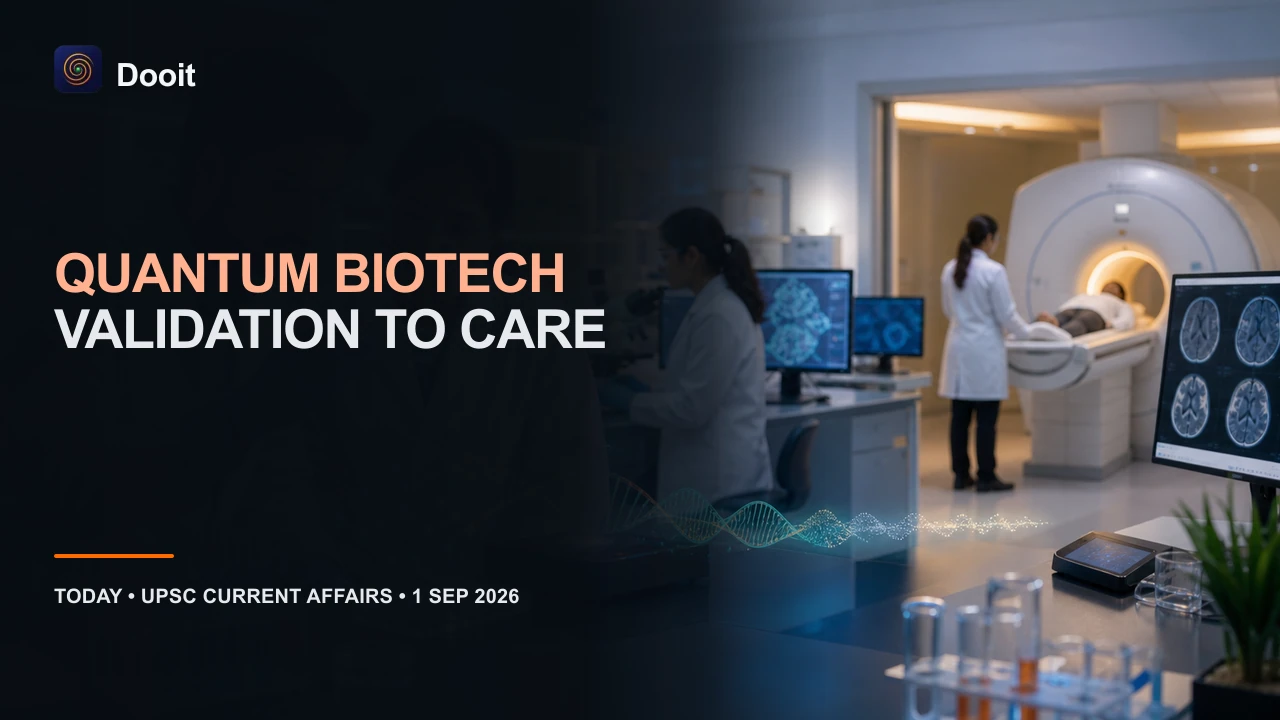
A national conference at IIT Bombay brought quantum scientists, life-science researchers, clinicians, industry, startups and students together to identify pathways for quantum-enabled diagnostics, biomedical imaging, drug discovery and precision medicine. The meeting was associated with QMet Tech Foundation, the Quantum Sensing and Metrology thematic hub supported under the National Quantum Mission. Quantum biotechnology combines high-sensitivity measurement, imaging and computing with biological questions that may be difficult for conventional instruments. The promise is substantial, but the distance between laboratory sensitivity and a safe clinical tool is also large. Health applications require reproducible evidence, comparison with existing standards, validation across populations, regulatory review, affordability and protection of sensitive biological data. A mission-oriented ecosystem can fund shared infrastructure and interdisciplinary teams, while industry helps engineering and scale. Public policy must prevent technological novelty from becoming a substitute for clinical benefit. The correct benchmark is not whether a device uses quantum effects, but whether it improves diagnosis or treatment reliably, ethically and at a cost the health system can sustain.
Why UPSC cares
For GS Paper 3, connect quantum biotechnology with the National Quantum Mission, translational research, diagnostics, precision medicine, regulation, research ethics, data governance and equitable access.
How to study this story
Quantum sensing may detect extremely small magnetic, optical or chemical signals, and quantum computation may eventually help some complex modelling tasks. These possibilities justify research, but a conference agenda is not proof of clinical effectiveness. Translational policy should define stages. Early research establishes physical feasibility and repeatability. Prototype development integrates the sensor with biological samples, software and user workflows. Clinical validation then compares performance with an accepted standard across representative patients and settings. Regulators assess safety, accuracy and intended use, while health-technology assessment asks whether the benefit justifies cost. Data governance is essential because precision medicine can combine genomic, imaging and clinical records. Consent, purpose limitation, cybersecurity and bias testing must be designed from the beginning. Publicly funded hubs can prevent every laboratory from duplicating expensive infrastructure and can create open measurement standards. Industry partnerships should include transparent intellectual-property and access terms so public investment does not lead only to inaccessible products. Training must bridge physics, biology, engineering, medicine and statistics. India gains strategic value when it owns core knowledge and can manufacture dependable systems, but social value arises only when the technology works in ordinary hospitals, not just controlled laboratories. Mission success should therefore be measured by validated tools, trained teams and affordable deployment rather than announcements or patent counts alone.
The larger paper context
For GS Paper 3, distinguish a promising output or technology from durable capability by examining measurement, value chains, safety, skills, access and lifecycle governance.
Probable question
Frontier science produces public value only when laboratory promise crosses the evidence, regulation and access gaps. Discuss in the context of quantum biotechnology.
Quick practice check
Q1
QMet Tech Foundation is associated with which National Quantum Mission thematic area?
- Quantum Sensing and Metrology
- Only quantum communication law
- Classical shipbuilding
- Agricultural price support
Show answer
Correct answer: Quantum Sensing and Metrology
QMet Tech Foundation is the thematic hub for Quantum Sensing and Metrology under the mission.
Q2
What best distinguishes clinical translation from a laboratory demonstration?
- A larger press release
- Validation against standards in representative patients and settings
- Avoiding regulatory review
- Using more technical vocabulary
Show answer
Correct answer: Validation against standards in representative patients and settings
Clinical translation requires reproducible validation, safety review and evidence of benefit in real use settings.
Related previous-year questions
- UPSC GS-3: Developments and applications of science and technology and their effects in everyday life; indigenisation and developing new technology