 International Relations
GS Paper 2 · 2 September 2026
BHASHINI Sangam Turns Shared India-Nepal Languages into a Test of Inclusive AI Diplomacy
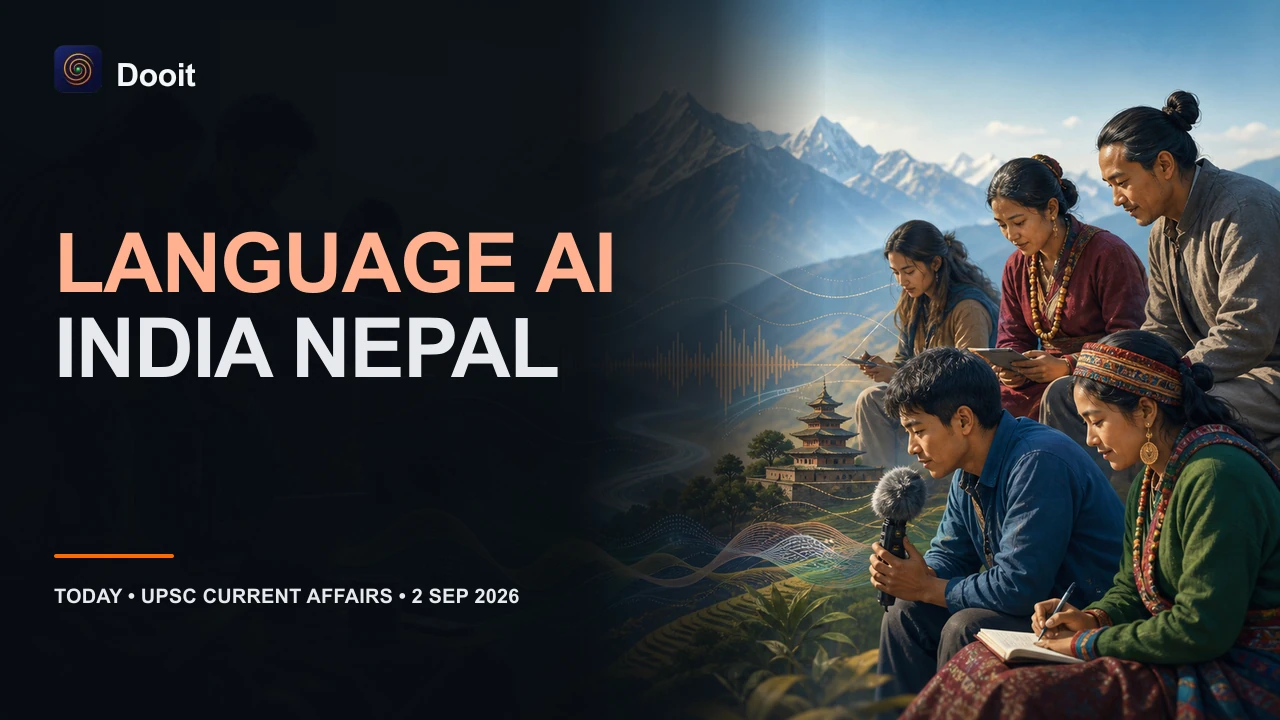
The Digital India BHASHINI Division, the Embassy of India in Kathmandu and Kathmandu University organised an international workshop on multilingual and voice-first artificial intelligence. The engagement builds on an existing memorandum between the division and the university for language technology and digital public infrastructure, with cooperation proposed around shared technology, datasets and locally relevant applications in Nepali, Newari, Maithili and other languages. Demonstrations covered speech recognition, real-time translation, voice interaction and document processing, while a BhashaDaan session highlighted community contributions across speech, text and image. The official platform profile says BHASHINI supports 36 Indian text languages, 23 Indian voice languages and 35 international languages, powers more than 800 government websites, has enabled more than 9 billion cumulative AI inferences and processes more than 24 million daily. Scale, however, is not the same as linguistic justice. Cross-border language AI needs representative data, informed community participation, bias testing, data stewardship, local research capacity and transparent evaluation so that culturally connected languages become digital bridges without losing local agency.
Why UPSC cares
For GS Paper 2, connect the workshop with India-Nepal relations, digital public infrastructure, technology diplomacy, regional cooperation and inclusive access; for GS Paper 3, examine AI datasets and language technology.
How to study this story
Language technology is infrastructure only when communities can use it reliably and influence how it represents them. Large languages usually have abundant digital text and speech, while smaller or oral languages may appear through narrow samples, formal registers or urban speakers. A model can then recognise a language label yet perform poorly for accents, code-switching, disability or public-service vocabulary. Co-creation should begin with community consent, documented collection purposes, fair contributor terms and local review of errors. Data stewardship must address whether recordings can be reused, combined or exported and how a contributor can seek correction or withdrawal. Open standards and interoperable interfaces can prevent a public platform from becoming a closed dependency, while transparent benchmarks should report performance across languages and tasks instead of one average score. India-Nepal cooperation adds diplomatic value because related languages, research institutions and public-service needs cross borders. It also requires clarity on data jurisdiction, cybersecurity and shared intellectual contribution. The strongest outcome is not a demonstration alone. It is durable local capability to build datasets, evaluate systems, maintain applications and deliver services in the language citizens actually choose.
The larger paper context
For GS Paper 2, identify the rights-bearing subject, the responsible institution and the cooperation mechanism; then test whether due process, representation, transparency and grievance redress convert policy intent into accountable public value.
Probable question
Multilingual digital public infrastructure can deepen neighbourhood diplomacy only when co-creation protects linguistic representation and local agency. Discuss.
Quick practice check
Q1
What makes a language dataset representative?
- Consent and coverage across speakers, accents and real tasks
- Only a large total file size
- A single formal register
- No local review
Show answer
Correct answer: Consent and coverage across speakers, accents and real tasks
Representation depends on who and what the data cover, not scale alone.
Q2
Why are open standards important for public language infrastructure?
- They eliminate the need for evaluation
- They support interoperability and reduce closed dependence
- They prevent community participation
- They guarantee perfect translation
Show answer
Correct answer: They support interoperability and reduce closed dependence
Interoperable standards allow multiple institutions and applications to work with the public platform.
Related previous-year questions
- UPSC GS-2: India and its neighbourhood relations; bilateral, regional and global groupings and agreements involving India