 Environment & Health
GS Paper 3 · 2 September 2026
India-Germany Wetlands Declaration Links Green Diplomacy with Restoration Institutions
At the 4th Indo-German Environment Forum in New Delhi, India and Germany signed a Joint Declaration of Intent on conservation and wise use of wetlands of international importance. The forum, described as the highest-level bilateral environmental-policy platform between the two countries and held since 2008, brought government, industry, experts and civil society together around climate resilience, biodiversity and resource efficiency. The declaration is intended to strengthen scientific understanding, exchange good practices, develop restoration approaches and enhance community participation. The wider forum also addressed low-carbon industry, wetland, mountain and forest biodiversity, circular economy, sustainable finance, green skills and investment mobilisation. Three bilateral working groups on climate change, biodiversity and circular economy had met during the year. The signed instrument matters because wetlands operate as ecological infrastructure: they support biodiversity, water regulation, flood moderation, livelihoods and climate resilience. Diplomatic intent becomes credible only when joint science informs site-level plans, local users share governance, restoration has measurable ecological baselines and institutions publish what changed rather than counting meetings or planted vegetation.
Why UPSC cares
For GS Paper 2, use the declaration as an example of India-Germany environmental diplomacy; for GS Paper 3, connect wetlands with biodiversity, climate adaptation, ecosystem services, restoration and community participation.
How to study this story
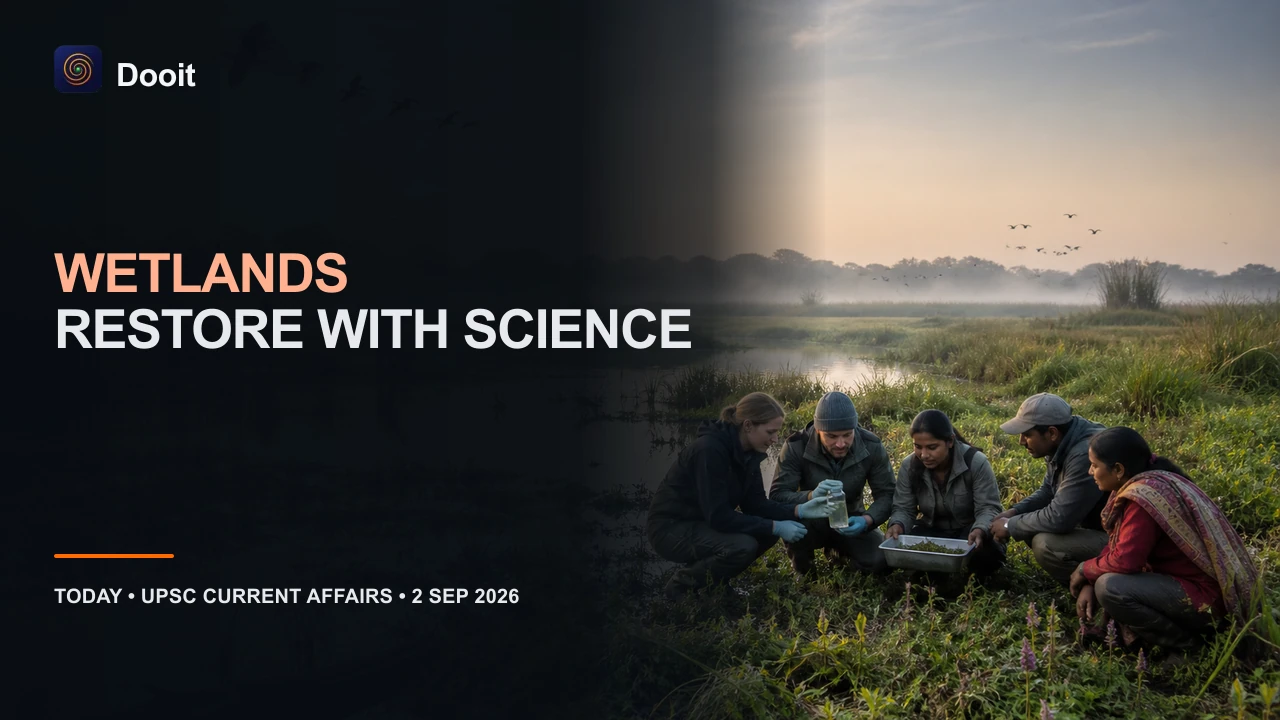
Wetland restoration fails when a living system is treated as an isolated patch of water. Hydrology connects a site to catchments, groundwater, floodplains and upstream land use. Pollution, encroachment or altered flow can therefore undo local planting or desilting. A sound programme begins with an ecological baseline covering water regime, native biodiversity, sediment, water quality, livelihoods and climate risks. It then identifies the pressure causing degradation and chooses interventions that restore function rather than manufacture a cosmetic landscape. Community participation is not a ceremonial consultation: fishers, farmers, pastoralists, local bodies and women users often hold operational knowledge and bear the cost of access rules. Their rights and incentives must enter the management plan. Bilateral cooperation can add comparative science, restoration techniques, finance design and professional training, but imported practice must be adapted to Indian hydrology and institutions. Monitoring should publish trends and acknowledge uncertainty over several seasons. Governance also needs coordination across environment, water, agriculture and urban agencies whose mandates overlap. Success appears as recovered ecological processes, reduced risk and sustainable livelihood compatibility, not simply expenditure or a one-time declaration.
The larger paper context
For GS Paper 3, separate an approval or digital output from operational capability by examining evidence quality, interoperability, lifecycle capacity, inclusion, ecological limits and measurable outcomes.
Probable question
Bilateral environmental declarations deliver value only when shared knowledge becomes site-level ecological accountability. Discuss with reference to wetland restoration.
Quick practice check
Q1
What should a wetland restoration baseline include?
- Only visitor numbers
- Only planted vegetation
- Hydrology, biodiversity, water quality, livelihoods and pressures
- A ceremonial declaration
Show answer
Correct answer: Hydrology, biodiversity, water quality, livelihoods and pressures
A baseline must describe ecological function and the human uses that restoration will affect.
Q2
Why must catchment conditions enter wetland management?
- Wetlands are sealed tanks
- Only international agencies manage runoff
- Catchments matter only for tourism
- Upstream flow, pollution and land use shape the wetland
Show answer
Correct answer: Upstream flow, pollution and land use shape the wetland
Hydrological and pollution pressures often originate beyond the visible wetland boundary.
Related previous-year questions
- UPSC GS-3: Conservation, environmental pollution and degradation, environmental impact assessment and climate-related challenges