 Economy & Energy
GS Paper 3 · 2 September 2026
Kavach 4.0 Approval for Moradabad Division Must Now Become Verified Operating Safety
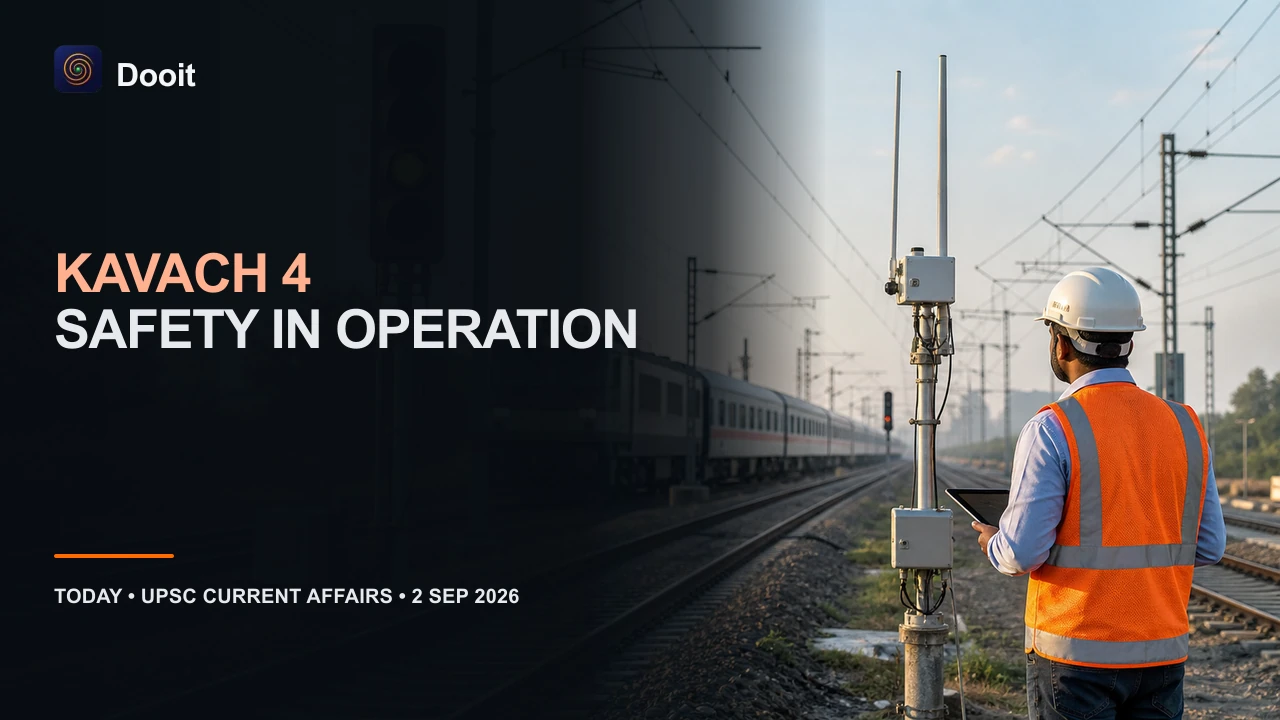
Indian Railways approved Kavach Version 4.0 for the remaining 712 route kilometres of Moradabad Division in Northern Railway at a cost of ₹170 crore. Kavach is an indigenously developed Automatic Train Protection system intended to prevent Signal Passing at Danger, supervise speed in critical conditions, apply brakes automatically when required and reduce collision risk. The sanction extends the division's planned train-protection layer and contributes to wider signalling modernisation. Yet an administrative approval and a route-kilometre target are not the same as commissioned safety coverage. Effective deployment requires compatible trackside and onboard equipment, reliable radio links, accurate mapping, controlled installation, independent testing, trained crews and maintainers, disciplined change management and clear rules for degraded operation. Safety also depends on conventional signalling, track integrity, human factors and incident learning; automatic protection is a defence layer, not a substitute for the entire system. UPSC analysis should therefore distinguish indigenous design capability, procurement progress, installation, certification and measurable operating performance before treating sanctioned expenditure as realised safety.
Why UPSC cares
For GS Paper 3, relate Kavach to infrastructure safety, indigenous technology, railway modernisation, systems engineering, public procurement, standardisation and institutional accident prevention.
How to study this story
Automatic train protection is a system of systems. Trackside equipment communicates movement authority and speed restrictions; onboard equipment interprets them; braking interfaces must respond correctly; communications, mapping, power and maintenance must remain dependable. A defect in configuration or an untested transition can weaken the whole safety case even when individual devices work. Deployment should therefore follow controlled site surveys, version management, laboratory and field tests, independent safety assessment and documented commissioning. Drivers and controllers need training for normal, warning and degraded modes so automation does not create confusion or overreliance. Maintenance teams require diagnostics, spares and configuration records throughout the asset life. Interoperability matters because locomotives and routes may carry equipment from different phases or suppliers. Safety indicators should examine availability, interventions, failures and near misses without creating pressure to suppress reports. Kavach can reduce defined risks, but track defects, trespass, rolling-stock condition and organisational fatigue require other controls. Indigenous capability is strategically valuable when design knowledge, standards, manufacturing, testing and support remain resilient. The correct policy sequence is sanction, installation, verification, operation, learning and continuous assurance—not a leap from budget approval to presumed accident prevention.
The larger paper context
For GS Paper 3, separate an approval or digital output from operational capability by examining evidence quality, interoperability, lifecycle capacity, inclusion, ecological limits and measurable outcomes.
Probable question
Railway safety technology creates capability only after procurement is converted into tested, interoperable and maintained operation. Discuss with reference to Kavach.
Quick practice check
Q1
What distinguishes sanctioned Kavach work from operating safety coverage?
- Installation, testing, commissioning and maintained performance
- A budget announcement alone
- A route map without equipment
- Removal of crew training
Show answer
Correct answer: Installation, testing, commissioning and maintained performance
Safety capability appears only after the integrated system is verified and sustained in operation.
Q2
Why is Kavach described as a defence layer rather than the entire safety system?
- It controls every railway risk
- Track, rolling stock, human factors and operations still require controls
- It replaces signalling
- It makes incident learning unnecessary
Show answer
Correct answer: Track, rolling stock, human factors and operations still require controls
Automatic train protection addresses defined hazards within a broader railway safety architecture.
Related previous-year questions
- UPSC GS-3: Infrastructure, including transport; indigenisation of technology and development of new technology