 Art & Culture
GS Paper 1 · 3 September 2026
Elephanta Study Connects Maritime Archaeology, Sea-Level History and Coastal Heritage Planning
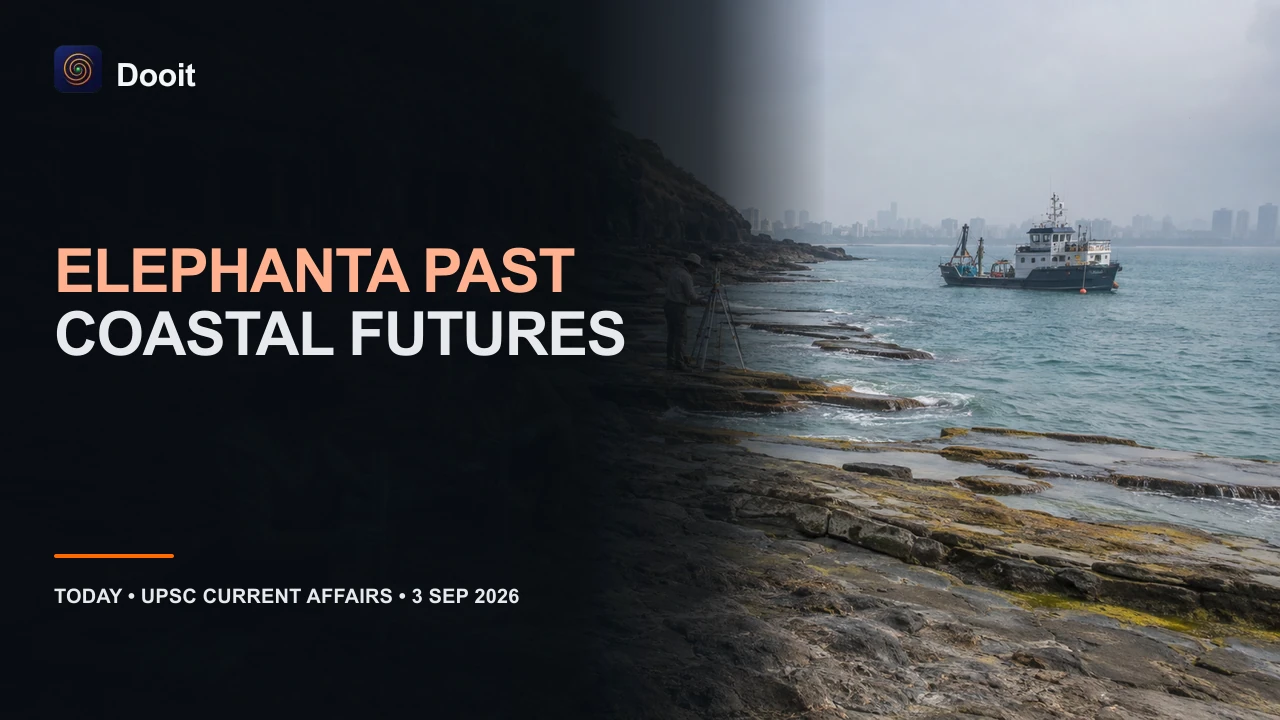
IIT Kharagpur, Mumbai Port Authority and the Archaeological Survey of India launched an interdisciplinary study of how past climate and sea-level change may have shaped maritime activity around Elephanta Island and India's western coast. The project combines earth-science techniques with archaeological evidence from the early historic to medieval period, with ₹1 crore pledged by Mumbai Port Authority. The official release described an excavated rectangular reservoir of 165 square metres and 8 metres depth, along with storage jars, Mediterranean amphora fragments, West Asian ceramic material, anchoring stones, submerged wharf features and intertidal habitation debris. These findings support a research hypothesis that the island participated in wider maritime circuits rather than serving only as an isolated ritual site. The project must now test that hypothesis through dated, contextual and reproducible evidence. Its contemporary value is equally important: reconstructing past shorelines can improve interpretation of coastal heritage and planning for future sea-level risk.
Why UPSC cares
For GS Paper 1, the story demonstrates how archaeology reconstructs trade, settlement and cultural exchange from material evidence. For GS Paper 3, it links climate science, coastal vulnerability and heritage conservation. A high-quality answer should distinguish artefact discovery from proof of a specific trade route, and correlation from causation. It should favour multidisciplinary methods, careful dating, open documentation and conservation-sensitive fieldwork. Heritage planning must also account for drainage, erosion, visitor pressure and local livelihoods rather than treating the monument as detached from its island ecology.
How to study this story
The project is valuable because it asks a testable question across disciplines. Archaeological objects can indicate contact, storage or consumption, but their presence alone does not reveal the size of vessels, the route of exchange or the political organisation of a port. Earth-science evidence on former shorelines, sediment and water depth can help determine whether large-scale anchoring or trans-shipment was physically plausible. Stratigraphy and dating must then connect objects and structures to the same period before a historical narrative is accepted. This method protects scholarship from turning an attractive hypothesis into certainty. The excavated water-storage structure adds another dimension: island settlement depends not only on maritime access but also on freshwater management and seasonal resilience. For contemporary policy, coastal heritage cannot be conserved as a stone monument alone. Managers need an island-scale plan covering erosion, drainage, mangroves, visitor movement, emergency access and livelihoods. Climate reconstruction is not a direct forecast, but it can reveal how sensitive a low-gradient coast is to changing sea levels and storms. For UPSC, use the case to demonstrate the unity of culture and environment. Material culture explains human networks; geomorphology tests the physical setting; conservation administration translates both into risk-aware public management. Evidence should remain documented, contestable and open to revision.
The larger paper context
Use archaeology as a method of reasoned reconstruction. Separate discovery from inference, test chronology and context, and connect cultural exchange with the physical geography that enabled it. Coastal heritage answers improve when they combine material evidence, environmental change, water management and living communities instead of treating a monument as an isolated object.
Probable question
Interdisciplinary archaeology can revise maritime history while also informing climate-resilient heritage management. Discuss with reference to coastal sites.
Quick practice check
Q1
Why should imported artefacts at a coastal site not be treated as final proof of a particular trade route?
- Artefacts have no historical value
- All imported objects arrive by land
- Context, dating and physical shoreline evidence are still needed
- Only written texts can support archaeology
Show answer
Correct answer: Context, dating and physical shoreline evidence are still needed
Objects indicate contact, but route, chronology and maritime feasibility require contextual archaeological and earth-science evidence.
Q2
What is the best unit for climate-resilient conservation of an island heritage site?
- Only the carved monument
- Only the tourist jetty
- Only the museum collection
- The wider island system including water, erosion, ecology, access and livelihoods
Show answer
Correct answer: The wider island system including water, erosion, ecology, access and livelihoods
Coastal heritage depends on the ecological and social systems around the monument, so management must work at island scale.
Related practice questions
- Explain how material remains help reconstruct patterns of ancient maritime exchange.
- Discuss the special conservation challenges faced by coastal cultural heritage.