 International Relations
GS Paper 2 · 3 September 2026
India-Afghanistan Trade Dialogue Rebuilds Economic Connectivity through Working-Level Institutions
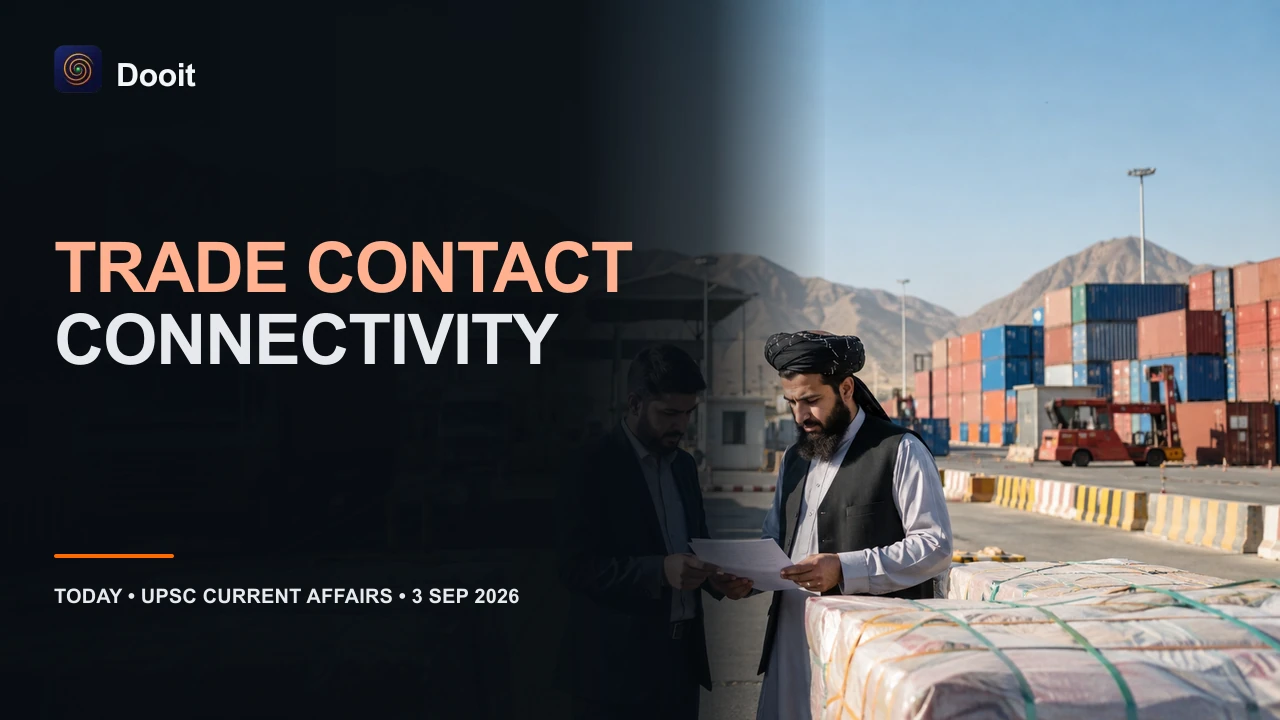
Officials from India and Afghanistan met through the Joint Working Group on Trade, Commerce and Investment and reviewed practical barriers to bilateral commercial engagement. The agenda covered customs cooperation, visa facilitation for Afghan traders, banking and financial channels, pharmaceutical and agricultural trade, energy cooperation, investment promotion, tariff concessions, cargo connectivity and port-related issues. The two sides agreed to strengthen institutional cooperation and pursue follow-up work on customs and data sharing, regulatory cooperation, connectivity and business engagement. The significance lies in the format: a working group converts a broad diplomatic relationship into solvable administrative tasks. For landlocked Afghanistan, reliable cargo routes, predictable border procedures and functioning payment channels shape whether market access exists in practice. For India, commercial engagement can support regional connectivity and people-centred ties, but it must operate within applicable financial, security and humanitarian safeguards.
Why UPSC cares
For GS Paper 2, this is a useful example of neighbourhood policy, economic diplomacy and institutionalised engagement. Trade cannot be sustained by goodwill alone; customs interoperability, standards recognition, banking compliance, visas and logistics determine transaction costs. A balanced answer should recognise the humanitarian and developmental value of commerce while avoiding claims beyond the official working-level dialogue. It should also separate engagement with Afghan institutions and traders from any unverified political inference, and explain why ports, multimodal links and transparent payment rules matter for a landlocked partner.
How to study this story
Economic diplomacy becomes durable when it is translated into routines. A joint working group can assign officials, compare procedures, identify bottlenecks and carry unresolved issues into the next meeting. That is especially important in a corridor where geography and political uncertainty make each shipment dependent on several institutions. Customs data exchange can reduce repeated documentation, but it needs agreed fields, secure handling and a method to correct errors. Regulatory cooperation in medicines and agriculture can widen legitimate trade only if safety and quality checks remain credible. Visa facilitation affects whether traders can negotiate, inspect goods and resolve disputes. Banking channels are equally central because a nominal trade route has little value when lawful payments cannot be completed or reconciled. Connectivity should therefore be understood as a system composed of transport, rules, finance and trust. India's policy interest includes neighbourhood stability, access for essential goods and diversified regional links, yet a UPSC answer should remain disciplined: the release records agreed commercial follow-up, not a settlement of broader political questions. Evaluate the mechanism by its implementation outputs, such as predictable procedures, functioning grievance channels and lower uncertainty for legitimate traders. This approach makes diplomacy measurable without reducing it to trade volume alone.
The larger paper context
Read governance through institutions, rights and procedures. Regulatory transitions need beneficiary protection; digital platforms need proportionate due diligence; neighbourhood diplomacy needs working-level continuity. In each case, identify the accountable body, the information it requires, the safeguard against arbitrary action and the measurable public outcome that converts a policy announcement into legitimate administration.
Probable question
Working-level economic institutions can preserve regional cooperation even when the wider political environment is difficult. Discuss with reference to India-Afghanistan trade connectivity.
Quick practice check
Q1
Which combination best represents effective trade connectivity for a landlocked partner?
- Transport links alone
- A single tariff concession
- Occasional political statements
- Transport, customs rules, lawful payments and predictable standards
Show answer
Correct answer: Transport, customs rules, lawful payments and predictable standards
Practical market access depends on the joint functioning of logistics, border procedures, finance and regulatory trust.
Q2
What is the main institutional value of a joint working group?
- It removes every political disagreement
- It turns broad cooperation into assigned follow-up and reviewable administrative tasks
- It replaces domestic regulators
- It guarantees private investment
Show answer
Correct answer: It turns broad cooperation into assigned follow-up and reviewable administrative tasks
Working groups create continuity by assigning issues, comparing procedures and reviewing follow-up across meetings.
Related practice questions
- Explain the role of connectivity and trade facilitation in India's neighbourhood policy.
- How do banking, standards and customs cooperation shape the practical value of market access?