 Environment & Health
GS Paper 3 · 3 September 2026
Tiger-Landscape Partnership Moves Conservation from Species Counts to Natural-Capital Governance
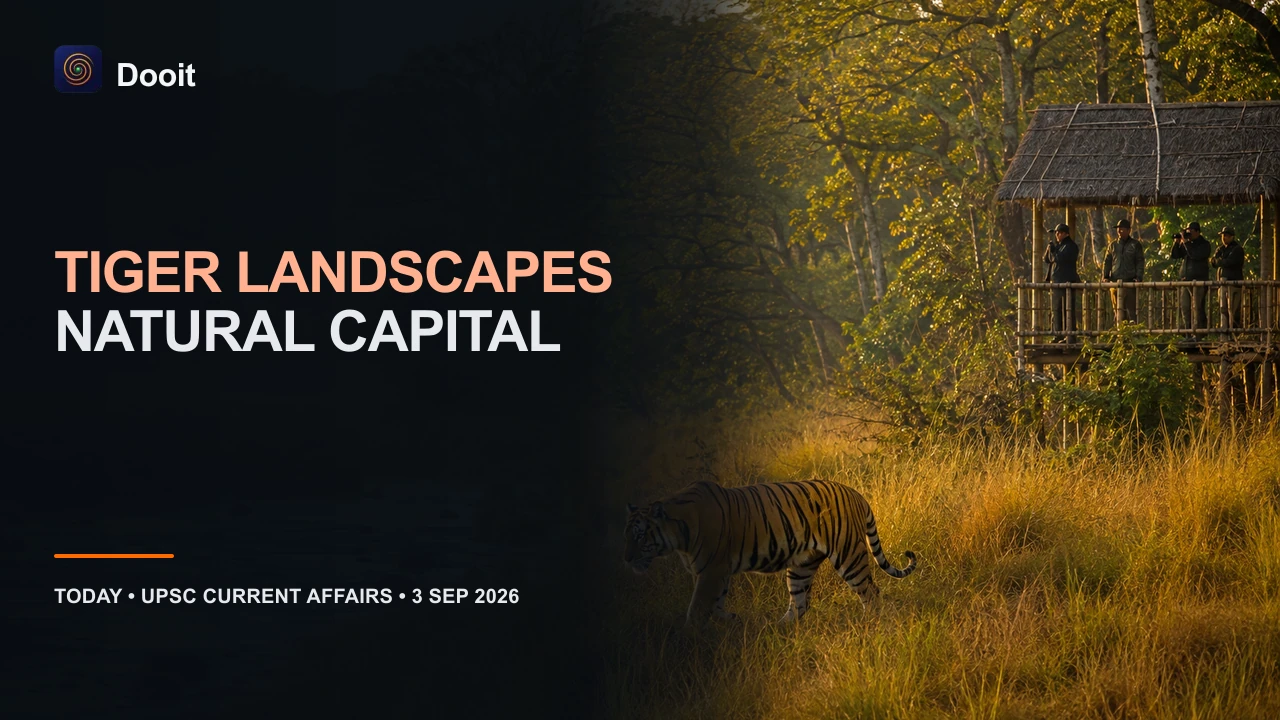
The International Big Cat Alliance, Asian Development Bank and National Tiger Conservation Authority convened a workshop on tiger landscapes, conservation, bioeconomy and ecotourism, and IBCA and ADB signed a memorandum on landscape conservation, sustainable development, capacity building, knowledge exchange and nature-positive finance. The official release framed tiger habitats as natural capital that supplies water security, carbon sequestration, climate regulation, biodiversity and livelihoods. It argued for integrated landscape management rather than a narrow species-only approach, with attention to nature-based solutions, community knowledge and community-based ecotourism. Representatives from several tiger-range countries and Indian forest institutions participated. The important shift is from protecting an animal in isolation to governing a connected social-ecological system: forests, grasslands, rivers, prey, corridors and nearby settlements. Finance and tourism can support this system only if ecological limits and community rights govern project design.
Why UPSC cares
For GS Paper 3, the story connects biodiversity conservation, ecosystem services, climate resilience and sustainable livelihoods. It also enables a critical discussion of natural-capital finance: valuation can make ecological benefits visible, but a monetary label cannot substitute for habitat integrity or rights. Good implementation needs landscape-scale indicators, wildlife-corridor continuity, transparent benefit sharing, local participation and safeguards against tourism pressure. A strong answer should treat communities as knowledge holders and governance partners rather than as obstacles or decorative beneficiaries.
How to study this story
A tiger is an apex indicator, but the policy unit must be the landscape. A protected-area boundary cannot by itself secure seasonal water flows, prey movement, genetic exchange or the livelihoods that shape land use outside the reserve. Landscape governance therefore requires coordination among forest departments, local governments, infrastructure agencies, financiers and communities across administrative borders. The natural-capital frame can help because it makes services such as water regulation and carbon storage visible to budget and investment decisions. Its weakness is reductionism: what cannot be priced easily may be treated as dispensable, and aggregate benefits can conceal who bears displacement, crop loss or tourism pressure. Nature-positive finance should therefore be conditional on measurable ecological additionality, public disclosure and independent monitoring. Community-based ecotourism is useful only when local institutions influence visitor limits, revenue sharing and grievance handling. Traditional knowledge should enter policy with consent and attribution, not be extracted as free data. For UPSC, connect conservation effectiveness with distributive justice. A corridor protected on paper but fragmented by infrastructure is not functional; similarly, income labelled green is not sustainable if it shifts risk onto residents. The strongest institutional design combines habitat science, landscape-level planning, accountable finance and locally legitimate benefit sharing.
The larger paper context
Analyse economy and environment as systems of resilience. Fiscal quality, financial buffers and productive capacity interact, just as habitats, corridors, finance and livelihoods interact in conservation. Avoid single indicators. Test whether incentives reward durable outcomes, whether risks are shifted onto weaker groups and whether monitoring can detect failure early enough for correction.
Probable question
Landscape conservation is an institutional challenge of ecology, finance and community rights, not merely a species-protection programme. Analyse.
Quick practice check
Q1
Why is a landscape approach stronger than species-only conservation for tigers?
- It removes the need for protected areas
- It treats tourism revenue as the only outcome
- It connects habitat, corridors, water, prey and neighbouring livelihoods
- It transfers all decisions to financiers
Show answer
Correct answer: It connects habitat, corridors, water, prey and neighbouring livelihoods
Tiger survival depends on connected ecological processes and human land-use decisions extending beyond a single reserve boundary.
Q2
Which condition best makes nature-positive finance accountable?
- A green label issued by the investor
- A higher visitor count
- A single monetary value for all biodiversity
- Measurable ecological gains, public disclosure and independent monitoring
Show answer
Correct answer: Measurable ecological gains, public disclosure and independent monitoring
Finance should demonstrate additional ecological benefit and remain open to public and independent scrutiny.
Related practice questions
- Discuss how ecological corridors and local livelihoods can be integrated in wildlife conservation.
- Examine the opportunities and risks of assigning economic value to ecosystem services.