 Environment & Health
GS Paper 2 · 15 September 2026
Ayurveda's Global Ambition Now Depends on Evidence, Quality and Regulatory Trust
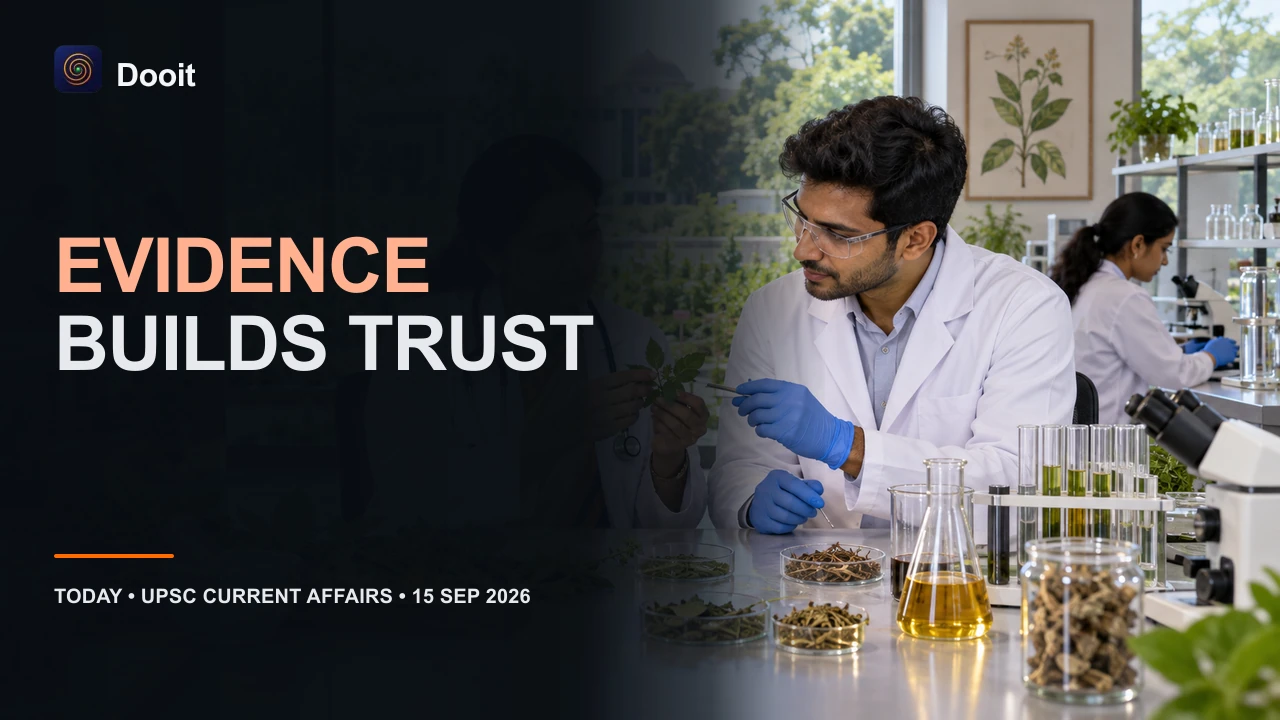
Ahead of the 11th Ayurveda Day, the Ayush Ministry framed Ayurveda's international expansion around research, standards and responsible integration. It reported that the Ayush market rose from USD 2.85 billion in 2014 to USD 43.4 billion in 2023, while exports increased from USD 1.09 billion to USD 2.16 billion. An NSS survey covering 181,298 households found high awareness and substantial reported use, but awareness and market size do not establish clinical effectiveness. NITI Aayog's July 2026 strategic roadmap looks to 2047 and covers regulation, research, education, exports, international collaboration and medical-value travel. The WHO Traditional Medicine Strategy 2025-34 similarly stresses evidence, safety and regulation. ICD-11 classification can improve comparable documentation, while WHO explicitly notes that classification is not endorsement of the efficacy of an individual practice. Responsible globalisation therefore requires validated indications, pharmacovigilance, product quality, trained professionals, biodiversity safeguards, ethical trials and clear communication that separates cultural legitimacy, consumer demand and market growth from evidence of safety and benefit.
Why UPSC cares
For GS Paper 2, connect traditional medicine with public health regulation and international health institutions; for GS Paper 3, examine research, quality standards, intellectual property and biodiversity.
How to study this story
Traditional medicine policy should avoid two symmetrical errors: rejecting a knowledge system because it is old, or accepting a claim because it is traditional or popular. Research questions should be appropriate to the intervention, while methods remain transparent, ethical and capable of detecting benefit and harm. Product quality needs authenticated ingredients, contamination testing, dose consistency and traceability. Pharmacovigilance matters because natural products can cause adverse effects or interact with other treatment. Professional education, scope of practice and referral protocols protect patients when systems interact. ICD classification can improve documentation and research comparability; it does not certify efficacy. Global expansion also raises questions of biodiversity, cultivation, benefit sharing, intellectual property and protection against misappropriating community knowledge. Medical-value travel needs accreditation, truthful advertising, continuity of care and grievance redress. Market growth is an economic indicator, not a health outcome. For UPSC, propose pluralism under common public safeguards: preserve knowledge, fund rigorous research, regulate products and claims, publish negative as well as positive findings, and let informed patients choose within a system that remains accountable for safety and evidence.
The larger paper context
Read the GS Paper 2 stories through cooperative capacity. Identify the neighbouring or international institution, the public-health or infrastructure need, the rules that protect trust, and the evidence that separates an announced channel from durable cooperation.
Probable question
The globalisation of traditional medicine requires cultural respect without relaxing evidence, safety and regulatory standards. Discuss with reference to Ayurveda.
Quick practice check
Q1
What does inclusion in an international disease classification establish?
- Automatic proof of efficacy
- Comparable documentation, not endorsement of every treatment
- A ban on clinical research
- Market growth
Show answer
Correct answer: Comparable documentation, not endorsement of every treatment
Classification supports recording and comparison; WHO distinguishes it from efficacy endorsement.
Q2
Which safeguard is central to responsible Ayurveda globalisation?
- Truthful evidence, quality control and pharmacovigilance
- Treating popularity as clinical proof
- Removing adverse-event reporting
- Unverified ingredient substitution
Show answer
Correct answer: Truthful evidence, quality control and pharmacovigilance
Responsible expansion requires evidence, consistent quality and monitoring for harm.
Related practice questions
- UPSC GS-2: issues relating to health and government policies
- UPSC GS-3: science and technology, biodiversity and intellectual property rights