 Science & Technology
GS Paper 3 · 15 September 2026
Next-Gen 1033 Helpline Makes Highway Safety a Dispatch and Accountability Problem
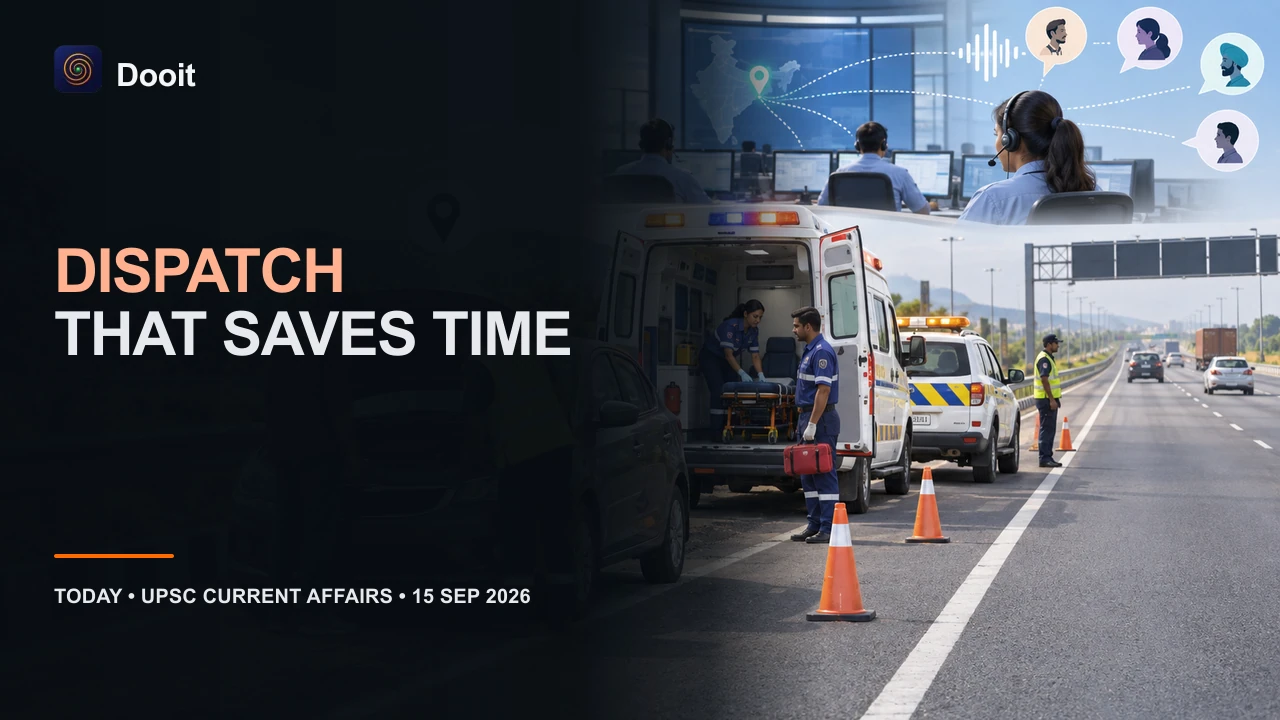
NHAI plans to upgrade the 1033 National Highway helpline with artificial intelligence, real-time location capture and smarter emergency dispatch while retaining human operators for judgment-intensive situations. Introduced in 2018, the round-the-clock service assists with medical emergencies, breakdowns, ambulances, cranes, patrol vehicles, toll-plaza and FASTag issues. It covers more than 1.46 lakh km of National Highways and receives about 15,000 calls daily. The proposed platform aims to locate callers faster, understand multiple Indian languages, identify a suitable response vehicle, issue proactive alerts and coordinate helpline, emergency and highway-operations teams. IHMCL has invited expressions of interest covering design, deployment, operation and maintenance. Technology can reduce search and hand-off delays, but only if location consent, data minimisation, audit trails, service availability and fallback channels are built into procurement. Success should be measured by verified response time, dispatch accuracy, incident resolution and equitable multilingual access, not by the number of AI features installed.
Why UPSC cares
For GS Paper 3, this covers road safety, transport infrastructure, emergency response and applied AI; for GS Paper 2, it illustrates citizen-centric service delivery, privacy and accountable procurement.
How to study this story
An emergency helpline is a chain, and its weakest hand-off determines the outcome. AI-assisted speech recognition may reduce language barriers; location capture may shorten search; computer-aided dispatch may identify a nearby ambulance or crane. Yet each tool can fail through accent bias, poor connectivity, stale vehicle data or inaccurate coordinates. Human operators therefore need authority, training and a clear override path. Location and voice data should be collected for a defined emergency purpose, retained only as needed and protected from unrelated use. Procurement must specify interoperability with concessionaires, police, hospitals and highway patrols, along with uptime, cybersecurity and disaster recovery. Performance dashboards should report answer time, dispatch time, arrival time, resolution, dropped calls, language accuracy and geographic gaps without exposing personal data. Independent audits and complaint review can identify false closures or systematic exclusion. For UPSC, frame the platform as digital public infrastructure for safety: technology is an enabling layer, while accountable institutions, trained responders, privacy-by-design and verified service outcomes create public value.
The larger paper context
Read the GS Paper 3 stories as measurement and systems problems. Trace inputs, operating capability, ecological or safety risk, distributional effects and outcome indicators. A number or technology matters only when its method, safeguards and last-mile performance are visible.
Probable question
Digital emergency services should be evaluated by response outcomes and rights safeguards, not by technological novelty. Discuss with reference to highway safety.
Quick practice check
Q1
Which metric best tests the upgraded 1033 helpline?
- Number of AI labels
- Verified dispatch and arrival time with resolution
- Volume of stored personal data
- Removal of human operators
Show answer
Correct answer: Verified dispatch and arrival time with resolution
Emergency-service value lies in timely, accurate and completed assistance.
Q2
Why should human operators remain in AI-assisted dispatch?
- AI cannot store any data
- Emergency judgment and exception handling remain necessary
- Location never helps responders
- Multilingual service is prohibited
Show answer
Correct answer: Emergency judgment and exception handling remain necessary
Human judgment is essential when automated interpretation is uncertain or stakes are high.
Related practice questions
- UPSC GS-3: infrastructure and road safety
- UPSC GS-2: e-governance, transparency and accountability