 Art & Culture
GS Paper 1 · 26 October 2026
Bhai Parmanand at 150 Illuminates the Transnational and Educational Strands of Indian Nationalism
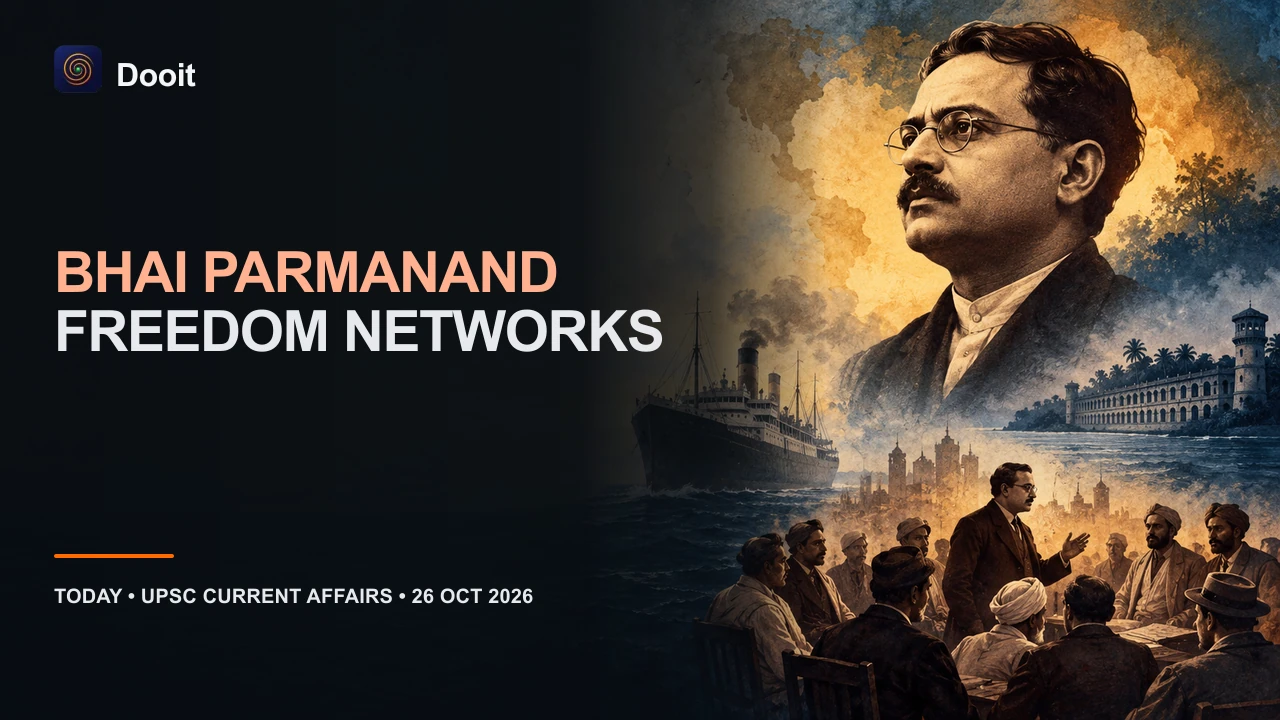
In the 139th episode of Mann Ki Baat on 25 October 2026, the Prime Minister recalled Bhai Parmanand ahead of his 150th birth anniversary on 4 November. The official English rendering described his association with the Arya Samaj, work among the Girmitiya community in Guyana, travel to South Africa, role in encouraging Lala Har Dayal to go to America, participation as a founding member of the Ghadar Party, transportation to the Cellular Jail and later work in education, including teaching Bhagat Singh. It also noted his later association with the Hindu Mahasabha. The speech is a commemorative account rather than a comprehensive scholarly biography. For UPSC, the episode is useful because it connects reform movements, diaspora networks, revolutionary nationalism, colonial repression and education. A careful answer should place Parmanand within these overlapping currents, consult historical evidence for contested interpretation and avoid flattening a complex political life into either celebration or dismissal.
Why UPSC cares
For GS Paper 1, connect Bhai Parmanand with Arya Samaj, the Ghadar movement, indentured diaspora, revolutionary nationalism, the Cellular Jail and nationalist education. Use commemoration as an entry point, not as a substitute for historical method.
How to study this story
Bhai Parmanand's career helps an aspirant see nationalism as a network rather than a single organisation or method. Reform associations created schools, print communities and personal connections that could travel with migrants. Overseas Indian communities were not passive extensions of politics at home; they developed institutions, grievances and channels through which anti-colonial ideas circulated. The Ghadar current linked diaspora experience with revolutionary action, while transportation to the Cellular Jail shows the coercive reach of the colonial state. Education after imprisonment also matters because nationalists treated teaching, historical writing and institution-building as political work. At the same time, a long public life can contain changes, alliances and positions that do not fit a simple heroic narrative. Historical method therefore requires separating a commemorative claim from corroborated biography, locating writings in their context and comparing contemporary records. Terms such as reformist, revolutionary and communal should be defined rather than used as labels that end inquiry. For UPSC, organise the answer around connections: Arya Samaj and social reform, diaspora and transnational circulation, Ghadar and revolutionary strategy, punishment and colonial law, then education and political legacy. This approach neither erases contribution nor avoids complexity; it demonstrates how individual lives reveal the plural routes through which Indian nationalism developed.
The larger paper context
For GS Paper 1, use the individual life to trace wider historical networks. Separate commemoration from method, connect reform, diaspora, revolution, repression and education, and retain complexity where political legacies overlap.
Probable question
Transnational networks and reformist institutions widened the social and geographical field of Indian nationalism. Discuss with reference to Bhai Parmanand.
Quick practice check
Q1
Which movement most directly connects Bhai Parmanand with revolutionary diaspora politics?
- Swadeshi Steam Navigation only
- Ghadar movement
- Home Rule League only
- Khilafat movement
Show answer
Correct answer: Ghadar movement
The official commemorative account identifies him as a founding member of the Ghadar Party.
Q2
What is the soundest use of a commemorative speech in historical study?
- Treat it as a complete biography
- Reject every claim automatically
- Use it as an entry point and corroborate with historical evidence
- Replace archives with celebration
Show answer
Correct answer: Use it as an entry point and corroborate with historical evidence
Commemoration can identify themes, but historical conclusions require contextual and corroborating evidence.
Related practice questions
- UPSC GS-1: personalities and contributors in the freedom struggle
- UPSC GS-1: different stages and strands of the national movement