 International Relations
GS Paper 2 · 26 October 2026
BRICS Parliamentary Forum Tests Whether Dialogue Can Strengthen Representative Global Governance
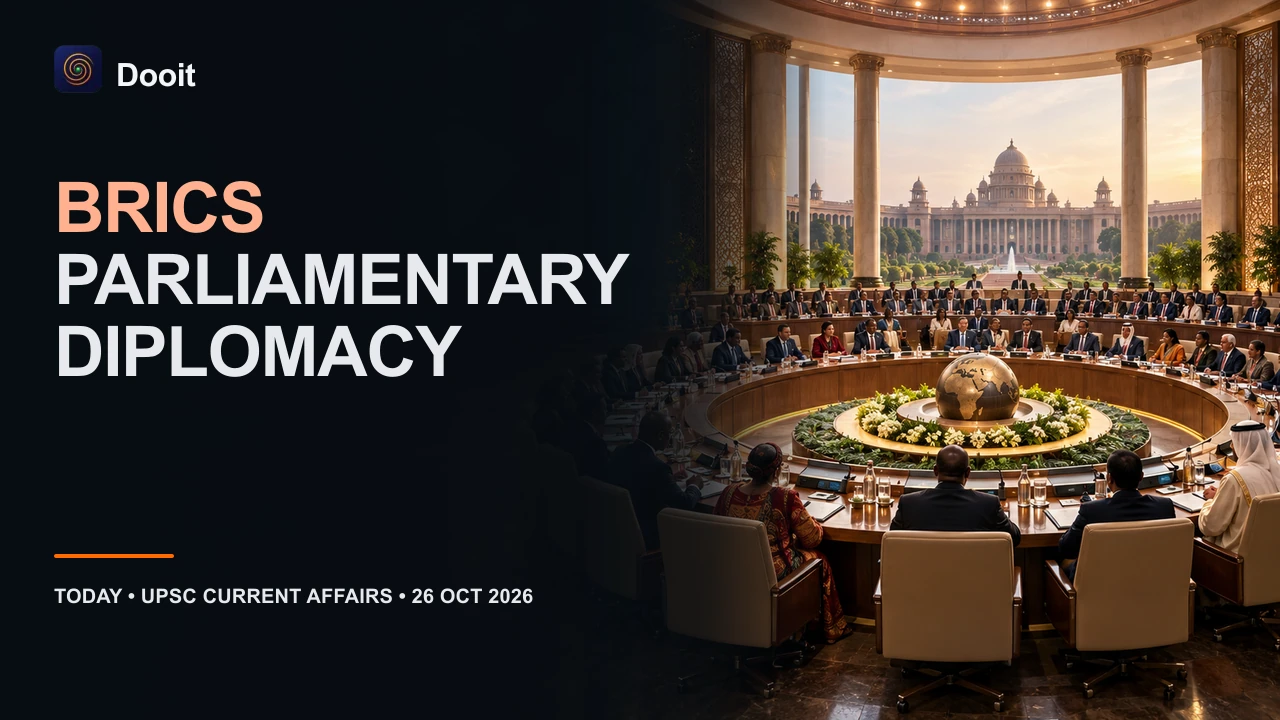
Ahead of the 12th BRICS Parliamentary Forum in New Delhi, the Lok Sabha Secretariat reported meetings on 25 October 2026 with parliamentary delegations from Russia, Cuba, Egypt and Belarus. The forum, scheduled for 26 and 27 October in the Central Hall of Samvidhan Sadan, was organised around people-centred development, institutional resilience, human-centred artificial intelligence, global-governance reform and sustainability. The release highlighted parliamentary diplomacy, exchanges among young and women legislators, technology for accessible proceedings and discussion of India's case for permanent membership of the United Nations Security Council. A parliamentary forum is a consultative platform, not a treaty-making conference, and its declarations do not automatically bind governments. Its value lies in scrutiny, agenda-setting, legislative learning and sustained institutional contact. Claims of success should therefore wait for the joint statement, follow-up committee work and evidence that ideas are translated into domestic oversight or cooperation.
Why UPSC cares
For GS Paper 2, examine parliamentary diplomacy, BRICS expansion, Global South representation, multilateral reform and democratic oversight of emerging technologies. Distinguish political signalling from binding international obligation.
How to study this story
Parliamentary diplomacy operates beside executive diplomacy. Legislators cannot usually negotiate binding foreign policy on behalf of the state, but they can sustain relationships, compare oversight practices and bring public concerns into international debate. This matters in a diverse grouping where political systems, interests and capacities vary. A forum focused on resilient institutions or human-centred technology can expose common questions: how representatives scrutinise algorithms, protect rights, approve public spending and ensure that international commitments survive domestic debate. The risk is declaration inflation—ambitious language without a responsible institution, timetable or review mechanism. Follow-up should identify committees, exchanges, research support and public records that permit later evaluation. Representation is also substantive, not only numerical. A stronger voice for developing countries should improve agenda-setting and rule-making while respecting sovereign equality, transparency and the legitimacy of universal institutions. Informal coordination may build trust, but it should complement rather than fragment multilateral law. For UPSC, distinguish outputs from outcomes: a meeting and joint statement are outputs; changed oversight, shared standards or sustained cooperation are outcomes. Evaluate BRICS parliamentary engagement through continuity, specificity, domestic accountability and its capacity to translate Global South concerns into workable proposals rather than rhetorical solidarity alone.
The larger paper context
For GS Paper 2, read decentralisation and parliamentary diplomacy through institutional authority, representation, accountability and follow-up. A formal forum or elected office matters when rules, resources and scrutiny turn it into working capacity.
Probable question
Parliamentary diplomacy can widen international dialogue but must be assessed through institutional follow-up. Examine with reference to BRICS.
Quick practice check
Q1
What is the clearest limitation of a parliamentary forum?
- It cannot support dialogue
- Its declarations do not automatically create binding state obligations
- It excludes all legislators
- It prevents committee work
Show answer
Correct answer: Its declarations do not automatically create binding state obligations
The forum can shape agendas and learning, but binding obligations require the appropriate constitutional process.
Q2
Which evidence would best show durable follow-up?
- Only an opening ceremony
- Only a broad slogan
- Named committees, public records and reviewed cooperation
- An unverified social-media post
Show answer
Correct answer: Named committees, public records and reviewed cooperation
Assigned institutions and reviewable records make later evaluation possible.
Related practice questions
- UPSC GS-2: important international institutions and groupings
- UPSC GS-2: effect of policies of developed and developing countries on India