 Economy & Energy
GS Paper 3 · 26 October 2026
India–South Korea Shipbuilding Cooperation Links Industrial Policy with Skills and Maritime Strategy
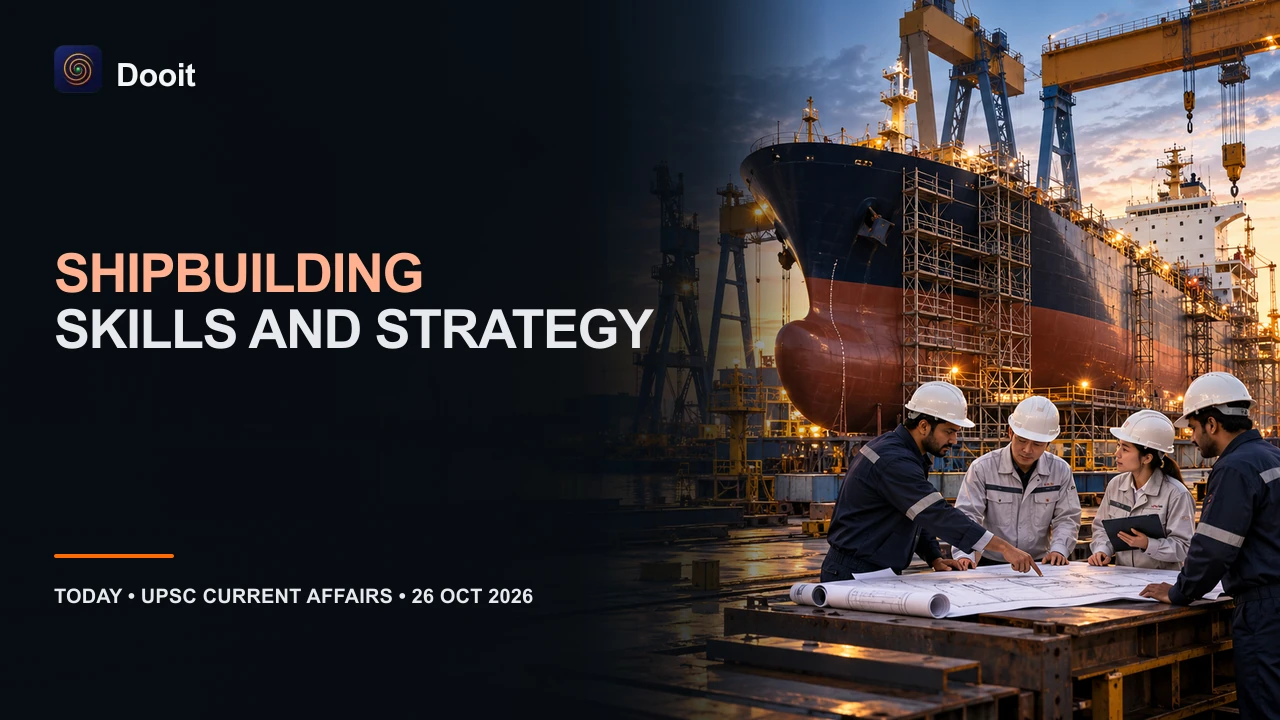
The Shipping Ministry said Sarbananda Sonowal began a four-day visit to South Korea on 25 October 2026 to deepen cooperation in shipbuilding, shipping, ports and maritime logistics. In Busan, he met Indian professionals working with major Korean maritime firms and presented the VOYAGES framework adopted by the two countries in April as a platform for technology, manufacturing and skills cooperation. The release linked this engagement to India's goal of becoming one of the world's top five shipbuilding nations by 2047 and to policy incentives approved in September 2025. It identified demand for shipbuilders, marine engineers, naval architects, designers, welders, project managers and technology specialists. The visit and framework are enabling steps, not evidence that vessels, jobs or technology transfer have already materialised. Evaluation should track contracted orders, domestic value addition, delivery performance, safety, financing, workforce quality, research capability and environmental compliance. The strategic question is whether partnership can build a competitive ecosystem rather than isolated subsidised yards.
Why UPSC cares
For GS Paper 3, link shipbuilding with manufacturing policy, logistics, employment, technology transfer, maritime security and external-sector resilience. Separate announced incentives and partnerships from commissioned capacity and export competitiveness.
How to study this story
Shipbuilding is a systems industry. A yard depends on design, steel, engines, electronics, classification, finance, insurance, port access, skilled labour and predictable orders. Subsidising the final vessel without strengthening these links can create expensive capacity that remains underused. Cooperation with an experienced maritime economy can shorten learning through joint design, supplier development, production methods and workforce training, but technology transfer is not automatic. Contracts should specify local engineering participation, intellectual-property arrangements, quality responsibility and pathways for domestic suppliers. Skills policy must cover technicians and welders as well as naval architects, project managers and safety specialists. Demand matters because commercial buyers compare price, delivery time, reliability and lifecycle service across global yards. Public procurement can provide an order pipeline, yet it should retain competition and performance discipline. Environmental rules are increasingly relevant across fuel efficiency, materials, waste and ship recycling. Strategic value also extends beyond commerce: repair capacity and a capable merchant fleet support supply-chain resilience. Administrators should publish contracted and delivered tonnage, local value addition, productivity, training completion, accident rates and export orders. For UPSC, judge the partnership by learning, capability and competitive output, not the number of memoranda or visits. Industrial policy succeeds when temporary support creates durable productivity rather than permanent dependence.
The larger paper context
For GS Paper 3, test security and industrial announcements against resilience, lawful coordination, skill, finance and measurable delivery. Technology or enforcement creates value only through capable institutions and verified outcomes.
Probable question
Shipbuilding competitiveness depends on an industrial ecosystem rather than subsidies alone. Discuss with reference to India–South Korea cooperation.
Quick practice check
Q1
Why is shipbuilding described as a systems industry?
- It depends only on shipyard land
- It combines design, suppliers, finance, skills and lifecycle services
- It has no safety requirements
- It cannot support trade
Show answer
Correct answer: It combines design, suppliers, finance, skills and lifecycle services
Competitive delivery depends on a connected industrial and service ecosystem.
Q2
Which indicator best demonstrates realised capability?
- A signed visit programme
- An aspirational speech
- Delivered vessels with domestic value addition and reliable performance
- An untested subsidy
Show answer
Correct answer: Delivered vessels with domestic value addition and reliable performance
Actual delivery and measurable domestic capability go beyond an announcement.
Related practice questions
- UPSC GS-3: infrastructure and investment models
- UPSC GS-3: industrial policy, employment and indigenisation