 Polity & Governance
GS Paper 2 · 26 October 2026
National Urban Conclave Reopens the Constitutional Question of Empowered City Governments
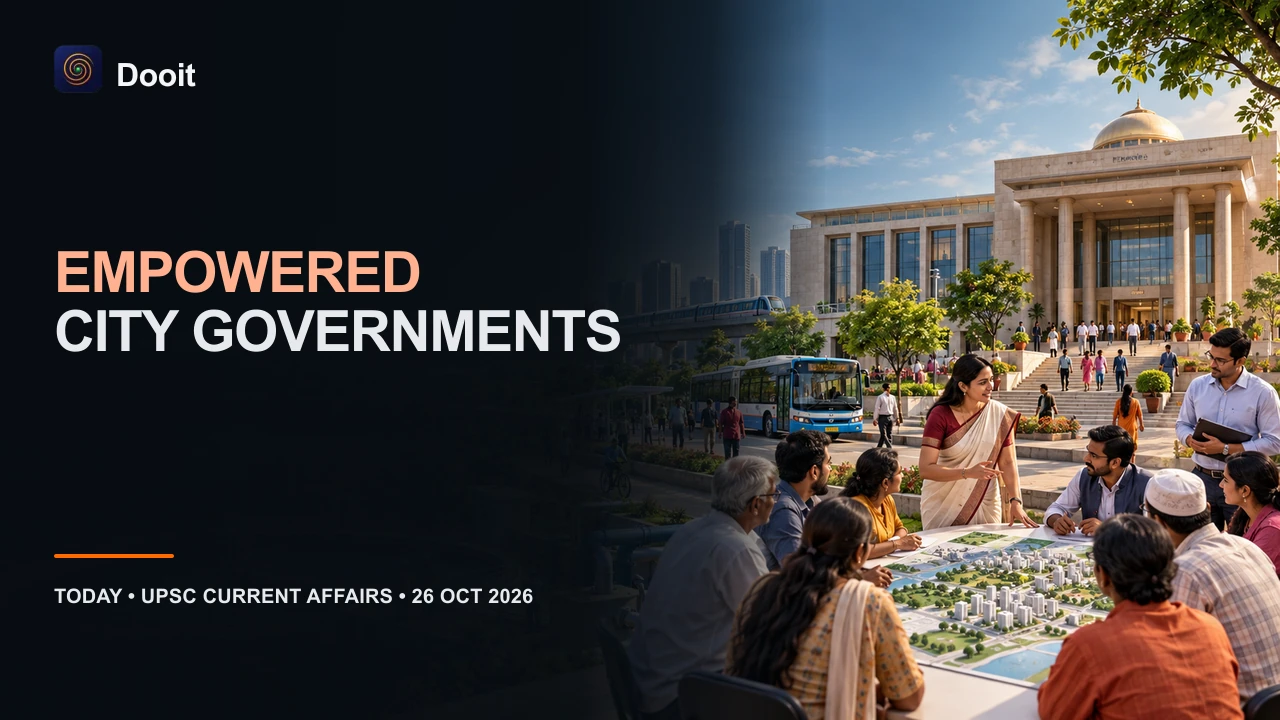
At the 2nd National Urban Conclave on 25 October 2026, NITI Aayog Member Rajiv Gauba called for directly elected mayors with five-year terms, a Mayor-in-Council system, timely municipal elections and devolution of all 18 functions listed under the 74th Constitutional Amendment. The official release also highlighted weak municipal revenue, irregular State Finance Commissions, low state-to-city fiscal transfer, restrictive planning rules and the need for affordable rental housing. It projected India's urban population rising from about 50 crore to 85 crore by 2050 and said urban-sector budgetary outlay had grown ten-fold after 2014. These are proposals and official estimates, not completed reforms. Municipal government remains a State subject, so durable change requires State legislation, functional assignment, staff, funds and local accountability. The story is therefore about constitutional decentralisation and public capacity, not merely choosing a different mayoral election method.
Why UPSC cares
For GS Paper 2, relate the 74th Constitutional Amendment to urban local bodies, State Finance Commissions, fiscal decentralisation, planning and accountability. Evaluate the three Fs—functions, funds and functionaries—rather than treating direct election as a complete reform.
How to study this story
Urban governance is a chain of authority, capacity and accountability. A directly elected mayor may provide a visible mandate, but a mandate without control over staff, budgets or assigned functions can produce conflict rather than delivery. The constitutional framework gives States a central role in designing municipal institutions, which creates variation in tenure, powers, finance and the relationship with parastatal agencies. Reform must therefore clarify who plans land use, supplies water, manages mobility, raises revenue and answers citizens when service fails. Regular elections protect democratic continuity. Ward committees and public disclosure can bring participation closer to neighbourhood problems. Property-tax administration and fair user charges can strengthen own revenue, while predictable transfers and regularly constituted State Finance Commissions address vertical imbalance. Planning reform should link housing, transport, livelihoods, climate risk and infrastructure instead of treating them as separate projects. Professional municipal cadres and reliable local data are essential for execution. Direct election also needs checks: council oversight, transparent procurement, audit, conflict-of-interest rules and removal procedures. In a Mains answer, treat the mayoral proposal as one institutional option inside a wider decentralisation package. The test is whether authority, money, personnel and public scrutiny align at the level where urban services are actually experienced.
The larger paper context
For GS Paper 2, read decentralisation and parliamentary diplomacy through institutional authority, representation, accountability and follow-up. A formal forum or elected office matters when rules, resources and scrutiny turn it into working capacity.
Probable question
Empowered city governments require more than directly elected mayors. Discuss in the light of the 74th Constitutional Amendment.
Quick practice check
Q1
Which combination best represents meaningful municipal devolution?
- Functions, funds and functionaries
- Only a new building
- Only a campaign manifesto
- Only a longer title
Show answer
Correct answer: Functions, funds and functionaries
Local bodies need assigned work, usable finance and capable personnel together.
Q2
Why are State Finance Commissions important?
- They conduct national elections
- They review fiscal relations between States and local bodies
- They appoint judges
- They regulate foreign trade
Show answer
Correct answer: They review fiscal relations between States and local bodies
These commissions recommend principles for sharing resources with local governments.
Related practice questions
- UPSC GS-2: devolution of powers and finances to local bodies
- UPSC GS-2: mechanisms and institutions for governance