Understanding your AI answer
Every answer in Dooit arrives as the same card — Exam-Oriented Answer — divided into numbered, exam-ready blocks. Once you know what each block is for, a single answer can hand you your Prelims facts, your Mains structure, and your next revision target in one read.
One card, the same blocks every time
When your answer lands (see Ask your first question for the asking flow), the card opens with the title Exam-Oriented Answer and the line Structured for quick revision and UPSC recall.
At the top of the card you get three quick actions: Bookmark to save the answer for revision (covered in History, saved answers & community), thumbs-up and thumbs-down icons to rate the answer, and Report if something looks factually wrong (see Report wrong content). When the AI detects them, small tags also show the GS paper and topic the question belongs to.
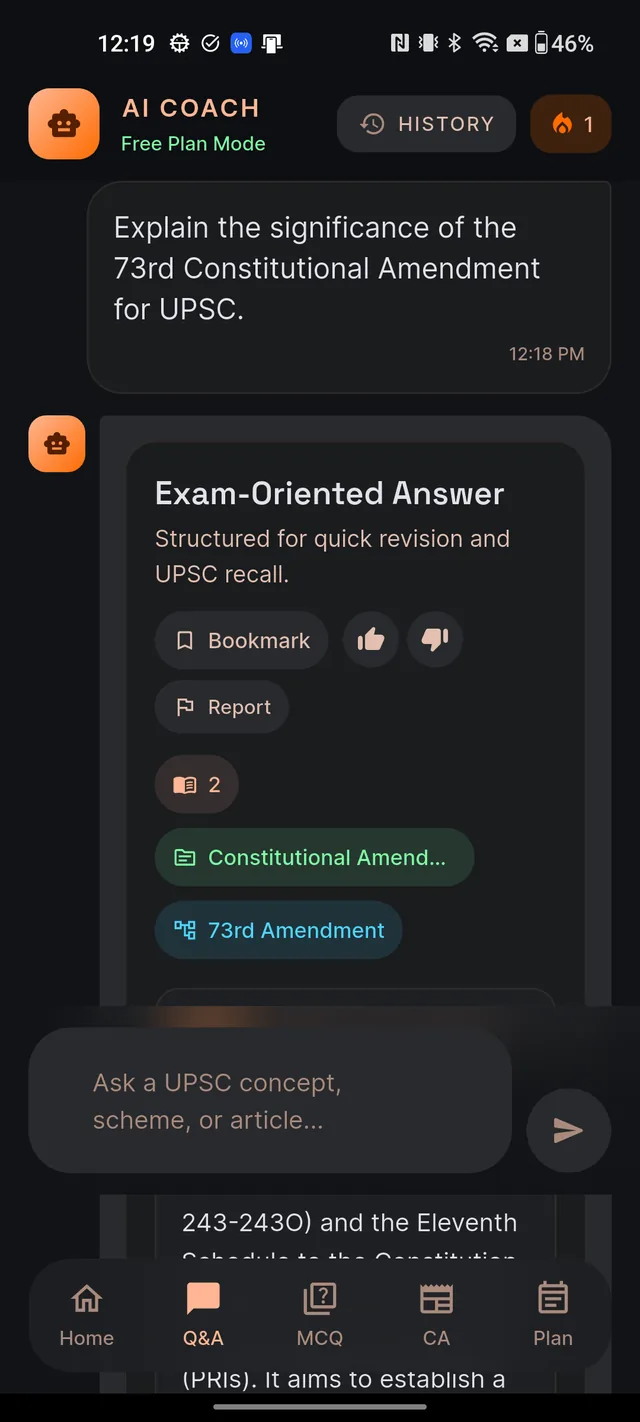
Below that come the numbered blocks. A full answer typically carries eight; some popular questions answered earlier may show fewer blocks in the same style. Either way, the numbering tells you the reading order.
The eight blocks, and how a serious aspirant uses each
1. Definition / Overview
The crisp two-line meaning of the concept. Memorise it as the opening line of any answer you would write on this topic — examiners reward a clean start.
2. Historical Background
How the concept came to be — the committee, the amendment, the event behind it. This context is what separates an average Mains answer from a good one. Pull one or two timeline anchors from here.
3. Detailed Explanation
The core teaching of the answer. Read it slowly the first time; on revision days, skip it and jump to block 4.
4. Key Points for UPSC
Six to ten memorizable bullet facts. This is your Prelims block and your revision block — if you copy only one section into your notes, copy this one.
5. PYQ Connection
How UPSC has asked about this topic before. Use it to learn the examiner's angle — the way a question is framed matters as much as the content.
6. Mains Answer Framework
A ready structure for a 250-word Mains answer: how to open, what to argue, how to close. Practise writing one timed answer from this skeleton instead of reading it passively.
7. Examples / Case Studies
Concrete examples you can quote. One well-placed example per paragraph is what lifts a Mains answer's marks — bank these.
8. UPSC Relevance
Where the topic sits in the syllabus — GS paper and topic — plus 3 to 5 related topics to study next. Treat that closing list as your queue: it tells you what to ask the AI after this.
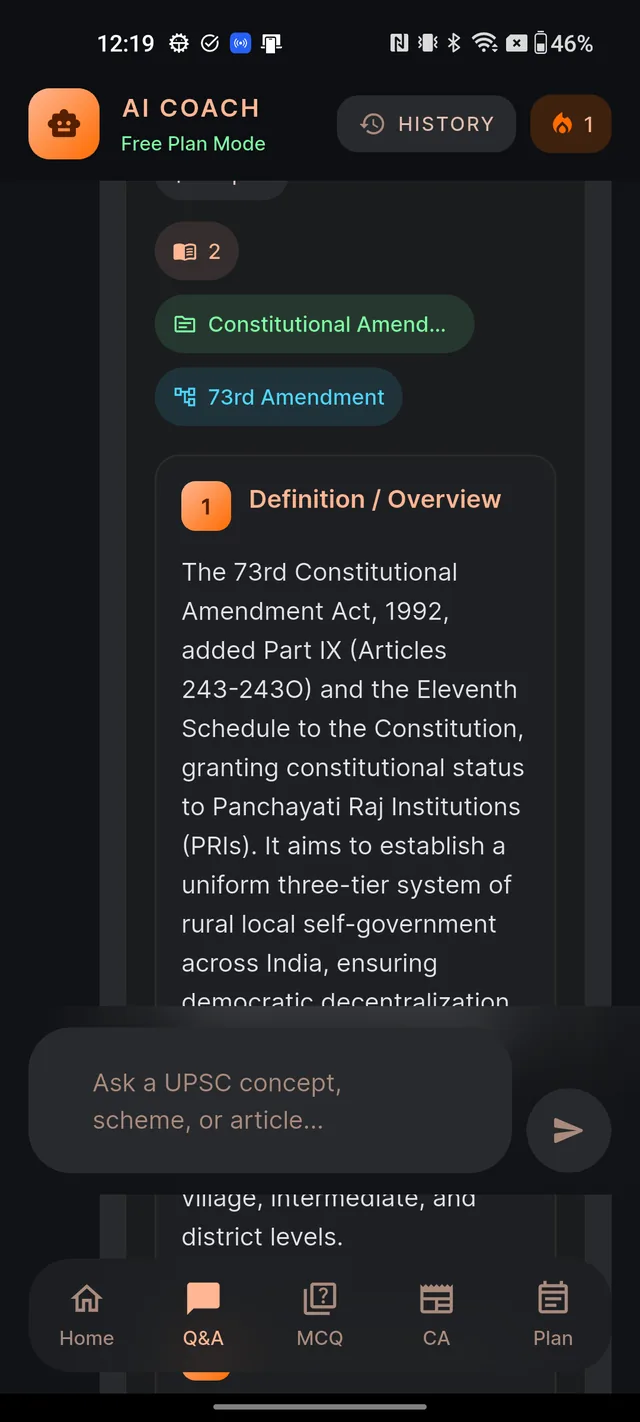
Off-syllabus questions get a redirect, not a lecture
Ask something that cannot earn you marks — a medical query, a coding doubt — and the AI behaves like a coach guarding your time. Instead of the usual blocks, you get one section titled Not on the UPSC syllabus: a short note explaining why the topic will not appear in the exam and where to pivot.
Below it, a box labelled STUDY THIS INSTEAD offers two or three tappable chips, each with a short label and a GS paper tag. Tapping a chip instantly sends a proper, exam-relevant version of your question — so a wrong turn costs you seconds, not an evening.
Some questions are answered with a discipline note
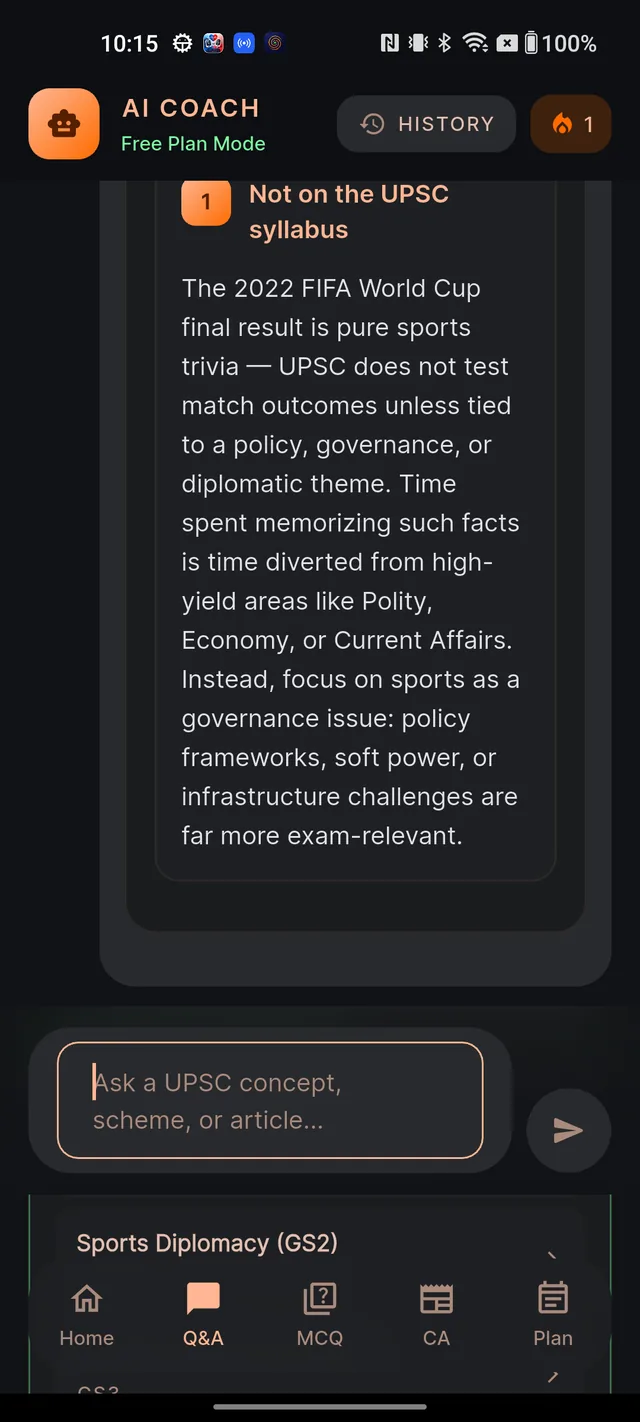
Questions that ask for opinions — "Is leader X good or bad?", or communal judgments — receive an instant, neutral note instead of a regular answer. Its three sections are titled Why this answer was held back, What to do for UPSC and Reframe for a useful answer.
This is exam discipline, not a malfunction. UPSC never asks whether a politician is good or bad — it rewards balanced, source-based analysis, and an opinionated answer is exactly what loses marks in Mains. The note shows you how to turn the same curiosity into a question that scores: ask the factual version ("What is Article 370?") and you get the full structured answer as usual.
These notes appear instantly and never use up your daily AI allowance.
Frequently asked questions
Why does my answer have fewer than eight blocks?
Some popular questions were answered earlier in a slightly shorter format. The blocks are always numbered in order, so the answer reads the same way.
Which blocks matter most for Prelims?
Key Points for UPSC is built for Prelims — 6 to 10 memorizable facts. PYQ Connection shows how UPSC has actually framed the topic in past papers.
Which blocks matter most for Mains?
Mains Answer Framework gives you a ready structure for a 250-word answer, and Examples / Case Studies supplies the evidence to quote inside it.
What does STUDY THIS INSTEAD mean?
Your question was outside the UPSC syllabus, so the AI explains why and offers two or three tappable questions that pivot to the nearest exam-relevant angle. Tapping one sends it instantly.
Why did I get a note instead of a full answer?
Questions asking for opinions on political figures or communal judgments get a neutral, exam-safe note that shows how to reframe them. It appears instantly and does not use your daily AI allowance. Factual questions on the same topics are answered in full.
The answer looks wrong — what do I do?
Tap the Report chip on the answer card, choose what is wrong, and submit. Our team verifies it against primary sources and the finding appears in Profile, under My reports.
Didn’t find what you needed? We are a small team and we read every message.
Email supportBack to Help Center